Put ramekins on a baking sheet. Bake for 25-35 minutes, until puffed and golden. Remove from oven, and let stand for 5 minutes. With a flexible spatula, remove strata to
Listen as the pages of the magazine come to life in the Storytellers podcast showcasing the voices of Our State writers. Each podcast episode features a writer reading their column
Listen as the pages of the magazine come to life in the Storytellers podcast showcasing the voices of Our State writers. Each podcast episode features a writer reading their column
Listen as the pages of the magazine come to life in the Storytellers podcast showcasing the voices of Our State writers. Each podcast episode features a writer reading their column aloud, allowing each distinct voice to shine. Click below to listen to Eleanor read her column aloud.
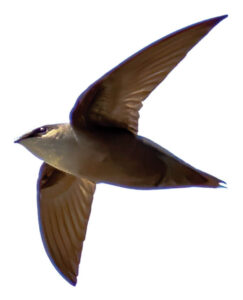
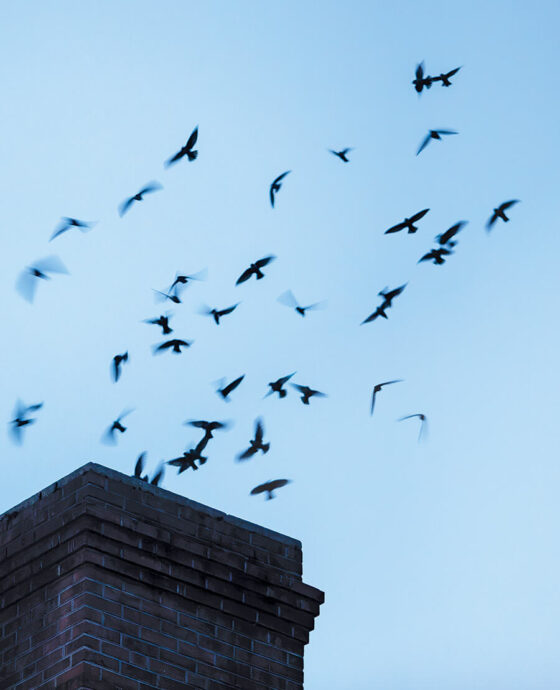
Chimney swifts are built from a net of impossibilities, filled with the stuffing of the incredible. The bomber jet-shaped birds and their swift cousins bear the scientific name Apodidae, or “without feet.” They do have feet, but with claws held close enough to their bodies to render hopping, walking, and perching on branches or bird feeders impossible. Their toes can only cling to vertical surfaces, like the walls of the chimneys where they nest and sleep. Swifts roost as colonies, sometimes thousands of birds, coating chimney walls like living scales. They can cling but not land to rest, so in the day, they fly.
photograph by Matthew Jolley/iStock/Getty Images Plus
“Chimney swifts are like fish,” says John Connors, an ornithologist and past president of the Wake Audubon Society. “The air is like water, just thinner. They stay in the sky and are comfortable there.”
Each chimney swift flies up to 500 miles a day, up to 3,000 feet high, diving through cathedrals of clouds, the sounds of our human world — our arguments and laughter, our car engines and barking dogs — too far away to hear. They fly over every county in this state, soaring over each of us, often unseen. They improbably capture up to 12,000 insects a day when they have babies to feed. Without babies, each bird eats at least a thousand insects, the jet fuel of the animal world.
Connors has been watching swifts for more than half a century. He finds the chimneys they call home and waits each year for them to come back from their winter vacations, from thousands of miles away in Peru and the Amazon River Basin. They usually show up the first two weeks of April and stay through September, eating our insects, lining our chimneys, and rearing their young.
Before Europeans arrived, no chimneys existed in the continent for chimney swifts to roost. Back then, they slept in hollow, standing trees. Humans have a habit of felling hollow trees, so the swifts, facing a world with no homes, made allowances. They adapted their behavior to live in the chimneys and bear that name — the name we made for them, from a structure we built. “If swifts hadn’t made that shift, they would have gone extinct,” Connors says. They have not gone extinct. Yet.
• • •
“Chimney swift populations are declining at a rate of 2 to 3 percent a year,” Connors says. Nobody’s really sure why, but some research suggests we cap our chimneys at the same rate, covering swifts’ summer homes.
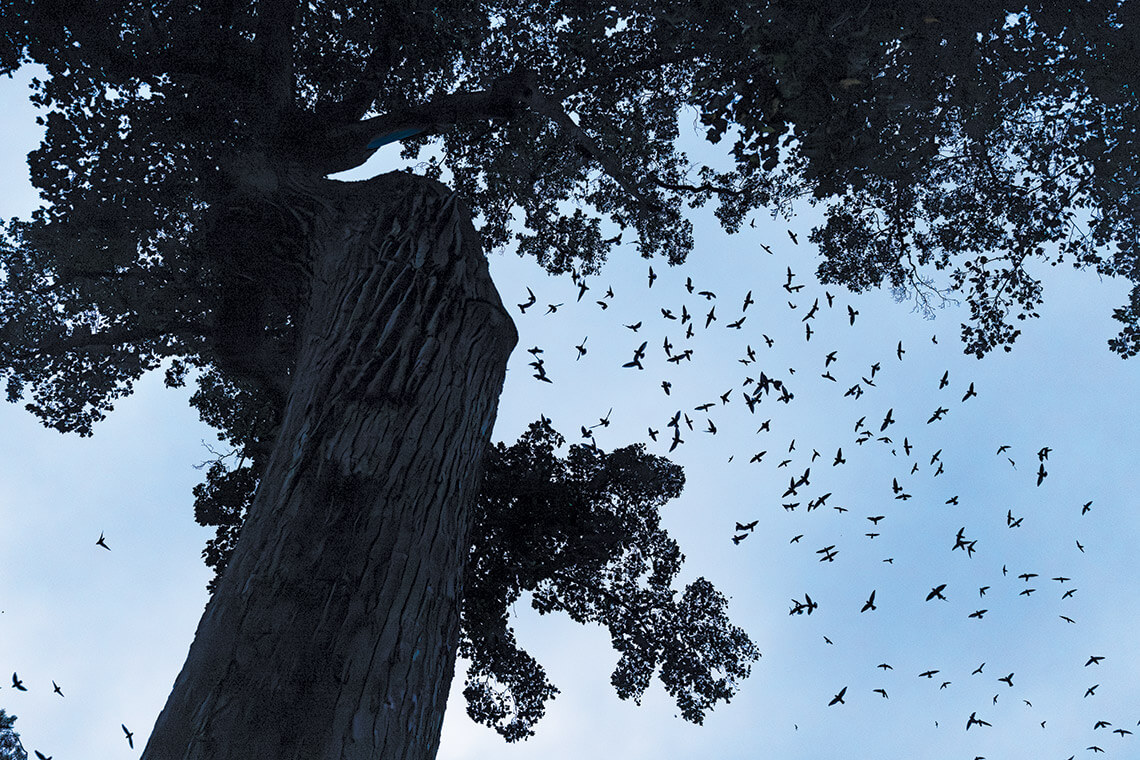
“Chimney swifts are one of the bird species most dependent on humans for their survival,” Connors says. Swift pairs nest in smaller chimneys at the beginning of the summer, and after their babies fledge, they gather in flocks and roost communally in larger chimneys or large hollow trees. Thousands of swifts can live in a single tree, like Chapel Hill’s famous Davie Poplar, or a chimney, like the one in Goldsboro’s old armory.
As the sun rises, the swifts take flight. The more than 3,000 swifts in Raleigh’s Broughton Magnet High School chimney, taken together, could fly far enough to circumnavigate the globe over 60 times each day.
As dusk settles over UNC Chapel Hill’s campus, chimney swifts make their nightly curfew to the Davie Poplar, often drawing crowds who gather to watch. photograph by Todd Pusser
If they can, they come home when the sky turns shades of pink and orange. They mill about, waiting for their colony to join them. As the sun gets closer to the horizon and the sky purples, more swifts join, and they begin to form an aerial, living gyre, whirling around the chimney’s entrance. The only sounds around them are their beating wings and the pips of greetings.
As the last bit of daylight winks below the horizon, without any other signal, they begin to funnel into the chimney, a cataract of bright eyes and beaks and wings. If too many come down at once, the chimney will throw the birds back into the living tornado, before they reorganize and enter the depths once more.
Again and again, night after night, year after year, the swifts return to their summer homes. They will keep coming, as long as we let them.
From the expanses of needlerush at Cedar Island to the lush spartina feathering the shores of Bodie and Roanoke islands, our salt marshes are the threshold to a watery world — the heartbeat of our coastal ecosystem.



 Listen as the pages of the magazine come to life in the