 Listen as the pages of the magazine come to life in the Storytellers podcast featuring the voices of Our State writers. Each podcast episode features a writer reading their column aloud, allowing each distinct voice to shine. Click below to listen to Eddie read his column aloud.
I follow the crab tracks that lead from the tide line across the sand, up and away from the waves. They disappear in a wrack line of crushed shell and seaweed, then pick back up to skirt a tuft of some kind of marshy, marigoldy-looking plant. In the sand, the crab leaves behind two clusters of four prints, like commas repeated over and over, separated by a long scratch, as if it were dragging a stick. Or a big, heavy claw.
Ghost crab tracking is one of my more highly developed skills. It’s not a marketable expertise, not yet. But along with studying the intricate sand patterns drawn by the leaves of American beach grass and scavenging old fish bones and sea glass in the low dunes, ghost crab tracking requires little more than pretty good eyes, a pretty good back, and a pretty understanding wife. Like the one that is, at present, hoofing it down the island while I’ve veered off on another ghost crab tracking tangent.
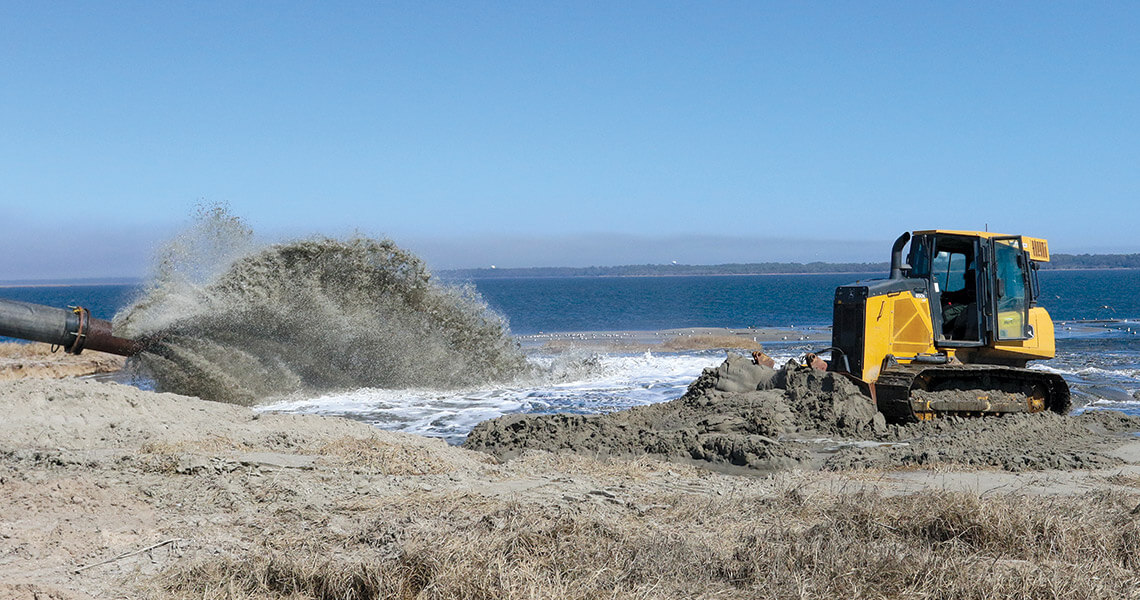
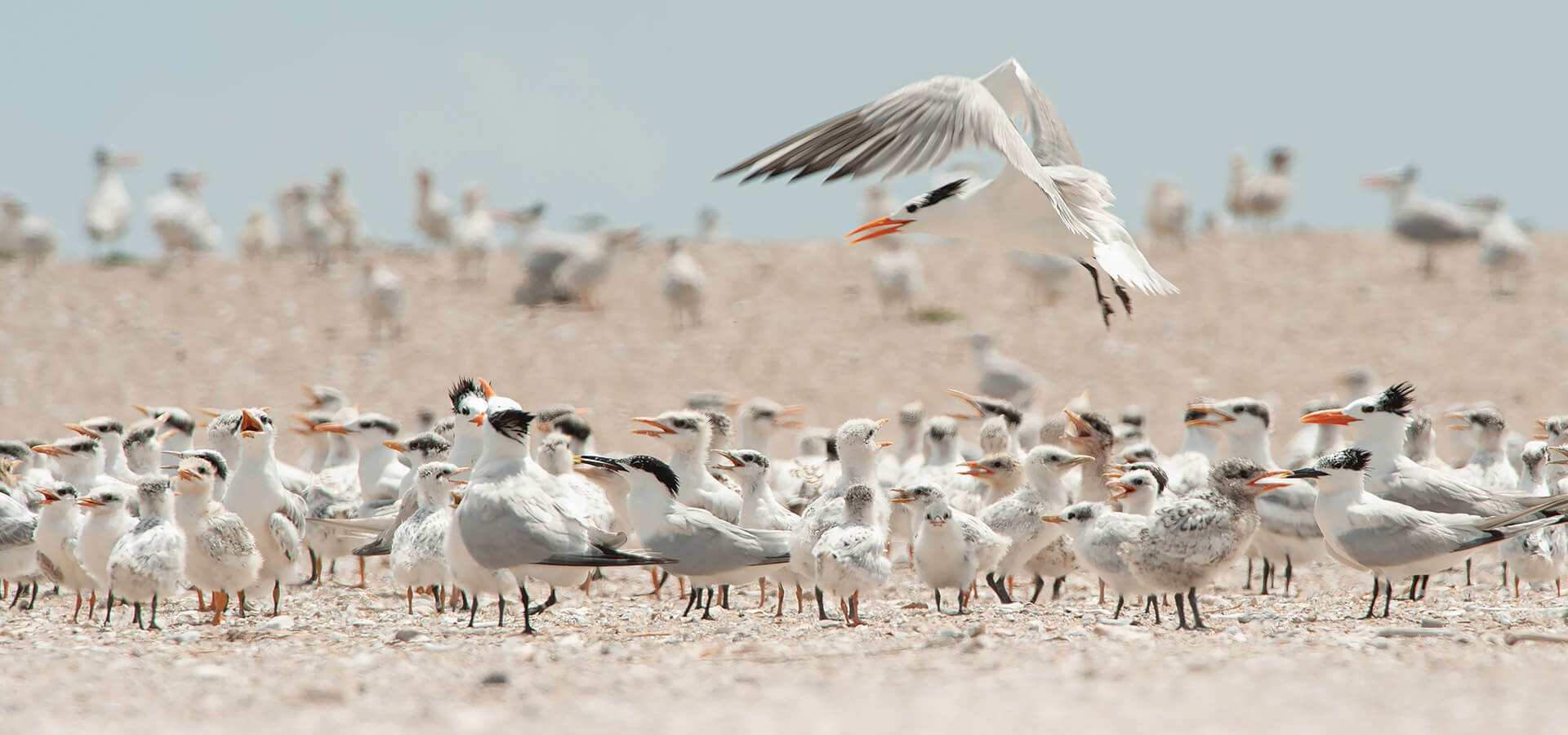
Heavy equipment and dredged sand reshape Ferry Slip Island, renewing the beach habitat that terns, skimmers, and oystercatchers rely on. photograph by Lindsay Addison
Bent over at the waist, I follow like some barefoot Sherlock Holmes, parsing out the trail. Within 50 feet of the high tide line, I run into a sign that reads: WATERBIRD NESTING & FORAGING AREA. NO TRESPASSING. I halt my crab tracking with one foot lifted from the sand, and that’s when a royal tern gives me a hey-buddy, what’s-yer-problem squawk. The tern is maybe 20 yards away and not giving ground. Its black, feathered crest is taut. It is not a happy waterbird.
I back away, cooing what I hope are soothing, reassuring sounds. The sign is no surprise; I see them all along the coast. Islands like this one are the last chance and last choice for birds like royal terns, American oystercatchers, brown pelicans, and the like. They need all the breaks they can get.
• • •
The island Julie and I are visiting is a “spoil island,” a man-made island created when the sands and silts of dredged navigation channels are dumped nearby. They’re all up and down the North Carolina coast, near inlets and harbors that have to be dredged frequently, or alongside the Intracoastal Waterway, where they can run for miles. Despite their name, spoil islands are hardly wastelands. In fact, if ever the adage “one man’s trash is another man’s treasure” held true for wildlife, it does here. Beach-nesting birds frequently lay eggs on the open sand and rely on having lots of nesting neighbors nearby to look out for predators. They can’t compete with condos and crowds, so they’ve been driven off much of the Atlantic shoreline. Instead, they look for off-the-beaten-path stretches of quiet sand, and spoil islands fill the gap. It’s more than slightly ironic that these totally fake landscapes offer some of the last remaining nesting habitat for some of the coast’s most common birds.
Despite their name, spoil islands are hardly wastelands.
Which is why it’s heartening to hear that these habitats in North Carolina are getting some love. Restoration and conservation of some of the most critical ones — to birds, at least — is ongoing along the coast. Three years ago, Pelican Island, in the Cape Fear River south of Wilmington, got its first fresh influx of dredged sand in 18 years. On Black Duck Island, a remote 68-acre stretch near Oregon Inlet, more than 2,500 feet of living shoreline made of granite has been constructed to help stem erosion, and planting of native beach grasses is underway. The North Carolina Coastal Federation is also working to prop up Sandbag Island, between Harkers Island and Cape Lookout, which has existed for more than 50 years. Once sprawling across 18 acres, it had dwindled to just one-tenth of an acre in recent years, wiping out critical waterbird nesting habitat. A new dredging project recently pumped 135,000 cubic yards of spoil to boost Sandbag Island to about five acres. Within days of the last sand pumping, two pairs of American oystercatchers, stunning birds with blaze-orange bills, returned to nest there. Terns and skimmers soon followed.
• • •
Back on my ghost crab tracking expedition, I retrace my steps — and the ghost crab’s — toward the water. Julie is far up the beach, but I don’t feel the need to catch up. When she reaches the end of the island, she’ll have no choice but to turn around.
Which only underscores the finite and fragile nature of spoil islands. Most are small. Walking their sands can be a seasonal pleasure. During most of the breeding season for waterbirds, many barrier islands are closed to foot traffic. Others are managed so folks can visit, but the primary nesting areas for birds — typically from a few dozen feet above the high tide line to the dunes and beyond — are posted off-limits from March 1 to mid-September.
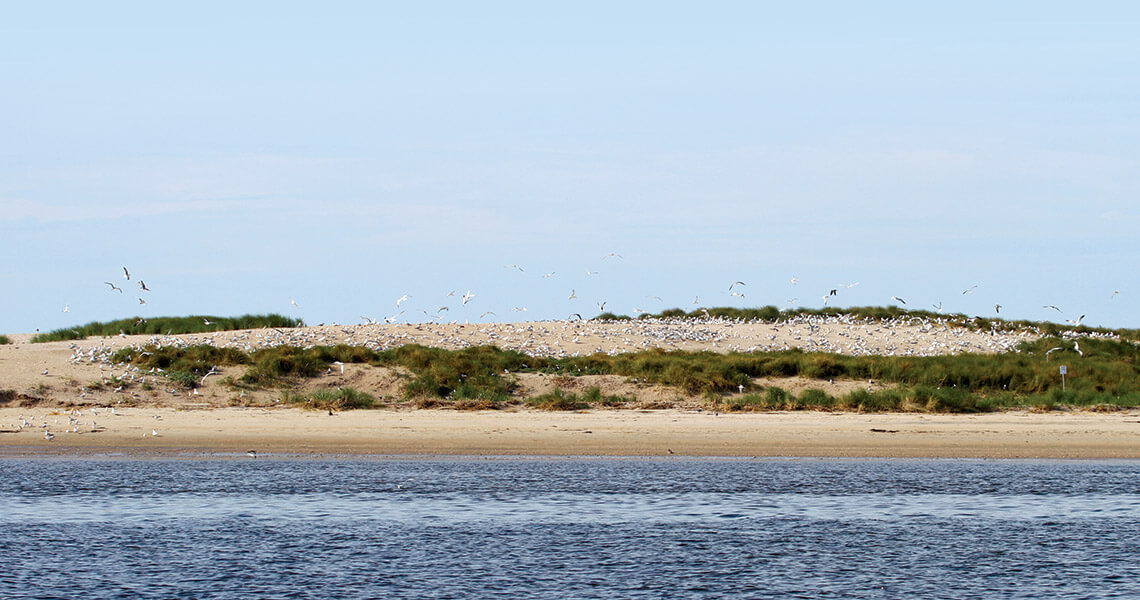
Ferry Slip Island photograph by Lindsay Addison
That seems fair. In just the last hundred years, we’ve pretty much taken over the wild beaches where these birds raised families for millennia. Sharing the shore seems a small price to pay for the sight of a black skimmer gliding low across a tidal creek, or a knot of sandwich terns wheeling over the breakers.
I glance back toward the dune, where that royal tern stood strong. It’s hard not to root for these birds, holding their own on what little bit of cast-off beach we’ve left for them. They live their lives playing with a stacked deck. Scorching sun, spring tides, early hurricanes, hungry raccoons, and ill-informed human visitors all make life as a beach-nesting waterbird no picnic. I’m happy to steer clear of their home turf and do my part to help a creature whose future is as unsettled and unsure as the edge of the sea itself.