 Listen as the pages of the magazine come to life in the Storytellers podcast featuring the voices of Our State writers. Each podcast episode features a writer reading their column aloud, allowing each distinct voice to shine. Click below to listen to Eddie read his column aloud.
I think I’ve heard them. I’m not 100 percent sure. It’s one of those things you want to be true so badly that you convince yourself it’s true. That it really happened.
That I really did hear the songs of birds migrating at night.
I’ve listened from mountaintops and backyards and beaches. On some nights, I’ve listened to the night sky so long and so hard that I’ve given myself a headache. And I think I’ve heard them — faint little calls from the onyx firmament overhead: teeny tiny tweets and chirps and whistles, all on the very edge of human hearing.
I’m almost sure I’ve heard them. I know I did. I must have.
• • •
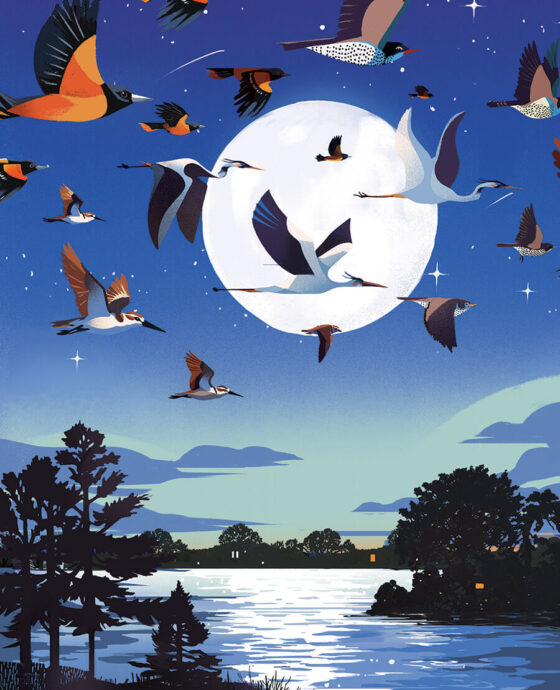
During spring and fall, tens of millions of birds migrate across North America, mostly after sunset. Warblers, thrushes, sparrows, and orioles migrate at night. So do herons. So do ducks and geese.
They take to the night sky for many reasons: To avoid daytime predators. To fly when the atmosphere is less roiled by thermals and thunderstorms. When you weigh but a few ounces, headwinds can be killer. These birds also use Earth’s magnetic field and celestial cues for navigation, orienting by the North Star and other twinkly stuff. And the cooler conditions after nightfall help. When you’re beating your wings 20 times per second, hour after hour, it’s easy to overheat.
The songs are faint as fog, elusive as a wrinkle in the mist.
While underway, overhead and unseen, many bird species communicate with trills and chirps and tweets. These aren’t the soaring songs of springtime, but high tseets (black-throated green warbler) and creaky creeeenks (least sandpiper) and rattly skwonks (great blue heron). They are faint as fog, elusive as a wrinkle in the mist. Swallowed up by the immensity of the night sky, birds use the calls, scientists figure, to keep tabs on others of their species, or to signal their age or sex. Artificial light can affect the number of calls birds make. They could be communicating in ways that keep them on track or together in a nighttime world filled with bright lights and loud noise.
Scientists have an unsexy name for these notes: nocturnal flight calls, or NFCs. Are you kidding me? One of the most astonishing phenomena of the wild kingdom. Millions of birds in the sky, tweeting and buzzing and chirping in a language only a computer can unravel, and “nocturnal flight calls” is all they could come up with. How about “tenebrous avian symphonies” or “Cimmerian psalms.” Maybe “Avian arias of the vespertine.” And that’s just off the top of my head.
But nocturnal flight calls it is. Sigh.
• • •
I suppose I get it: These calls are cryptic, fleeting, and difficult to parse. Most NFCs are less than half a second long. A hooded warbler’s nocturnal flight call sounds like a buzzy chirp, but, start to finish, it’s only perhaps one-twentieth of a second in duration. It’s not like you can really get into the beat. Simply identifying the species that’s making the call requires specialized acoustic microphones and computer programs.
But all I want to do is hear the dang things. In the Roanoke River swamps, there’s no missing the counter-calling who-cooks-for-you-all of barred owls. But the Cimmerian psalms — OK, the NFCs — of migrating songbirds is harder to catch.
Spending the night deep in the swamp on one of the Roanoke’s elevated camping platforms, I lie on my back beside the tent, the smell of bug spray heavy in the air. Overhead, the soaring branches of giant tupelo trees gently sway, like interlaced fingers, occasionally blocking out the stars. I lie there and listen, and listening like this is hard work. I’m pretty sure I picked up a few faint trills. A tzeep or two. I know they’re up there, a quarter mile overhead, chatting it up.
Bzzt. Tssst.
[Hey man, give me some wing room, will ya?]
Tseep. Gronk.
[Anybody know if it’s a left turn at the Little Dipper, or do we hang a right?]
Tch. Tch. Bloop.
[Where’s Fred? Hey, Fred!!! That guy could get lost in an empty parking lot.]
I once had an assignment that took me to an observation deck of the Empire State Building in Manhattan, where a biologist and I set up an array of microphones calibrated specifically for recording nocturnal migrants. The instruments are amazingly sensitive. Some of the best can capture the high-frequency note of a warbler flying almost 1,000 feet overhead or the hoarse buzz of a grosbeak at twice that distance.
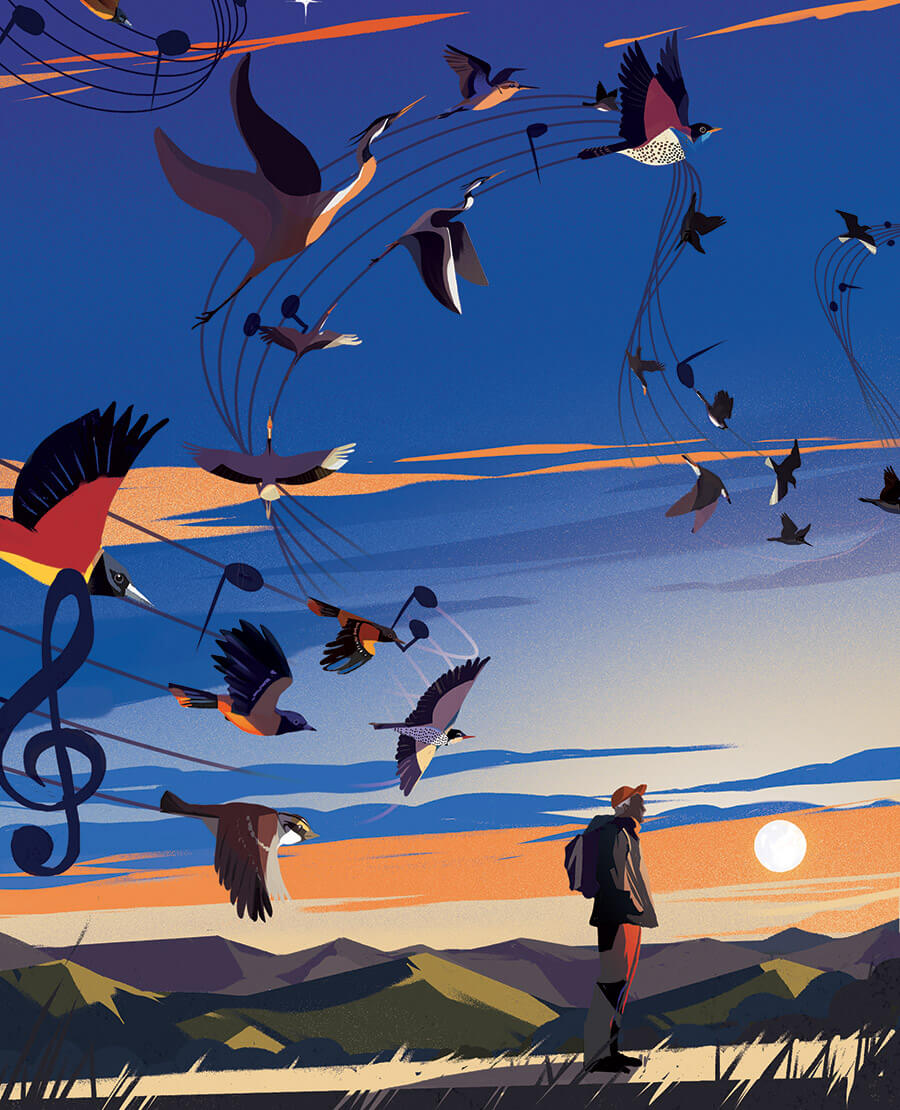
illustration by Marianna Tomaselli
As the muted din of the city rose to the 86th Floor Observatory, the microphones fed their data to a laptop computer. Soon enough, the machine would analyze the cryptic calls plucked from the night sky and spit out a roll call of the concert above.
At the moment, it didn’t seem fair. I thought of those dark nights in quiet places, my face turned skyward, listening so hard I could hear the blood moving through my body. I knew there was a river of music beyond the treetops, a wild jumble of faint calls just beyond reach. That a lifeless machine could discern what I wanted so badly to hear seemed an affront.
So back in North Carolina, on the crest of Big Yellow Mountain in the Roan Highlands, I roll out a sleeping pad under the stars, cup my hands behind my ears, and seine the night breeze for the faintest calls. They’re up there, I know it.
I listen hard. Harder still. And I think I hear them. I’m almost positive. Faint as a sigh, a gossamer chirrup, as if sound could twinkle like the most distant stars.
I hear them. I do. I just know it.
print it