 Listen as the pages of the magazine come to life in the Storytellers podcast showcasing the voices of Our State writers. Each podcast episode features a writer reading their column aloud, allowing each distinct voice to shine. Click below to listen to Sheri read her column aloud.
I’ve spent many an afternoon wiled away under the shade trees in my parents’ backyard. We sit in lawn chairs and chat about everything and nothing.
Twenty-some-odd years ago, I mentioned to my dad that someone had given me a bag of delicious, old-timey stone-ground cornmeal and that I sure wished I knew where to get more. Daddy replied, nonchalantly, “Well, you know I’ve got Papa Will’s mill.” If the thoughts that zipped through my mind in that moment had a soundtrack, it would be a record scratching to a quick stop. All I could sputter out was, “Say what now?”
My dad is one of those retired fellows who’s accumulated all sorts of things that are covered by blue tarps cinched with bungee cords and anchored by rocks. Unbeknownst to me, under one of those tarps was the Meadows Mill that my maternal great-grandfather purchased in 1923. We even have the original bill of sale from when he purchased it in Wilkes County and hauled it up the mountain to his home in Zionville.
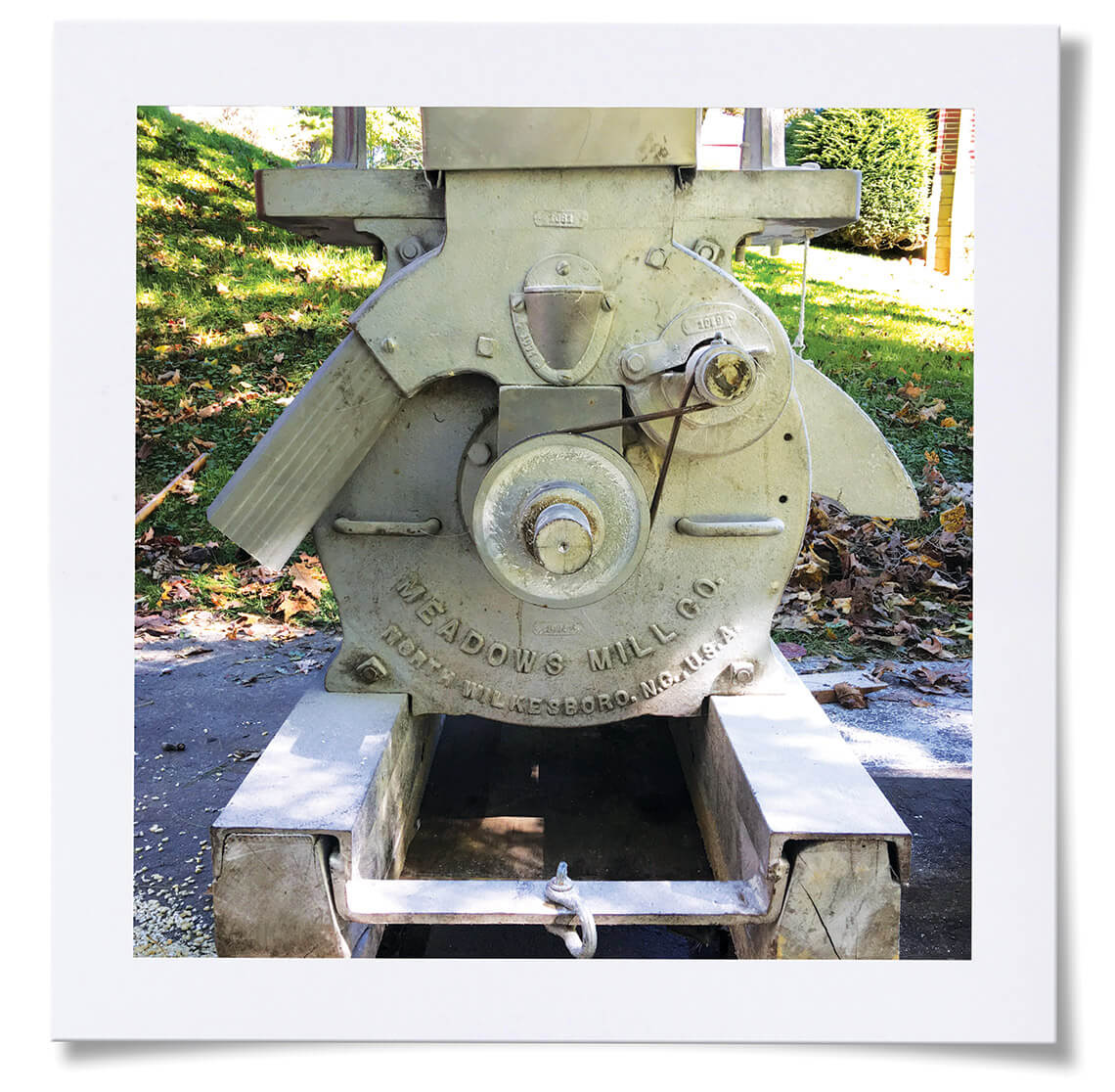
Author Sheri Castle uses her great-grandfather’s Meadows Mill, so named for the Wilkes County minister who patented his burr mill design in 1907. Photography courtesy of Sheri Castle
It’s the type of mill that folks once used when there was no access to a running stream or millpond that would turn the large, picturesque waterwheel that comes to mind when most of us think of a gristmill. These mills were considered portable, even though they are the size of a small refrigerator and weigh hundreds of pounds. They were designed to handle small-batch jobs, such as supplying families and neighbors with homegrown cornmeal for a few months.
I understand that not everyone has a dad who is willing and able to restore a family heirloom mill as a treasured gift for his only child and grandchild. But a few traditional mills still turn in North Carolina and sell their meal, which means every one of us can taste the real deal, no blue tarp necessary.
• • •
The backyard revelation set several things into motion, including the mill. Tickled and motivated by my utter glee, my dad cleaned up our mill, found someone to sharpen the two millstones, and figured out how to run the thing in the backyard and at the occasional festival. The process is neither quick nor easy. It takes several people and at least one of them must understand the intricacies. I try to help each time he sets it up, with hopes I’m learning enough to someday be able to keep things turning for another generation, but the truth is that my daughter is the mechanically inclined one waiting in the wings. She’s been obsessed with the mill since she was little. Her first job was to scoop the cornmeal from the collector box into sacks. The air around the mill fuzzes with floating bits, so by the time we’d worked through our usual batch of 400 pounds of corn, she’d look like she’d been dredged.
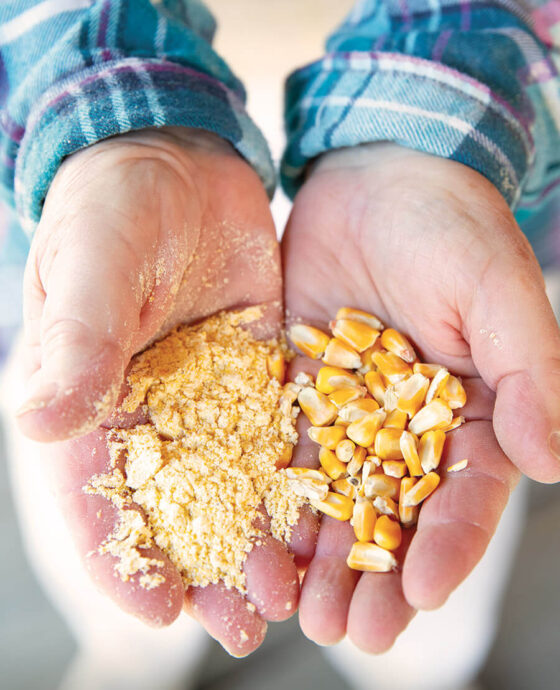
Our beloved mill is a delightful means to fresh, stone-ground cornmeal. We grind a variety of Appalachian white dent corn that we buy from a good friend in Alexander County. The meal is whole-grain and perishable, closer to a fresh ingredient than an everlasting commodity. It tastes like corn, even when cooked, with rich, robust, complex flavor and the aroma of fresh cream, a bit of butter, and clean earthiness with a touch of sweetness. Every cupful captures the essence of corn and a tradition worth keeping.

photograph by Tim Robison
Meyer Lemon Cornmeal Cookies
Cornmeal gives these simple buttery shortbread cookies an additive crunch. Meyer lemons add an aromatic burst of sunny citrus flavor and a hint of color. Meyers have bright zest and sweet juice because they are a cross between a citron and a mandarin-pomelo hybrid. Most well-stocked grocery stores carry Meyer lemons during the winter, but if you cannot find them, you can substitute a blend of equal parts lemon and orange, mandarin, or tangerine.
Yield: About 30 cookies.
Cookies:
1½ cups all-purpose flour
½ cup cornmeal, whatever kind you have on hand
¼ cup cornstarch
½ teaspoon salt
⅔ cup granulated sugar
Finely grated zest of 1 Meyer lemon
8 ounces unsalted butter, softened
1 teaspoon vanilla extract
Glaze:
1¾ cups powdered sugar
Finely grated zest of 1½ Meyer lemons, plus more for garnish
Freshly squeezed Meyer lemon juice, as needed (about 5 tablespoons)
For the cookies: Line 2 baking sheets with parchment or silicone baking mats.
In a large bowl, combine flour, cornmeal, cornstarch, and salt, and whisk for 30 seconds.
In a second bowl, use fingertips to rub together granulated sugar and zest until the mixture is shiny and fragrant.
Add butter and vanilla to sugar mixture. Using a hand mixer on medium speed, beat until very smooth, about 2 minutes.
Add flour mixture and beat on low speed until pea-sized clumps begin to form. Gather the clumps into a ball.
Place the ball between two sheets of parchment and roll to a ¼-inch thickness. Use a 2-inch cutter to stamp out cookies and arrange them 1 inch apart on the prepared baking sheets. Cover tightly with plastic wrap and chill until the dough is firm, at least 2 hours or up to overnight.
When ready to bake, preheat oven to 350°.
Bake one sheet at a time in the center of the oven until cookies are firm and slightly golden on the edges, about 14 minutes; do not let them brown on top.
Let the cookies cool on the pan for 2 minutes and then gently transfer them with a spatula to a wire rack to cool completely. They will continue to firm as they rest.
For the glaze: In a small bowl, whisk together powdered sugar and zest. Gradually stir in enough juice to make a smooth, creamy glaze that slides off a spoon without being runny. Spoon glaze over tops of cookies, spreading to the edges. Garnish with more lemon zest, if desired. Let stand until glaze hardens, about 15 minutes.
Store cookies in an airtight container at room temperature.
print it