At Walt Wolfram’s booth at the State Fair, posters surrounding him describe the various dialects of North Carolina. In front of his table, fairgoers listen to recordings of dialects and guess where in the state they originated. They spin a wheel with photos of different objects to see if they can name them in their own dialect. They grab buttons with fun terms or phrases that represent the diverse ways people speak across the state. “Fixin’ To,” “Bless Your Heart,” and “All Y’all” are popular choices, but Lumbees visiting his booth become more excited than anyone when they see the button that says “Fine in the World,” a popular phrase among members of their community.
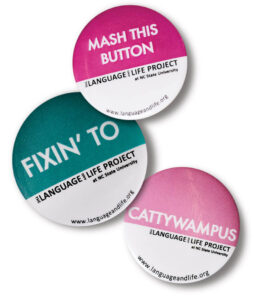
photograph by Joshua Steadman
Wolfram likes to explain to people who stop by the booth inside the Gov. Kerr Scott Building that, contrary to what they may have learned in school, there is no right or wrong way to talk. Sure, language can be grammatical or ungrammatical. It can adhere to dictionary definitions or be chock-full of slang. But “if you can talk and people can comprehend you, it’s right,” Wolfram says. “Which is not to say that, socially, people consider it right.”
Wolfram is a linguist and the director of the Language & Life Project at North Carolina State University. His nonprofit program seeks to celebrate dialect diversity and spread the message that, as Wolfram says, “dialects are something to be treasured, as opposed to something to be ashamed of.”
That shame is a result of dialect prejudice. Often, when people who aren’t from the South hear a strong Southern accent, they assume that the speaker is backward, uneducated, and unsophisticated. Many times, that language prejudice is tied to racial prejudice — traditional Black North Carolina dialects are distinctive, as are Lumbee, Hispanic, and other ethnic dialects. “If people comment on Black speech, it’s really a comment about Black people,” Wolfram says. But, more than other kinds of discrimination, linguistic discrimination is tolerated. Wolfram wants to change that.
• • •
Wolfram grew up in Philadelphia, The Youngest of six children born to German immigrants. The family lived in a predominantly German neighborhood, attended a German-speaking church, and spoke German at home. But Wolfram was born during World War II and attended a school that had a high concentration of Jewish students. As a young boy, his non-German neighbors would play Army and pretend to kill Germans. Wolfram began to feel conflicted and developed an aversion to his native tongue.
In high school, Wolfram asked a Jewish girl to the prom. She initially said yes, but the next day at school, she informed him that her parents wouldn’t let her go with him because of his heritage. “That was humiliating,” Wolfram says. On prom night, he stayed home.
“If you can talk and people can comprehend you, it’s right.”
Wolfram wanted to hide his German roots and establish his identity as an American. As a child, he had begun to pay attention to the dialects spoken around him, and he learned to talk like a Pennsylvanian. He didn’t go to the beach; he went to the shore. At the shore, he played in the wuh-der. He didn’t have a bad day; he had a bay-id day.
Wolfram never really traveled anywhere until he attended Wheaton College in Illinois. Before he got there, he had assumed that his way of speaking was “normal and standard.”
At Wheaton, Wolfram played football and studied cultural anthropology with a minor in Greek, and the lessons he had learned about language when he was growing up — that it is inextricably tied to culture and is a cornerstone of a person’s identity — were reinforced through his studies.
After earning a master’s and a Ph.D. in linguistics from Hartford Seminary Foundation in Connecticut, Wolfram planned to serve as a missionary and translate the Bible for an Indigenous tribe in South America. When he couldn’t raise enough money to accomplish that, his mentor offered him a job doing linguistics research and teaching the subject at Georgetown University. “I consider myself an accidental linguist,” he says.
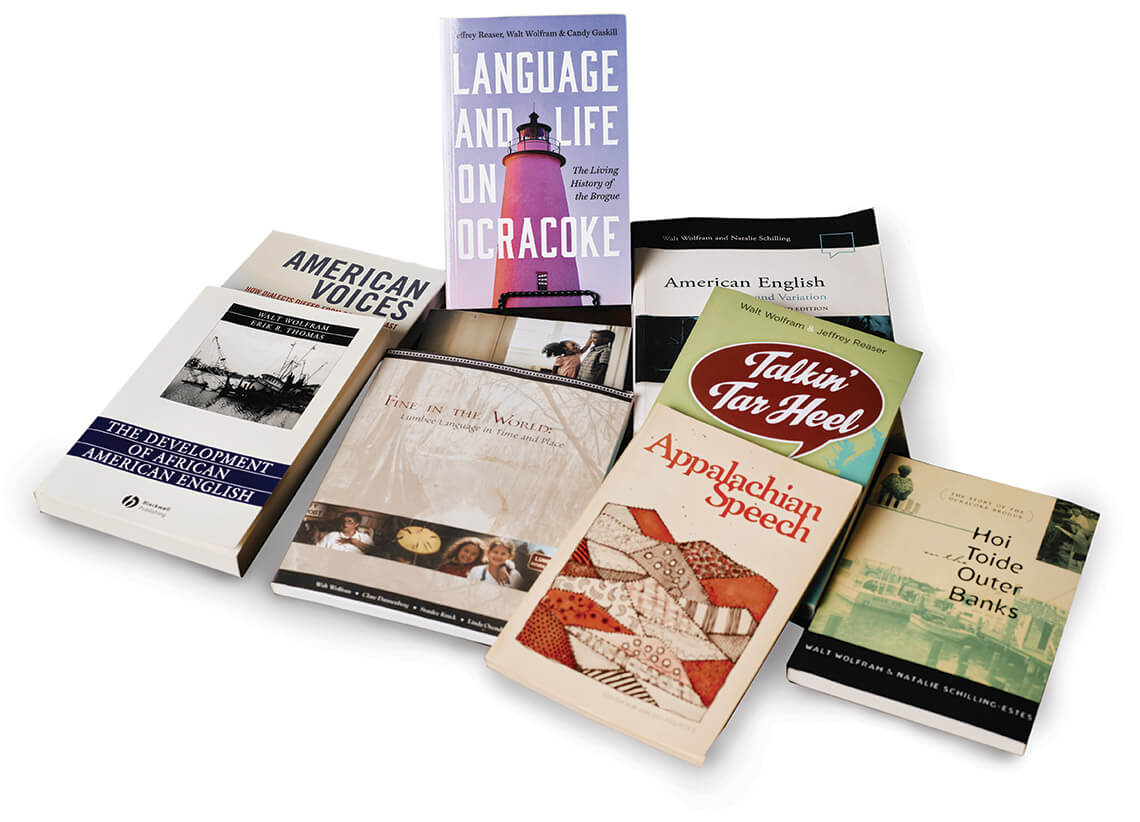
Wolfram is best known for his books that show the importance of language in Southern culture. photograph by Joshua Steadman
Wolfram went on to teach at the University of the District of Columbia. More than two decades later, on Thanksgiving Eve, he was offered a distinguished professorship at NC State. “I thought it was a gag call, to tell you the truth, because who calls you the night before Thanksgiving?” Wolfram says with a laugh. “So we came here on a lark.”
Wolfram has been the William C. Friday Distinguished University Professor at NC State since 1992. In 1993, he started the North Carolina Language & Life Project to study and document the dialects of the state and the country. Before then, much of the linguistic diversity of the state had never been researched. Through his work, he has studied the vernacular of North Carolina from Appalachia to the Outer Banks. Generation to generation. Urban versus rural. He’s also developed museum exhibits in Ocracoke, Manteo, and Robeson County on local dialects; created a curriculum to teach eighth graders about language diversity; and produced 15 documentary films on the subject for public television.
• • •
Wolfram is fond of saying, “North Carolina is dialect heaven.” We have as many dialects as any state in the country, he explains. “There isn’t a state that has a richer heritage.”
He has identified five main dialect regions in the state: the Southern Appalachian Highlands, the Coastal Plain, Pamlico Sound, the northern border counties known as the Virginia Piedmont, and the remaining central counties known as the North Carolina Piedmont. But ask Wolfram how many dialects there are in the state, and he’ll respond, “Anywhere from two to 200.”
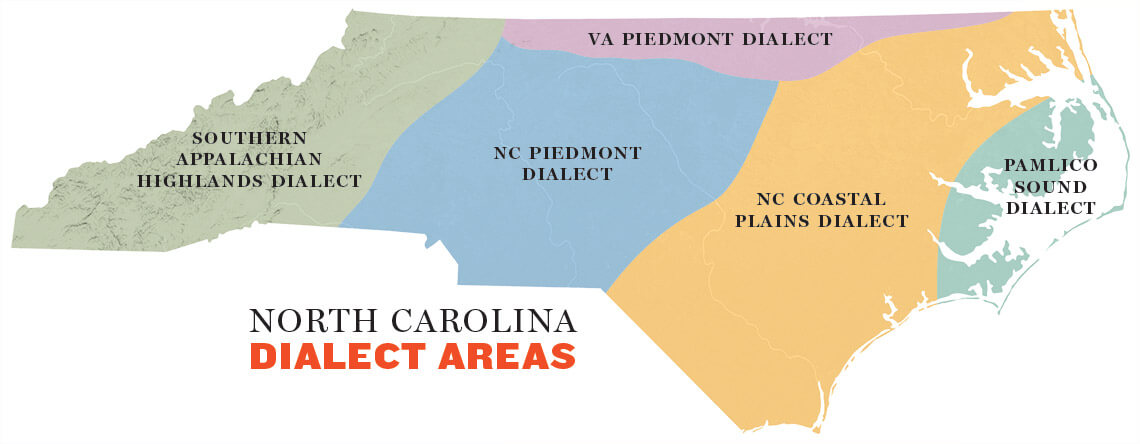
Through his research at NC State, Wolfram has discovered that North Carolina has as many as 200 dialects.
“Sitting in my office, we say Harkers Island and Ocracoke are the same dialect,” Wolfram explains. “But if you live on Harkers Island or Ocracoke, they’re different dialects because the people know the differences. So when is a dialect a dialect? In a sense, it’s in the ears of the beholders, and that’s why these designations are pretty fluid.”
Wolfram can often tell where in the state a person is from just by hearing them talk. In the Coastal Plain, you throw your luggage in the boot of the car, a term that is also heard in England, but developed independently here. In the western part of the state, folks go a-huntin’ and a-fishin’ — another holdover from Ireland and England, where people used to say they were “at hunting” or “on fishing.” The Hoi Toide vowel pronunciation of the Outer Banks came down from the Chesapeake Bay area when many people migrated south by boat around the turn of the 18th century.
In Appalachia, folks drink dope instead of soda, or, as older generations in the state say, Co’ Cola. If something is crooked, they call it sigogglin’. On the Outer Banks, something that’s crooked is cattywampus or whopperjawed.
If you don’t have tahm to do something, you could be from anywhere in the state. But if you’re raht as rain, Wolfram knows you’re from either Appalachia or the Coastal Plain. Folks from the Piedmont usually speak using two vowels instead of one within a single syllable before a voiceless sound. Think five instead of fahv. Wolfram explains a voiceless sound this way: Put your hand on your throat and make an “m” sound, then a “f” sound. You’ll feel that the “m” sound causes your vocal cords to vibrate. The “f” sound doesn’t — that’s a voiceless sound.
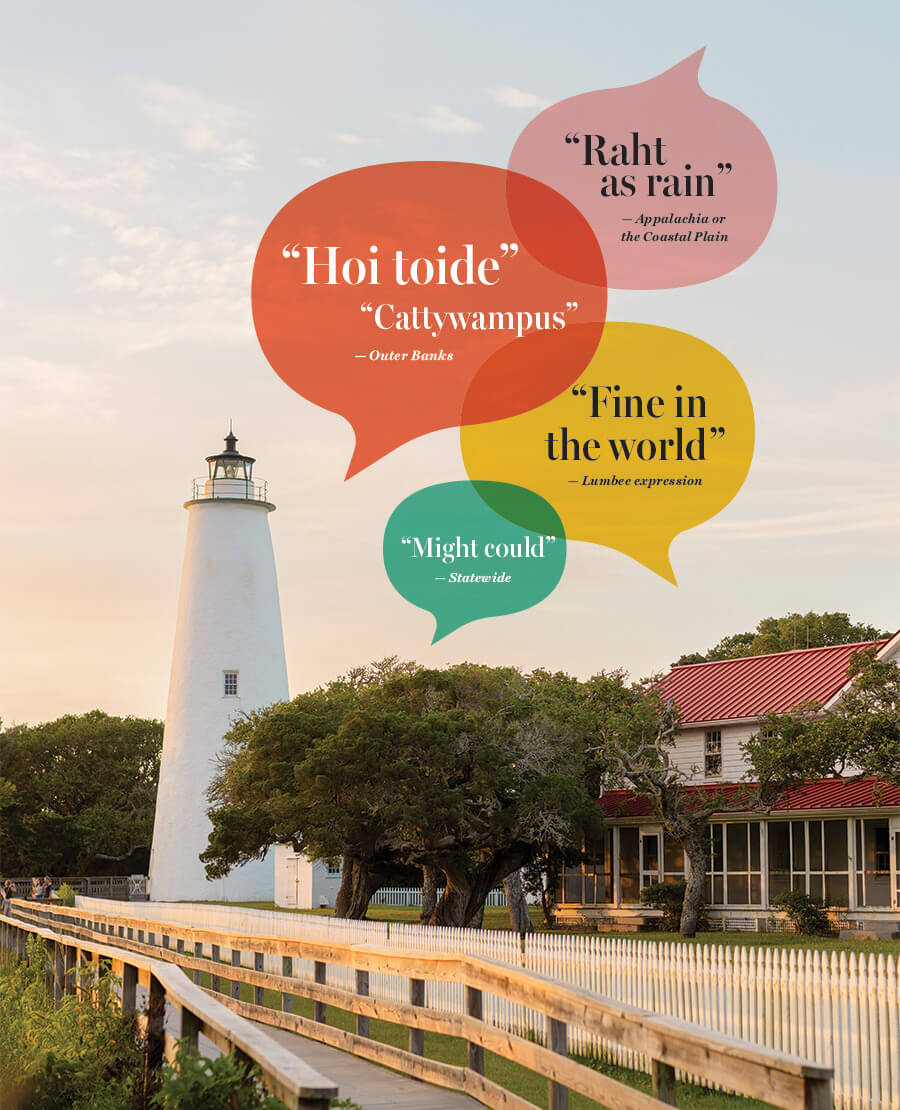
Walt Wolfram and his students have conducted more than 3,500 sociolinguistic interviews with residents of North Carolina — including Ocracoke (pictured) — and beyond. photograph by Chris Hannant; Quote bubbles by calvindexter/DigitalVision Vectors/Getty Images
In rural areas, parents carry their kids to the movies. Before bed, they cut off the lights. City folk take their kids to the movies and turn off the lights. People move to North Carolina’s cities from everywhere, and their dialects influence how people speak here. “The chasm between urban and rural in North Carolina,” Wolfram says, “is greater than the difference between Northern and Southern speech at this point.”
Older folks mash buttons. Younger folks push them. In Black dialects, the “be” form is common: “I be goin’.” And while Lumbee Indians lost their ancestral language long ago, they speak a particular dialect of Southern English that identifies them as Lumbee. “They’re very proud of that,” Wolfram says.
Is there a universal North Carolina-ism that ties us all together? Why, yes. The double modal is stigmatized elsewhere — but not in the South. “The last four governors of the state,” Wolfram says, “have used ‘might could.’”
• • •
“Wie Hast Du Geschlafen?” Wolfram often says to his wife in the morning. How did you sleep?
“Ganz gut geschlafen,” she responds. I slept quite well.
After shunning German as a child, Wolfram now speaks the language often with his wife, who is also of German descent. As he does with his mother tongue, Wolfram wants us to embrace our dialects. They unite us with other people of our own heritage. They are who we are. An Appalachian or a native of the Outer Banks. A baby boomer or a millennial. A country gal or a city guy.
So forget your high school English class. And don’t be ashamed of how you speak. However you’re a-talkin’, you’re a-talkin’ raht.
We North Carolinians have our own way of a-talkin’. Here are a few words and phrases we use to communicate raht.
“Dingbatter”
Tourist on Ocracoke; comes from All in the Family with Archie Bunker — Ocracoke
“Halfback”
Summer resident — Mountains
“Buddyrow”
Good friend — Rural Piedmont
“Over yonder”
Over there — Mostly used in Appalachia
“Yuns”
Plural of “you” — Smoky Mountains
“Airish”
Cool breeze — Mountains & coast
“Poke”
Bag/paper bag — Appalachia & rural North Carolina
“Pizer”
Porch — Coastal Plain, Outer Banks
“Fetch”
To retrieve — Rural North Carolina
“Scud”
Trip around the island by boat, car, or golf cart — Ocracoke
“Off”
Used to describe someone or something from outside of the region — Harkers Island & Ocracoke
“Slam”
Completely, as in “slam full” or “slam out” — Rural Piedmont & Coastal Plain