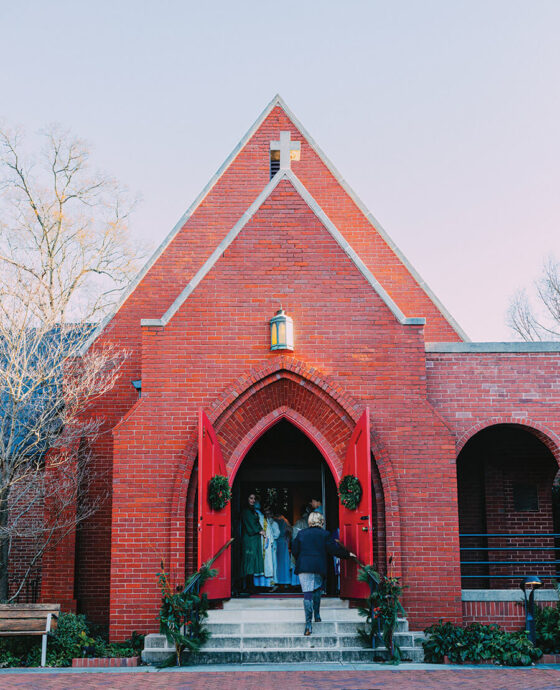
On a late November Sunday, if you duck into St. Martin’s Episcopal Church on Seventh Street in Charlotte after the service, you can hear the holiday season begin. The scraping of a ladder, a rattle of chains, and a half-dozen men calling out directions: This is the chorus to the raising of a wrought-iron Advent wreath high above where clergy stand during services.
St. Martin’s Advent wreath is made in two sections, topped with a crown, and by some estimates, it weighs about 200 pounds all together. It takes at least five people to hang it — one to steady the ladder, one to climb up and down with the pieces and the chain, and three or four more to supervise and remind the guy on the ladder how it all fits together. Usually, a Boy Scout or two lurks around, to watch and learn. It involves metal, chains, and ladders — what Scout can resist?
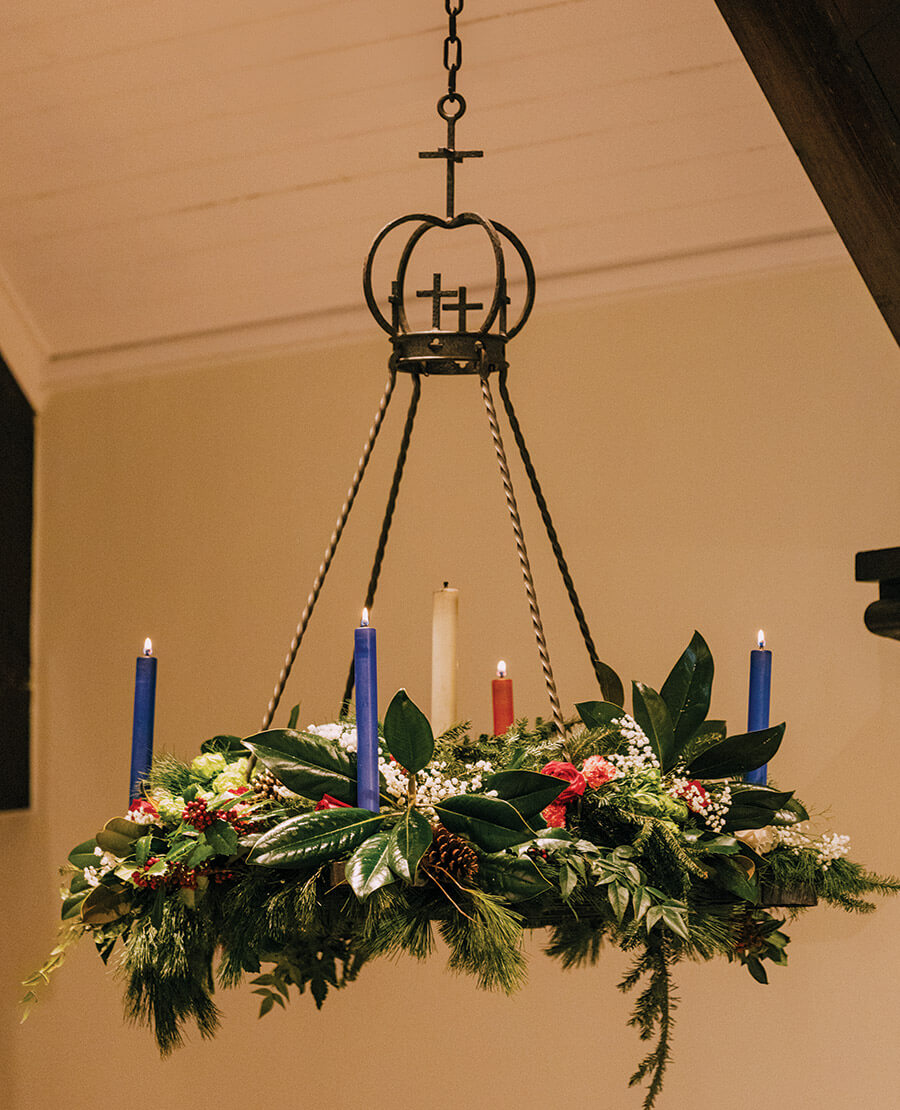
High above the pews at St. Martin’s Episcopal Church in Charlotte, a crown of iron and greenery waits for its first flame — the quiet beginning of Advent. photograph by Rémy Thurston
Just a few minutes before, the altar was all organ flourishes, white robes, and priestly gestures. But on that particular Sunday, as soon as the service finishes and the congregation is safely outside, a group of men organize themselves and head down into the undercroft — the charming word for “spider-webby basement under the church” — to fetch the pieces of the Advent wreath.
When assembled, it will hold five tall candles — three blue and one pink, with a white one in the center — with that crown at the top and a scattering of crosses. The whole thing hangs by a chain attached to a sturdy wooden rafter.
The entire production takes place near the end of November because Advent, the four-week season that culminates in Christmas, starts the next Sunday.
The holiday greenery, the carol singing, and the Christmas frenzy are all yet to come. Children’s Santa lists are still in their minds and hearts. But first, a quiet Sunday afternoon and a giant iron candle holder topped with a crown.
• • •
Thanks to a rebellious youth, I didn’t find the Episcopal Church until I was in my 30s, and I came to St. Martin’s even later — well into my 50s. But on that Sunday in late November, I find myself looking forward to that rattle of chains and the scraping of the ladder.
Every year, from the first Sunday of Advent to the final lighting of the candles — by then all that remains are melted stumps on the 12th night after Christmas — I sit in a pew every week and admire that iron wreath. The crown at the top is fitting for Charlotte, the Queen City, but truthfully, it reminds me of the logo for Imperial margarine, the ersatz-butter of my youth, complete with the trumpets flourish as an actor takes a bite of margarine on toast and a big crown magically appears on his head.
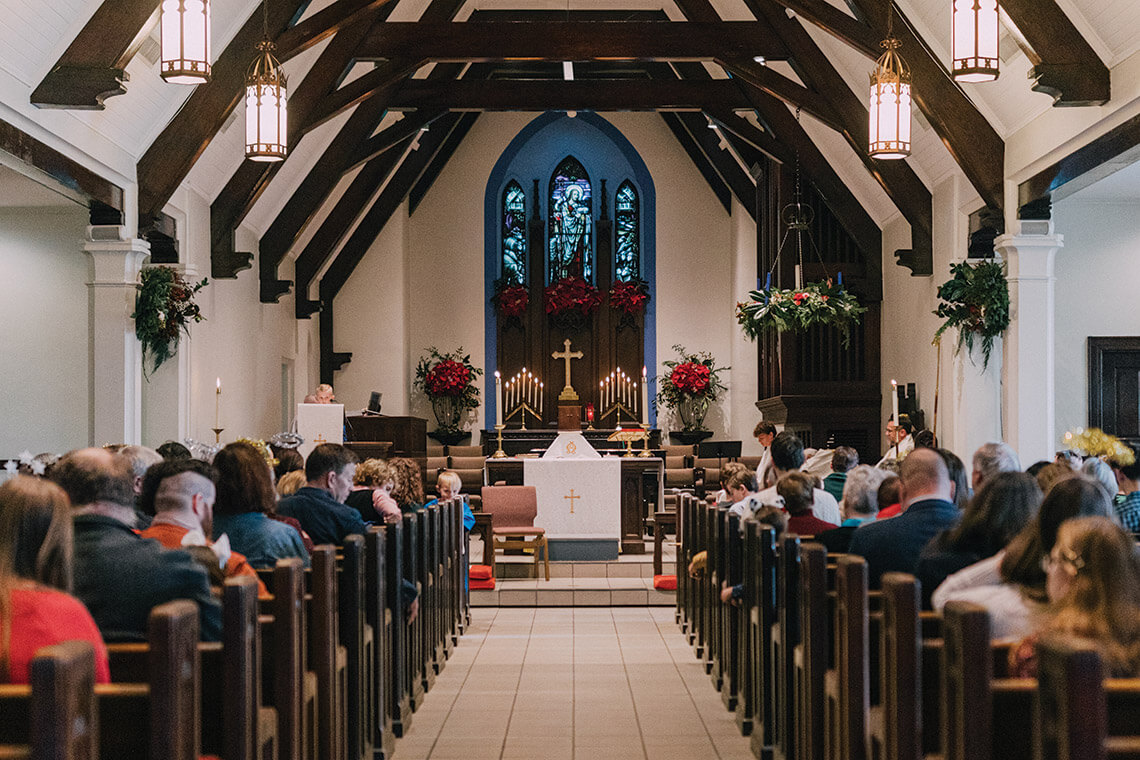
St. Martin’s congregation gathers for Advent services, where candlelight and carols mark the march toward Christmas. photograph by Rémy Thurston
But even I, in my “coldness of heart and wandering of mind,” to quote the Book of Common Prayer, can’t help but feel the glow and anticipation of what those Advent candles are ushering in.
After services, when the church is quiet, I like to wander over and take a good look at that iron wreath. Viewed from below, the bottom section that holds the candles has graceful swirls that look like keys, one of those powerful symbols of faith. Keys mean authority, but they also mean access to Heaven. I like knowing that the maker of our wreath worked that into his design.
St. Martin’s is an old church, at least by the standards of Charlotte, where 20 years is enough time for a building to be declared obsolete and reduced to rubble. Although it started in a small schoolhouse in 1887, construction on the current building didn’t begin until 1912.
We don’t actually know how old our Advent wreath is — some say it’s from the 1920s, others say the 1950s. And no one knows who donated it — surprising in an Episcopal church, where anything bigger than a dust bunny usually has a brass plate with someone’s name on it.
Even I can’t help but feel the glow and the anticipation of what those Advent candles are ushering in.
We do know who made it, though. Under the wheel, if you know exactly where to look, you can see its origin stamped into the iron: Dance Foundry, Rome, Georgia. The owner, Karl Dance, was an ironworker who was revered in Floyd County, Georgia, for his artistry. He opened his foundry in 1933 and kept it going until 1985, a month before he died. He was so admired in Rome that there’s a historical marker to his memory, declaring him “artist, foundryman, friend.”
Dance’s creation gets better as the weeks go by and the candles are lit. The first Sunday starts with a blue candle to symbolize hope. The second week, we light another blue one, for faith. The third week, Gaudete Sunday is always time to light the pink candle. Gaudete is Latin for “rejoice,” because of the Latin mass that starts “Rejoice in the Lord always.” It’s halfway through December, and we’re shifting from penitence to joy and anticipation. On the fourth Sunday, we return to the last blue candle, for peace. Finally, on Christmas Eve, we light the white candle in the middle, the Christ candle, to symbolize the birth of Jesus.
• • •
The tradition of Advent wreaths with candles goes back to Germany, the source of many Christmas symbols, including light-covered trees and Advent calendars with their 24 tiny doors. These wreaths used to be something people hung at home with their families. They didn’t become a regular feature in churches until the 1950s.
Different churches use different styles of wreaths. Smaller wreaths that are easy to reach are often lit by a different family every week. At St. Martin’s, though, our wreath hangs so high in the air that the tallest teenaged acolyte is usually assigned the job of balancing a long taper to light the candles. Sitting out in the pews, I usually hold my breath, waiting for the taper to tilt and fall. It never does.
• • •
My favorite part of the wreath ritual usually happens one afternoon by December 23, during the Greening of the Church, when a whole team — men and women this time — swoop in to fill the church with greenery and flowers. A brave soul — last year, it was Father Josh Bowron’s oldest daughter, Ava, home from her sophomore year at college — climbs back up a ladder and fills the whorls of the iron wreath with so many magnolia leaves and evergreens that the iron disappears.
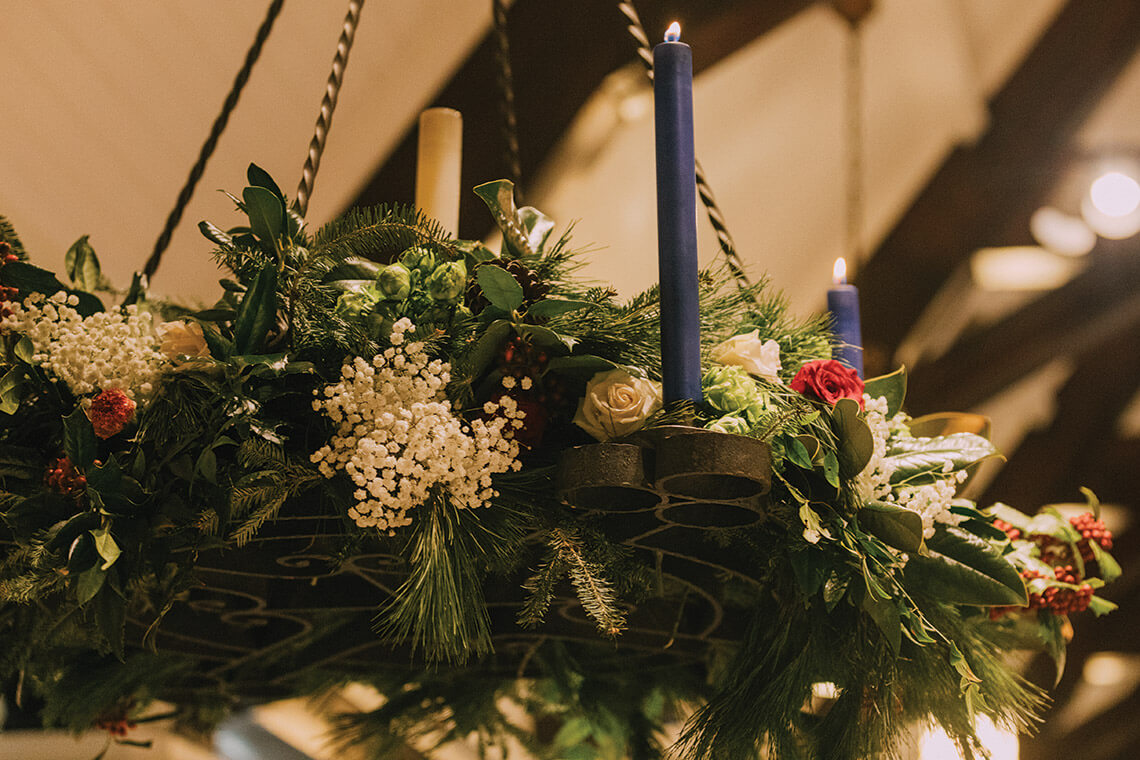
Each candle tells the story of Advent — blue for hope, faith, and peace; pink for joy; white for the birth of Jesus — their light growing as Christmas nears. photograph by Rémy Thurston
When we come into the church that night for midnight mass, the iron wreath has been transformed. It reminds me of an osprey nest, like the kind you see perched on poles along the Outer Banks. An osprey nest of greenery and flickering candles, all topped with a crown, and dangling high in our church.
At the end of the service, when we pass out small candles and turn out the lights to sing “Silent Night,” our Advent wreath glows in the candlelight. We’ll keep on lighting its candles every Sunday until January 6, until the last note of “We Three Kings” fades away, the ladder comes out, and the wreath is dismantled. And we’ll be ready to do it all again next year.
print it