Put ramekins on a baking sheet. Bake for 25-35 minutes, until puffed and golden. Remove from oven, and let stand for 5 minutes. With a flexible spatula, remove strata to
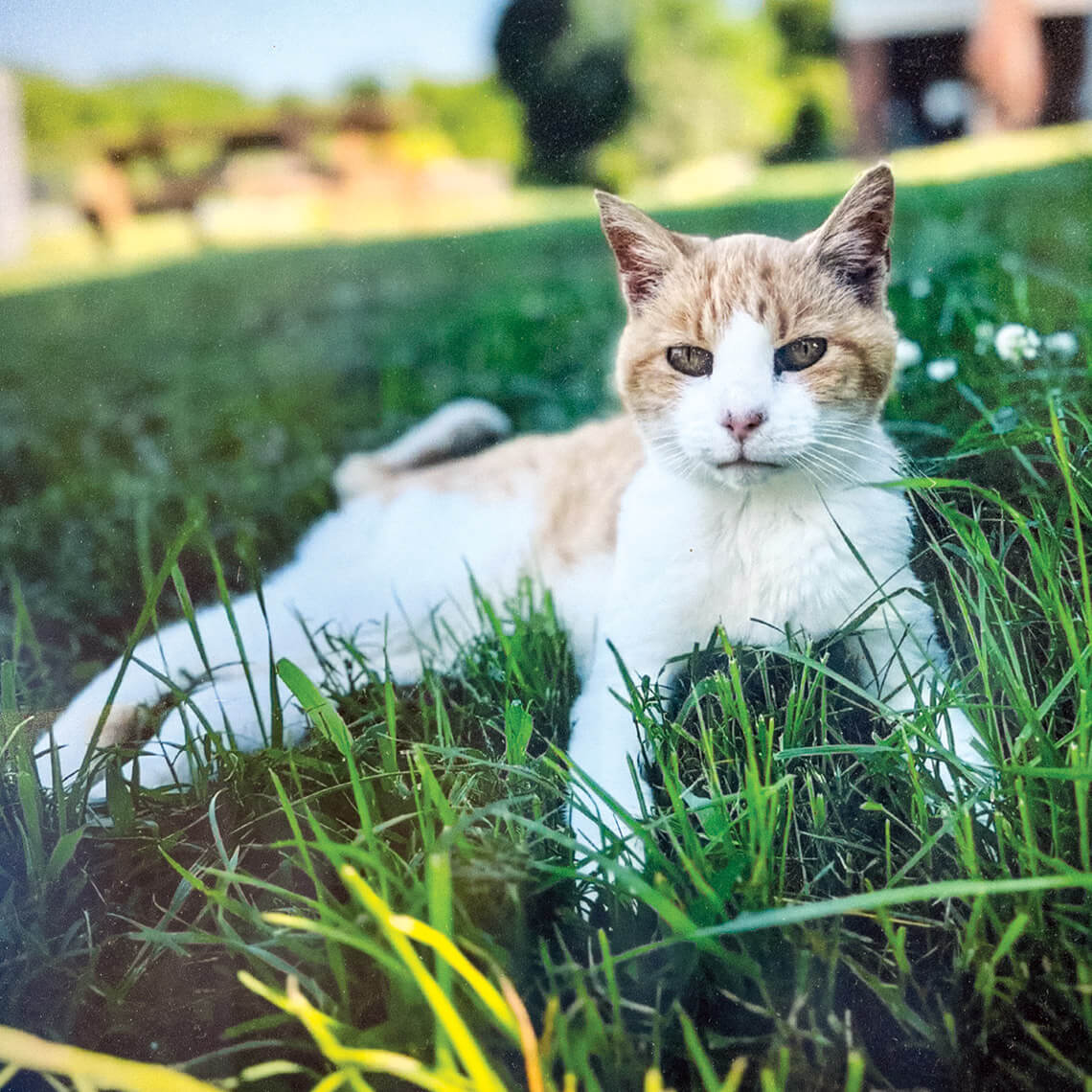
He wandered into Peacehaven sometime in 2009 and never left. When volunteers and staff arrived, they’d spot him lounging around the barn like he owned this former dairy cattle farm
He wandered into Peacehaven sometime in 2009 and never left. When volunteers and staff arrived, they’d spot him lounging around the barn like he owned this former dairy cattle farm
A mother’s vision transformed a Whitsett farm into a place where differences dissolve, friendships flourish, and every life — even a barn cat’s — shines on.
He wandered into Peacehaven sometime in 2009 and never left. When volunteers and staff arrived, they’d spot him lounging around the barn like he owned this former dairy cattle farm in Whitsett. He had a gravelly meow, a feline swagger, and a knack for greeting everyone who came by. If he saw someone planting vegetables, weeding a raised garden, or holding a hammer while building a six-bedroom house, he’d nuzzle their ankles, coaxing them into giving him a loving rub. They always did.
Last spring, right before Easter, he disappeared. Everyone at Peacehaven suspects he wandered off into the woods because he knew his end was near. But really, he hasn’t fully vanished. He’s in a frame of photos in the barn, in chalk messages on the driveway, and in a nine-page memory book that ends with the line: “We won’t always feel sad — and we will feel happy again.”
Peacehaven’s late barn cat, Boom, left a legacy of love and companionship that residents carry with them. Photography courtesy of Peacehaven
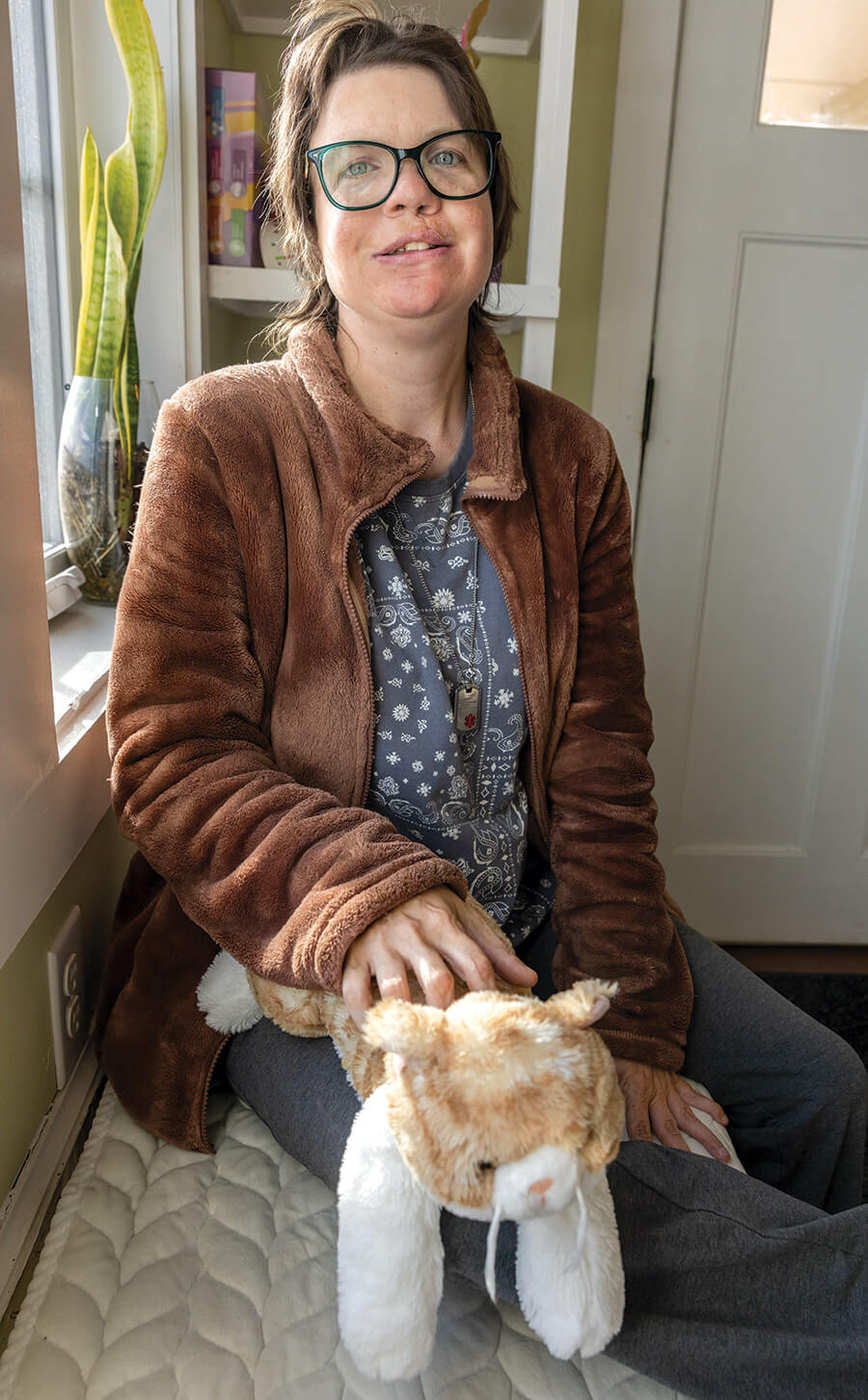
Also, his likeness is usually perched on the shoulder of Autumn Troy. He’s all orange and white, with whiskers like shoelaces. Autumn lives at Peacehaven, and she carries him almost everywhere. When I first meet her, I ask the name of her stuffed animal. She smiles, moves her fingers, puckers her lips, and forms a single word.
“Boom,” she says.
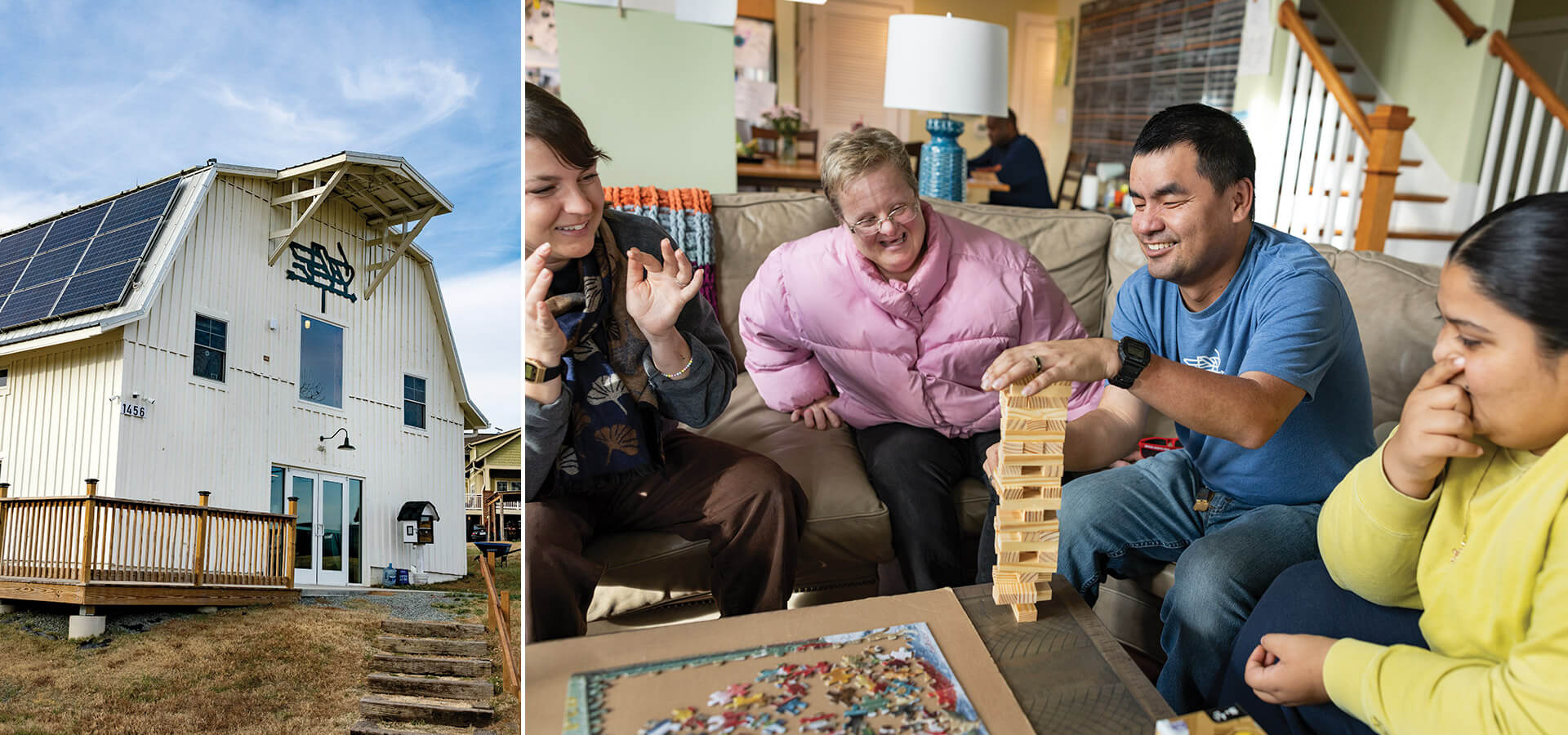
That’s how I first hear about the barn cat named Boom. As I try to decipher Autumn’s signs and spoken words, I start to see what Peacehaven is all about. On 89 acres along a loping curve of NC Highway 61, the nonprofit is creating a community where people of all abilities can learn from one another. The farm’s slogan begins to make sense: Let’s Be Different Together.
• • •
Beside the front door of the home where Autumn lives, a plaque reads:
IN MEMORY OF SUSAN. May all who enter this place find new promise and new hope through love, joy, and inspiration.
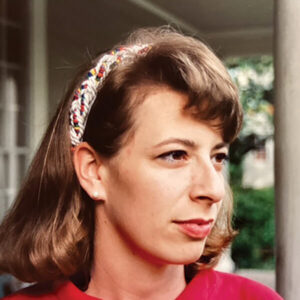
Susan Elliott Photography courtesy of Tim Elliott
That’s Susan Elliott, one of Peacehaven’s co-founders. She discovered the farm and coaxed her husband, Tim, and her friend the Rev. Buck Cochran, to see it because she had an idea. In 2007, when Buck first stepped onto the property, he knew: She’s right. This is it.
By the time Boom appeared, Buck and a team of volunteers were building a home for adults with intellectual and developmental disabilities — IDD, in medical shorthand. Both the Elliotts and the Cochrans raised children with IDD. In her first email to Buck about the idea, Susan shared her vision: “I want his life to be full, varied, and purposeful,” Susan wrote, referring to her grown son Julian, “and the same for the Peacehaven residents. Not sterile. Not insulated. I want life to have meaning and daily opportunities for happiness and stimulation.”
• • •
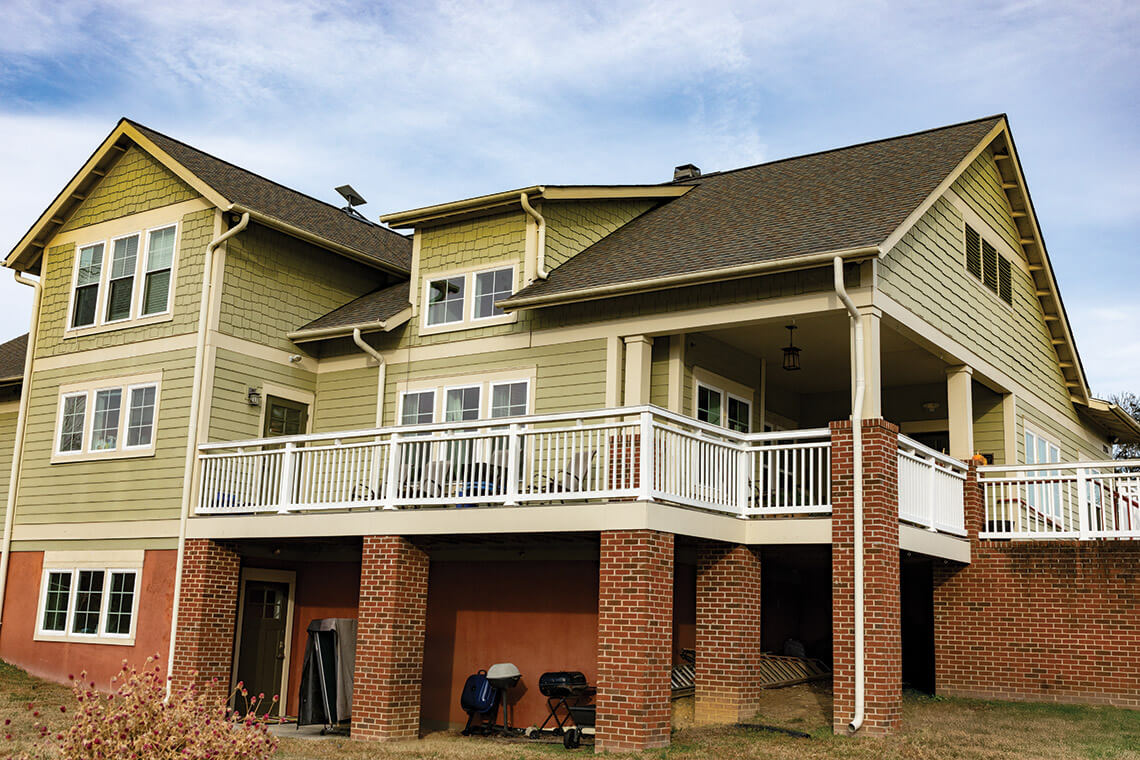
Unlike Autumn, Julian never got a chance to live at Peacehaven. As it was taking shape, his mom battled breast cancer. She died in 2009 at age 44. Tim eventually remarried, took a job in Florida, and brought Julian with him. The six-bedroom home built by volunteers and staff members opened in 2014 and was christened “Susan’s View.” Her dream became real, Tim remained active, and support grew. Like Boom, Susan’s spirit is everywhere at Peacehaven.
“Peacehaven has become a place where differences between people melt away,” says Buck, the nonprofit’s first executive director, now retired. “I don’t know how it’s happened, but what remains is authentic and life-giving, where things of everyday life are valued with great love.”
Built by volunteers and staff members, Susan’s View opened in 2014.<br><span class="photographer">photograph by Charles Harris</span>
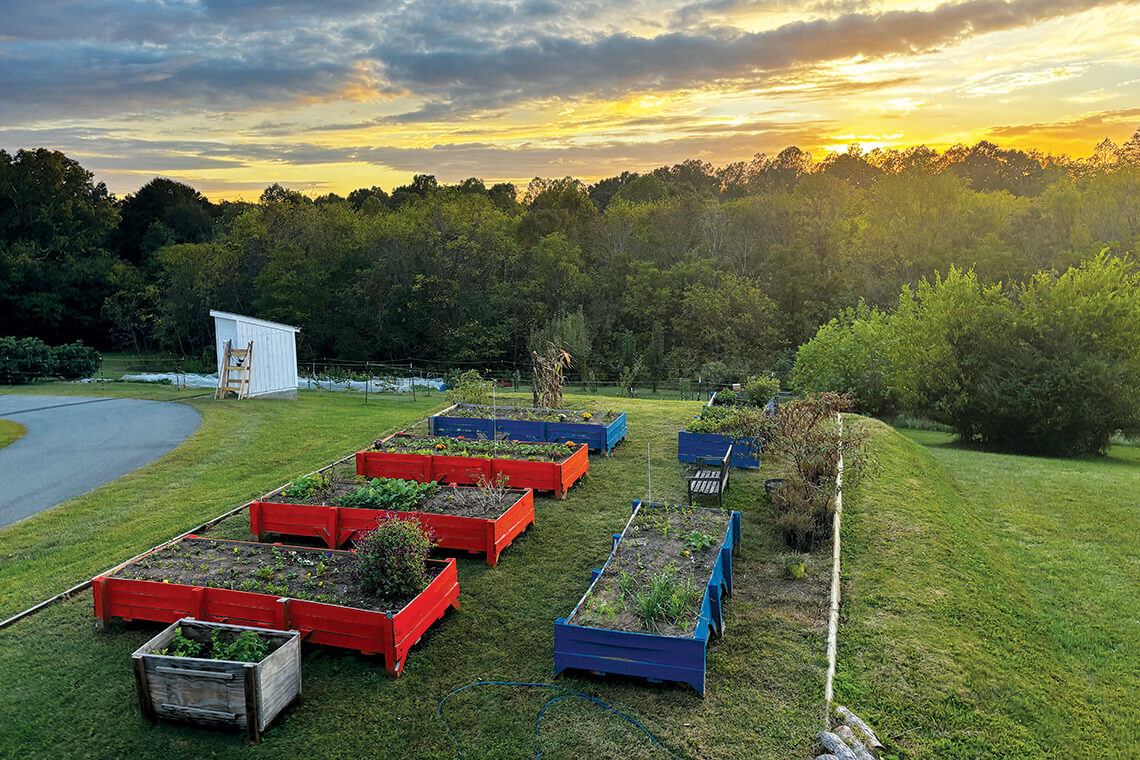
Susan’s View’s residents do much together, such as tending the raised garden beds outside their front door. <br><span class="photographer">Photography courtesy of Jeri Rowe</span>
Adults with special needs don’t have to live with their aging parents and feel isolated from the world. At Peacehaven, they live independently, have jobs, grow their own food, help with chores, eat together, and, among the rolling hills beside Lake Mackintosh, they can create a life where they feel accepted and loved.
The land where cattle once grazed becomes the teacher for Autumn, her four housemates, and the six participants in Peacehaven’s skill-building program, offered every weekday. In turn, they become teachers for anyone who shows up. Anyone like me. That’s how Buck sees it.
• • •
As for Peacehaven, it’s about to get much bigger. It has already raised $15.1 million toward its $70 million goal to create a self-reliant community for adults like Autumn. Construction began last fall on a 20,000-square-foot community center that will include a catering kitchen, an event hall, classrooms, and a recording studio. In about five years, an entire community is expected to grow here — a clinic, a makerspace, and a neighborhood of homes where 200 people, both able-bodied and those with IDD, will live side by side.
Autumn, 38, and the four other residents of Susan’s View are the pioneers: Jeff Piegari, 36; Adam Stall, 32; a 31-year-old named Ben; and Anne Harris, 51.
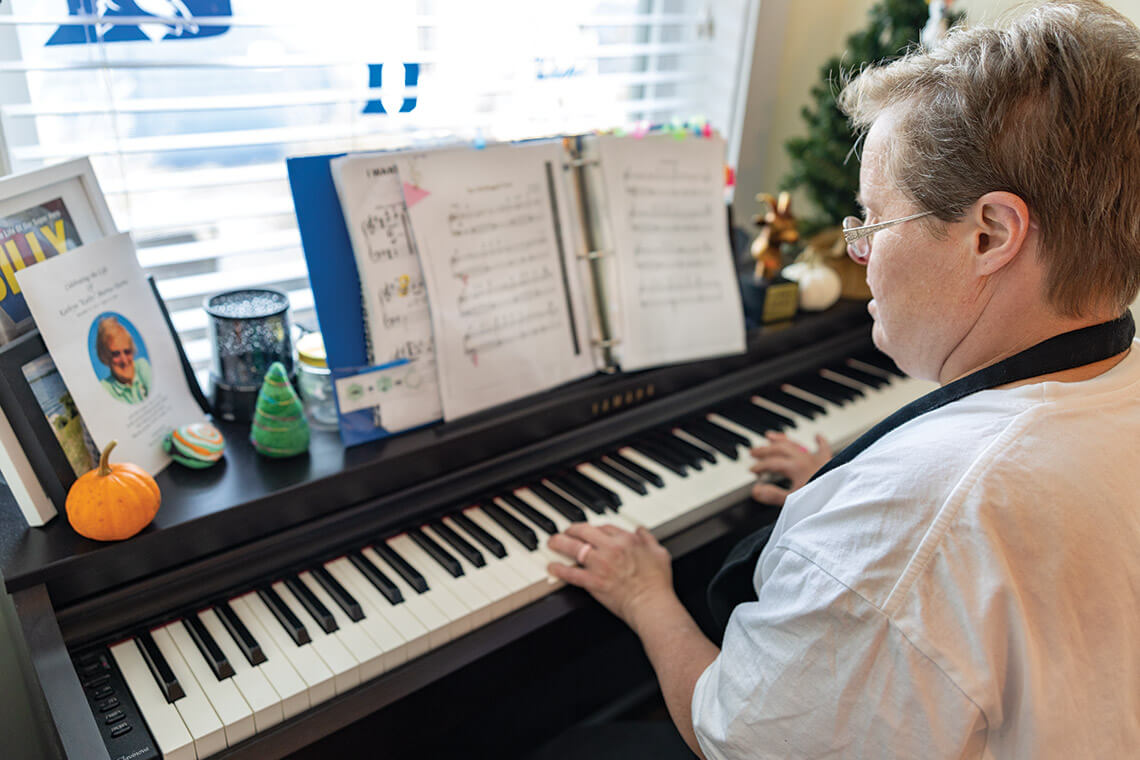
Peacehaven resident Anne Harris shares hymns she play for her mother’s funeral service. photograph by Charles Harris
When I meet Anne, I hear how she works part-time as a hostess at a pizza restaurant in Burlington. Beside a piano in her bedroom, I spot a funeral bulletin. It’s from the service for her mother, Kathy, a former middle school teacher who died in June 2024 at age 82. I open it and see that Anne played two of her mother’s favorite hymns.
“Can you play those for me?” I ask.
Anne smiles and plays “The Old Rugged Cross” and “Michael Row the Boat Ashore” beneath a window plastered with stickers from Duke University — the alma mater of her older sister, Kimberly.
When she finishes, Anne talks about Susan’s View, her home for the past decade. She’s found friendship, purpose, and joy in tending the garden beds — growing cucumbers, tomatoes, and herbs. In her soft, deliberate voice, she tells me about turning 51, her friends singing “Happy Birthday,” and sharing the moment with her dad, Lenny.
The parents of Autumn Troy say they are eternally grateful for Susan’s View and Peacehaven. Says Autumn’s mom, Janet: “We feel secure because she feels secure.” photograph by Charles Harris
Those stories make Lenny smile. Anne’s move to Susan’s View was emotional, but he and Kathy, his wife of 55 years, knew it was right.
“Her brother and her two sisters said Anne could live with them,” he says. “But Kathy and I knew Anne needed a home — and Anne has found a home.
“I don’t have a contract on tomorrow. I’m 82, going on 83, and I do miss having Anne around. But Peacehaven gives me peace of mind. That’s where she wants to be.”
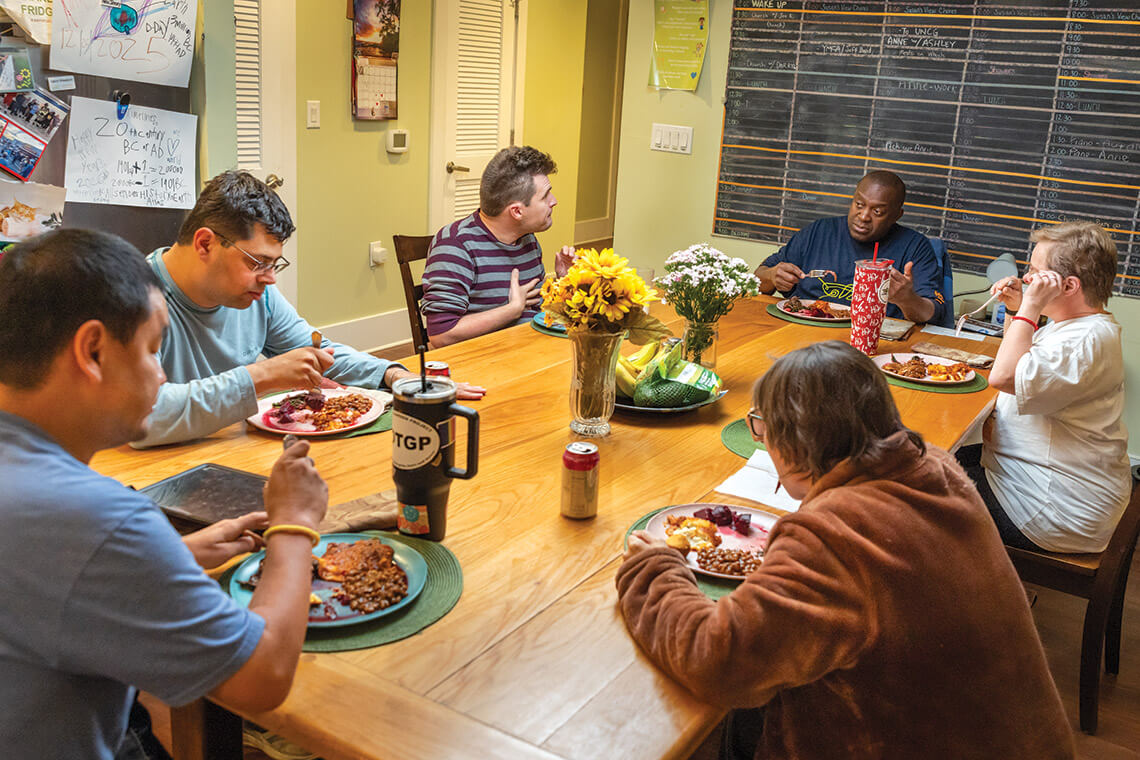
Anne and her four friends are never alone. Staff members known as home-life leaders stay with residents overnight, helping with dinner, laundry, and daily routines.
The blackboard in front of the dinner table at Susan’s View helps residents keep track of their responsibilities. photograph by Charles Harris
Darryl Roseboro, a retired middle school science teacher, is one.
He’s been a home-life leader for seven years, and he’s had his own share of moments, like the time when Peacehaven’s farm dog, a labrador named Maverick, died. “It tore me out of my frame,” he says. Then Adam, Anne, Autumn, Ben, and Jeff found him in the barn and wrapped him in a big group hug.
“It’s a family,” says Darryl, 62. “We’re working together, growing together, supporting one another when one of us has a hard time. How else are we going to make it?”
• • •
Beside the barn, Adam’s art stretches across the driveway in white chalk — a dinosaur, a whale, a shout-out to NC State, and the words: Love my pet Boom.
Inside the barn, a frame of 15 photos of Boom bears one word: Love.
Darryl’s wife, Dana, Peacehaven’s director of programs, has just finished reading Charlotte’s Web to six adults in the day program. Like her husband, she’s a retired educator. She tells me about the painted rocks.
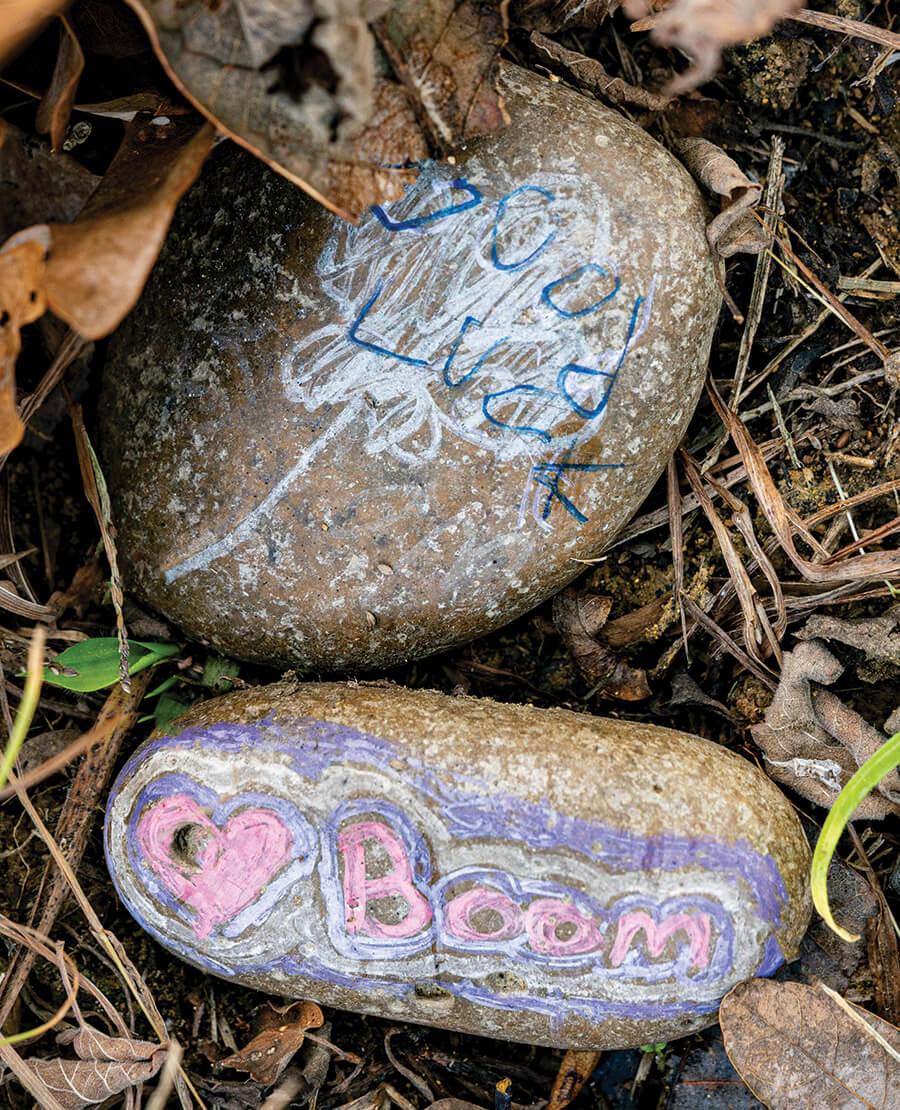
Peacehaven’s columbarium — a low, 65-foot stone wall in a former cow pasture — holds shells, flowers, and the ashes of Susan and Maverick. Nearby, memory rocks honor Boom. After Easter, residents and staff held a small memorial service, planting painted rocks near a grove of cedar and oak trees.
Last spring, residents painted rocks to help them process their grief in losing their cat, Boom. photograph by Charles Harris
When I set out to see it, I run into Autumn — without her shoulder-riding cat toy, a gift from Adam. Together, we walk the winding gravel road toward the columbarium. Beneath a patch of oregano and wildflowers, she finds her rock. On it, she’s painted a flower and written in blue: Good Luck.
I ask Autumn if the memorial service made her happy. She nods. Her fingers dance; her lips pucker. She forms one word and points toward the clouds.
“Sky,” she says.
Sky?
“Sky,” she repeats.
I understand.
FOR MARCH: A longtime resident of Spring Lake started a nonprofit a quarter-century ago to empower those who have long felt powerless. Today, her spirit lives on.
Get our most popular weekly newsletter: This is NC
From the expanses of needlerush at Cedar Island to the lush spartina feathering the shores of Bodie and Roanoke islands, our salt marshes are the threshold to a watery world — the heartbeat of our coastal ecosystem.