Clouds brush the top of the Smoky Mountain peaks around Winchester Creek Farm. A flock of magpie ducks waddles around the grounds, their orange feet pitter-pattering across the grass by the pavilion that’s hosting this morning’s farm yoga class. The mats are laid out, acoustic music plays softly, and a breeze tousles the wildflowers in the garden beds nearby. It’s the perfect setting for an uninterrupted yoga session.
“Place your hands just behind you, lift your hips, and let your head fall back,” the instructor says. The students follow, tilting their heads back — only to come face-to-face with an alpaca just a few inches away. OK, so there might be some interruptions during alpaca yoga, but that’s the best part. On this morning, two mother alpacas and their babies, called crias, roam among the yogis, munching on scattered hay — and one curious cria named Artie munches on the mats, too.
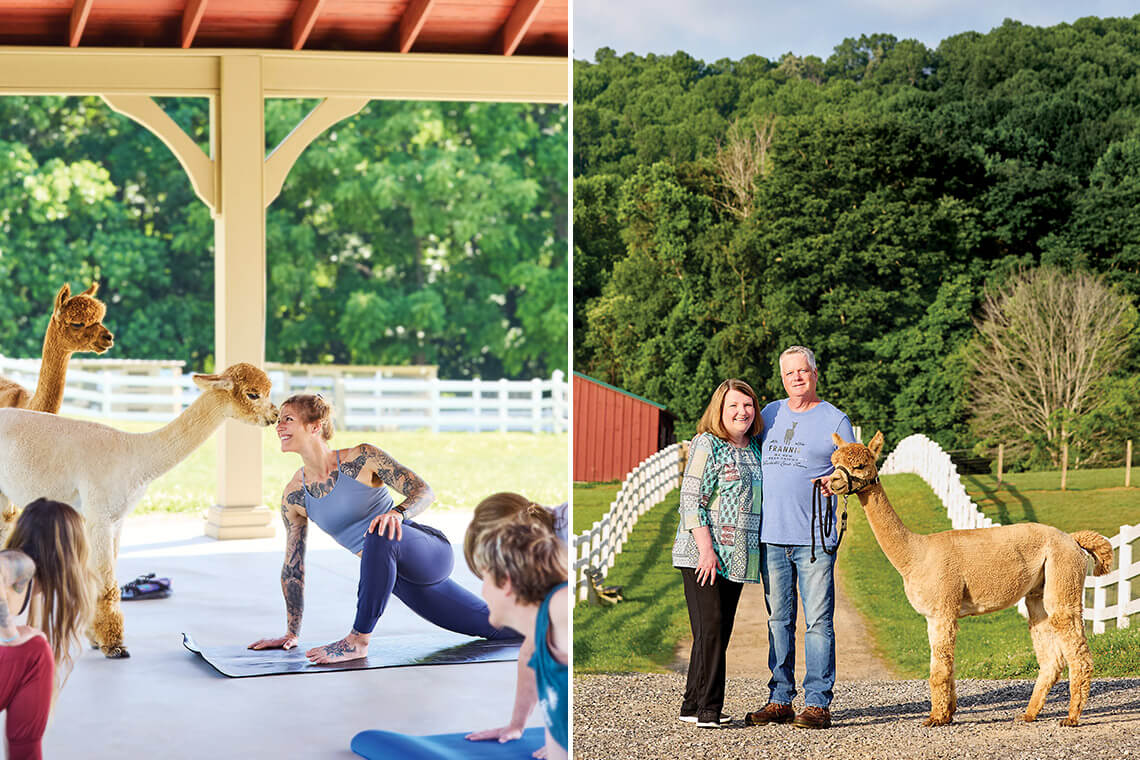
Gayle and Ken Woodis — pictured with former “presidential candidate” Teddy — tell participants in the farm’s yoga classes (left) to be prepared for alpaca kisses and nuzzles. photograph by Stacey Van Berkel
Alpaca yoga is one of many memory-making experiences for visitors at this 22-acre property in Waynesville, but for the alpacas, it’s an enrichment activity designed to build their social skills. “We raise them so that they’re not fearful,” co-owner Gayle Woodis says.
Gayle and her husband, Ken, believed in the healing power of animals long before purchasing the farm in 2019. Originally from the Midwest, they grew up around creatures of all kinds: Most of Gayle’s family members had farms, and Ken’s first job in high school was at the Minnesota Zoo.
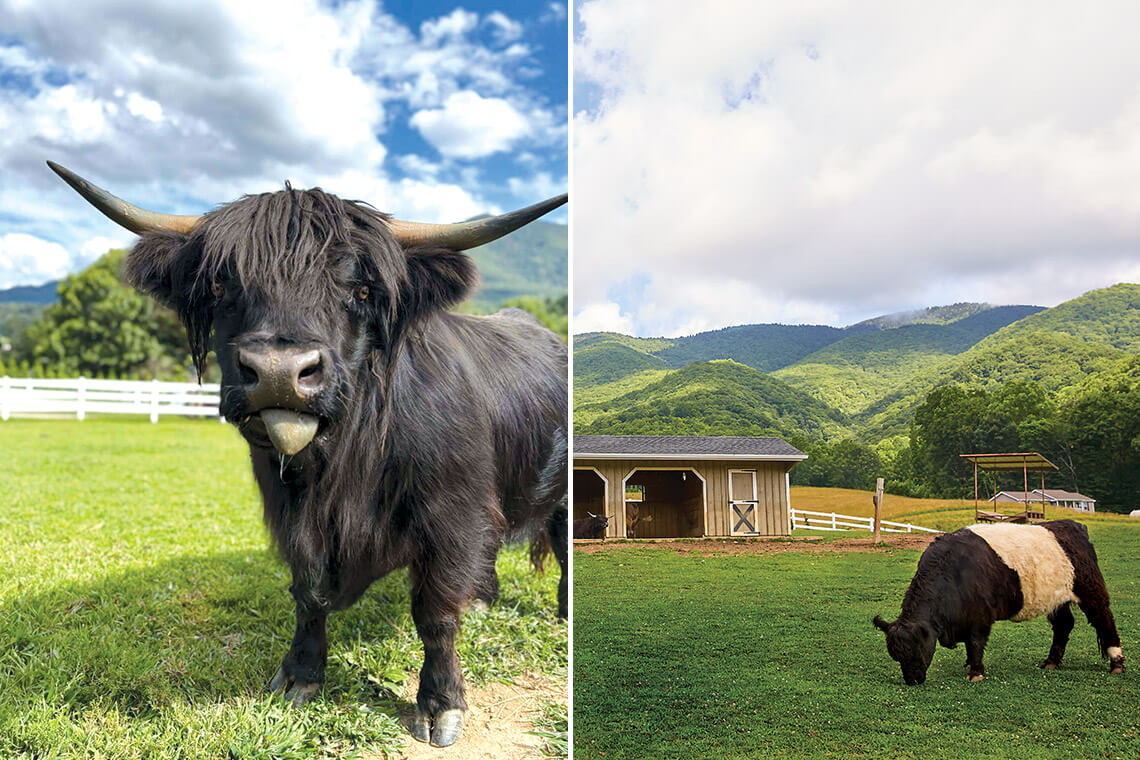
Baby Bug (left), a Scottish Highland cow, was born just 18 inches tall. She and Kitty Kat (right), a miniature Belted Galloway, share a pasture and are often seen together, as Kitty Kat is very protective of her friend. photograph by Stacey Van Berkel
After they married, the couple spent years hobby farming while working full-time and raising their two adopted children, both with special needs. They trained therapy dogs and horses and raised livestock like pigs, miniature horses, and goats. Their son and daughter tended to the animals, and Gayle and Ken saw the positive impact these chores had on them from a young age.
The Woodises designed Winchester Creek Farm to be a place for everyone to feel welcome.
“As parents of special-needs kids, we knew how important that was to be able to be inclusive for everybody,” says Gayle, who has worked to make major areas of the farm ADA-compliant. “All the animals that we use as ambassadors are very gentle and usually gravitate toward the people who need them most.”
• • •
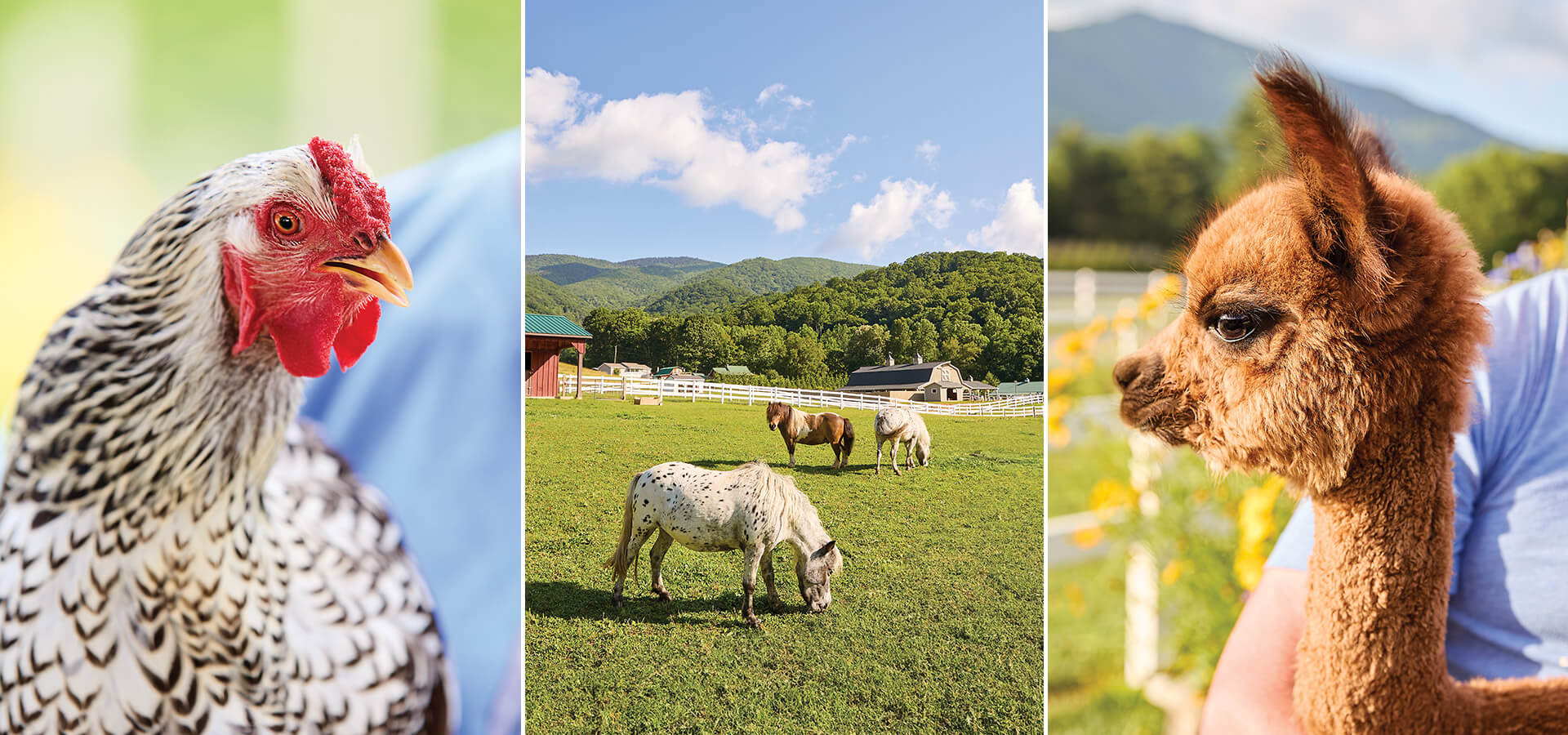
The children gathered around tour guide Beka Benfield stare at the chicken in her hands. So far during their morning farm tour, they’ve begged the mini horses, mini cows, and alpacas to come to the fence so they can sneak in a pat. But now they’re still, and most of them don’t appear eager to come any closer.
“Has anyone ever touched a comb before?” Benfield asks, patting the chicken. One brave girl steps forward, and Benfield shows her how to gently feel the red crown atop the chicken’s head. The girl makes a face but stays close. “It kinda feels like really dried-out gummy worms, right?” Benfield says. “But that’s actually where they cool off. The best ways [they do that] are through their feet and their combs.”
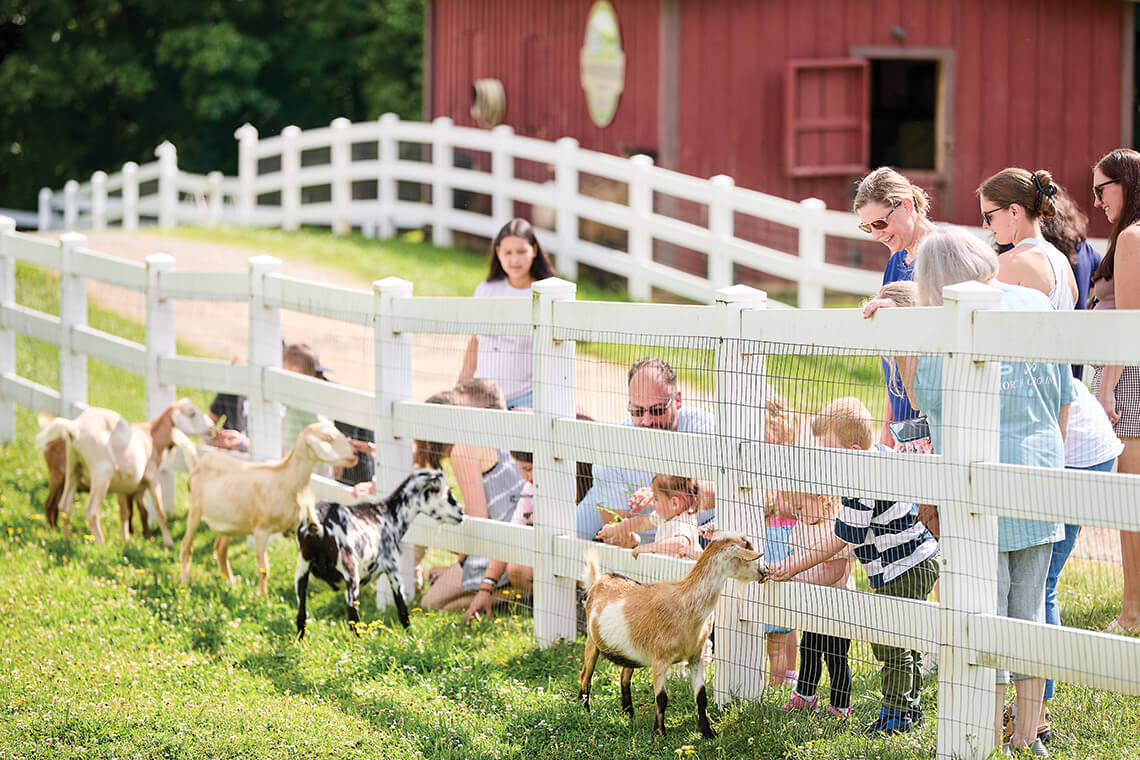
Guests on farm tours greet mini goats and chickens, many of whom allow pets and enjoy treats from visitors. photograph by Stacey Van Berkel
This is one of many facts that the group learns during its 45-minute tour of the farm’s furry and feathered residents. When they meet the three miniature cows, Benfield explains that the miniature donkeys in the pasture are there for the cows’ protection: The donkeys’ kick is the most powerful of any animal their size. She tells them that the farm’s most famous miniature cow, Baby Bug, is one of the smallest in the country.
And speaking of celebrity creatures, she shares some lore about the farm’s miniature horses: “[They] were originally bred for nobility,” Benfield says as the children imagine these horses, not much taller than them, running around castles in the 1600s. “Horses can learn a lot, but potty training is just not one of those things.”
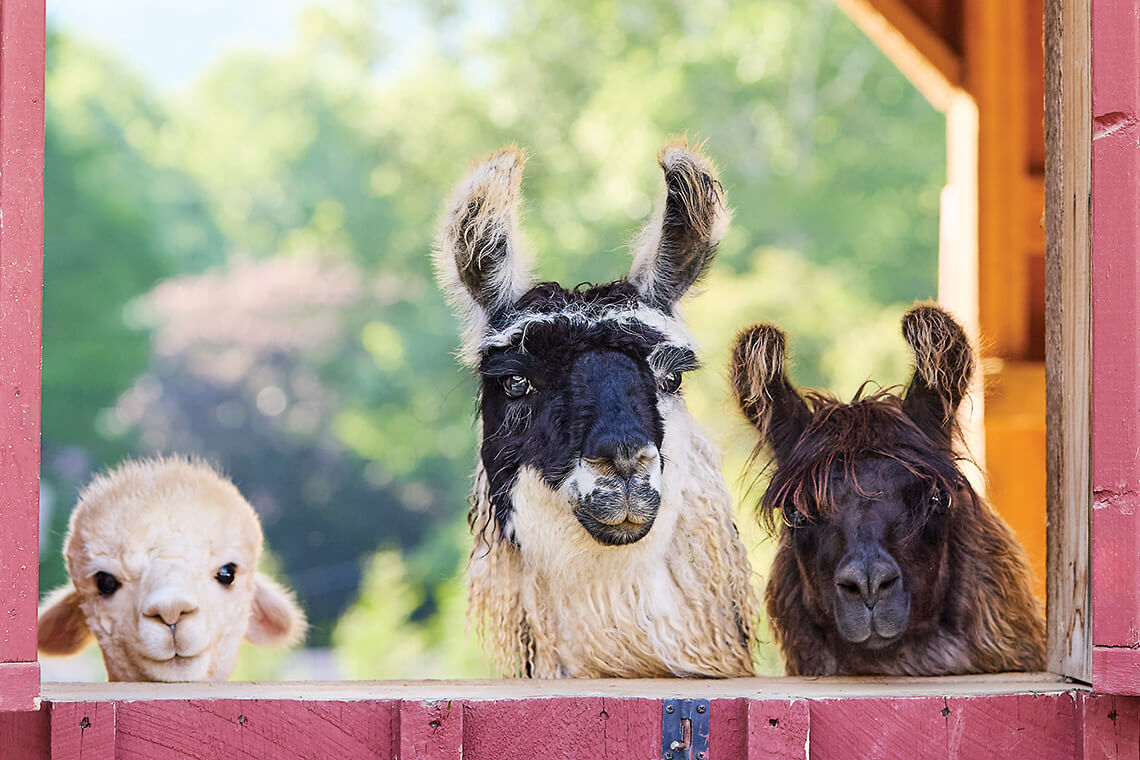
Tink the alpaca (far left) is just tall enough to join llama pals Cosmo and Toya in peeking out the barn window to keep an eye on the farm. photograph by Stacey Van Berkel
Sure, these animals aren’t potty-trained, but new visitors often remark on the lack of that signature farm smell. “People will say, ‘Where’s the poo?’” Gayle says with a chuckle. “We clean constantly, all day long, because it’s not only healthy for our animals, but you don’t want to take pictures with poo in them, right?”
Photography courtesy of Winchester Creek Farm
At each stop along the way, the children learn something new about these animals and how to interact with them. The alpaca pastures hold the farm’s mascot animal and some of its most memorable personalities, including Teddy, who ran for president in 2024. (His campaign merch is still available in the farm gift shop, along with yarn made from his fiber.)
A lot of folks come to Winchester Creek Farm not knowing much about alpacas. Domesticated in the Andes Mountains thousands of years ago, they were only brought to the United States in 1984 and are often confused with their larger counterparts, llamas. But here are a few reasons everyone falls in the love with alpacas by the end of the tour: Instead of hooves, they have two padded toes. To clean their fleece and cool off, they roll around in the dirt, taking dust baths. They have no upper front teeth, so they can’t bite, only kiss. And if you’re lucky enough to catch their eye, their lips are always curled up into a friendly and very contagious smile.
Winchester Creek Farm
386 Walker Road
Waynesville, NC 28786
(828) 246-9486
winchestercreekfarm.com