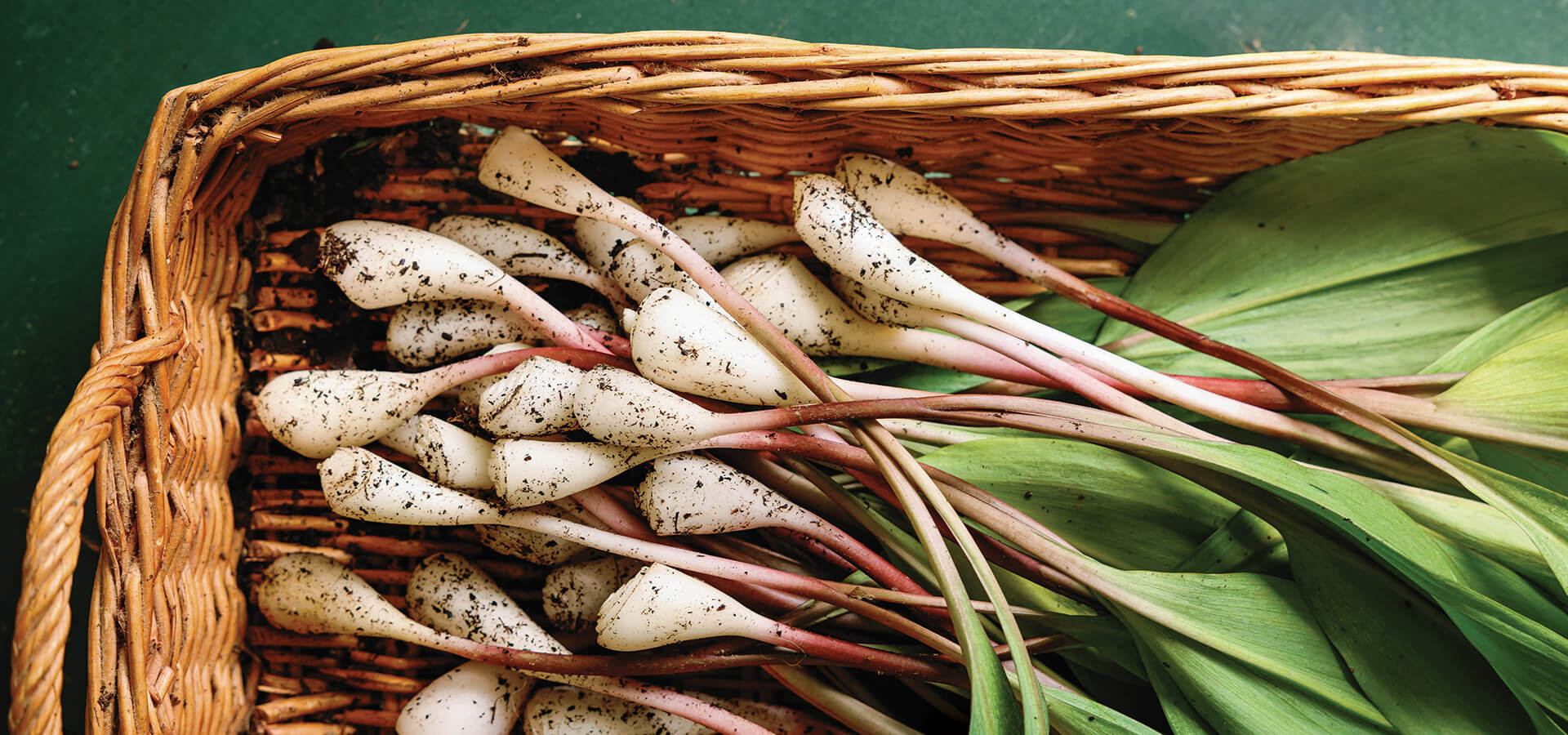
In the western North Carolina mountains, the way people talk about ramps hints at the spirit of Appalachia itself: part folk medicine, part mischief, part elusive, wild mystery. The native allium slips up through last year’s leaf cover in early spring, when the dirt starts to smell alive again but the first Brandywine tomatoes are still a distant dream.
Both my Appalachian grandfather, Clarence Lunsford — one of the many generations of my family who lived and died in Roanoke, Virginia — and Tennessee bacon maker Allan Benton have told me, “Tax day is ramp day.” That phrase is resurrected in my mind each spring.
Both men revered the pungent, garlicky flavor of ramps, which can be as stubborn as the hills themselves, serving as a reminder that winter doesn’t get the last word around here. Clarence would eat ramps layered in ham sandwiches with copious amounts of butter, at least until my grandmother put a stop to that.
Ramps grow in loose, secretive patches in deciduous highland forests, thriving as far north as Canada and as far west as Missouri and Minnesota. But they’re most deeply associated with Appalachia. In the wilds around towns like Boone, Blowing Rock, and Banner Elk, they’ve become an iconic and somewhat infamous symbol of the region’s rugged, resilient spirit.
Ramps can ward off colds just as well as they can fend off kisses.
Their history as a spring tonic reaches back to the Cherokee and other tribes, who foraged them when their leaves brought the first hint of green to the woods. Long before the corner pharmacy was a thing, they used the plant to treat croup and coughs, and pressed its leaves into poultices to soothe the sting of bees and insects. Rich in vitamins and minerals, ramps were believed to strengthen the body after a long winter. They’re just as capable of warding off colds as they are of fending off kisses.
Early Appalachian settlers foraged them, too. They fried them with potatoes and bacon grease — really, anything that might keep through the winter — folded them into cornbread, and stirred them into pots of beans. Ramps were handy flavoring agents, especially revered in places where spices were scarce.
If nothing else, they’re hard to ignore. Fiercely garlicky, almost sweet at the edges, they have a way of announcing themselves. And they stick around. Their odor clings to clothes, lingers in church pews, and follows children to school. It can take days to fully sweat them out.
Where ramps hung around, the smell of chain oil and work boots, smokehouses and hard winters lingered, too. Over time, that tenacious scent became the butt of jokes and the stuff of neighborhood legends, an olfactory calling card that marked people like Clarence as belonging to the hollers — and, in some circles, as belonging to poverty.
But on that last point, the ramps have had the final say.
The same plant that once got Appalachian kids teased is now the star of spring menus.
They’re still a part of Appalachian folklore and celebrated in small-town festivals like Waynesville’s Ramp Convention in early May. But they’ve also pushed through the margins and landed in top-tier kitchens, their aroma now drifting through dim rooms full of diners well-heeled enough to pay for what mountain families have been pulling from the dirt for generations. The same plant that once got Appalachian kids teased is now the star of spring menus, a wild thing plated on designer pottery and paired with fine wines.
Chefs like William Dissen at The Market Place in Asheville still pickle them. Others grill the bulbs, pressing those leaves into a beautiful char that pairs perfectly with a good steak. They’re perhaps even better with mountain trout and a clutch of morel mushrooms, sautéed with fresh thyme and a generous knob of butter. They’re elegant folded into a rich, velvety soup with plenty of cream. Ramps and fat are, and always have been, great friends. Ramps are even a beautiful complement to sweet, rich lobster meat, which is a pairing that surely would have flummoxed my grandfather.
Despite their passport into a fine-dining era, ramps remain rooted in something far more grounded. They’re still profoundly cherished by Appalachians as a symbol of the region’s native foodways. They’re still part of a heritage that was once a punch line and is now, increasingly, food-influencer fodder.
That’s why old-timers like to remind online influencers, who forage for social media clicks as much as for the thrill of the hunt, that there’s a respectful way to gather ramps. That means taking only what a hillside can spare so the same patch will return next spring. That also means gently cutting the plant rather than ripping it out of the ground, leaving the roots to bring more ramps the following year.
Because ramps aren’t just something you eat. They’re something you inherit. A taste of place that lives in the memory of someone like my grandfather Clarence, heading into the woods at first light and coming home with dirt under his nails and a handful of leaves the color of early spring, gone almost as soon as they arrive.
Related: Visit these locations in western North Carolina to buy ramps.