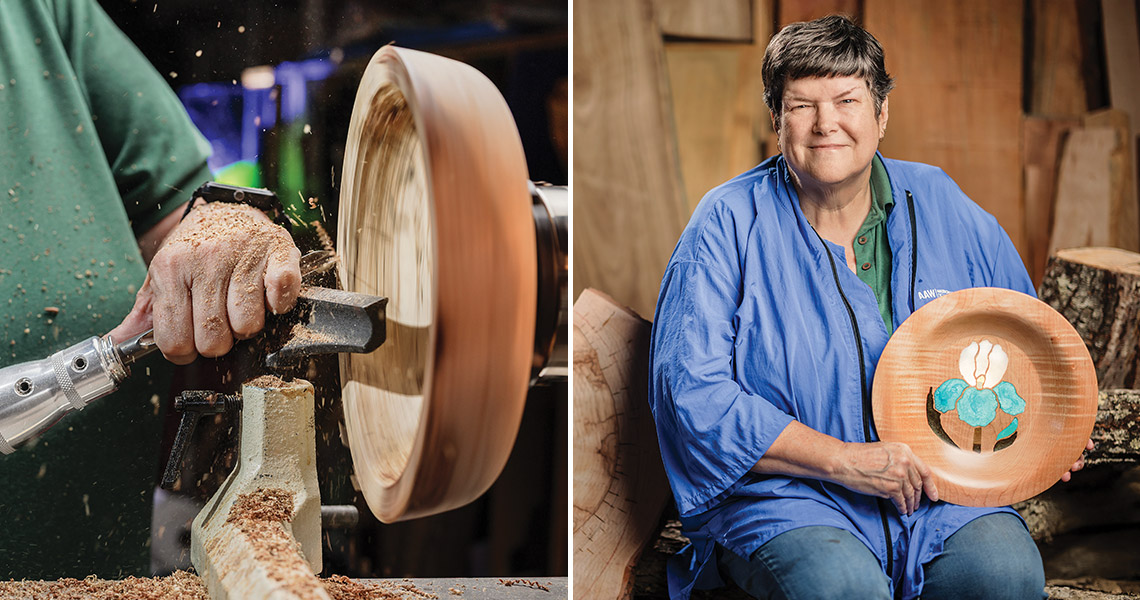
Louise Butler leans into the whirring lathe, coaxing a bowl from a jagged piece of wood whose future only she can see. Curled shavings of maple cling to her cotton polo shirt like the memories in her mind.
The things she crafts are born of skills handed down over four generations. Butler learned to work wood by watching her parents and grandfather. Now 65, with her two brothers gone and no children, she feels the weight of being the last of her family to practice the craft: The quiet ability to find the tune in a piece of maple or walnut may fade with her unless she passes it on.
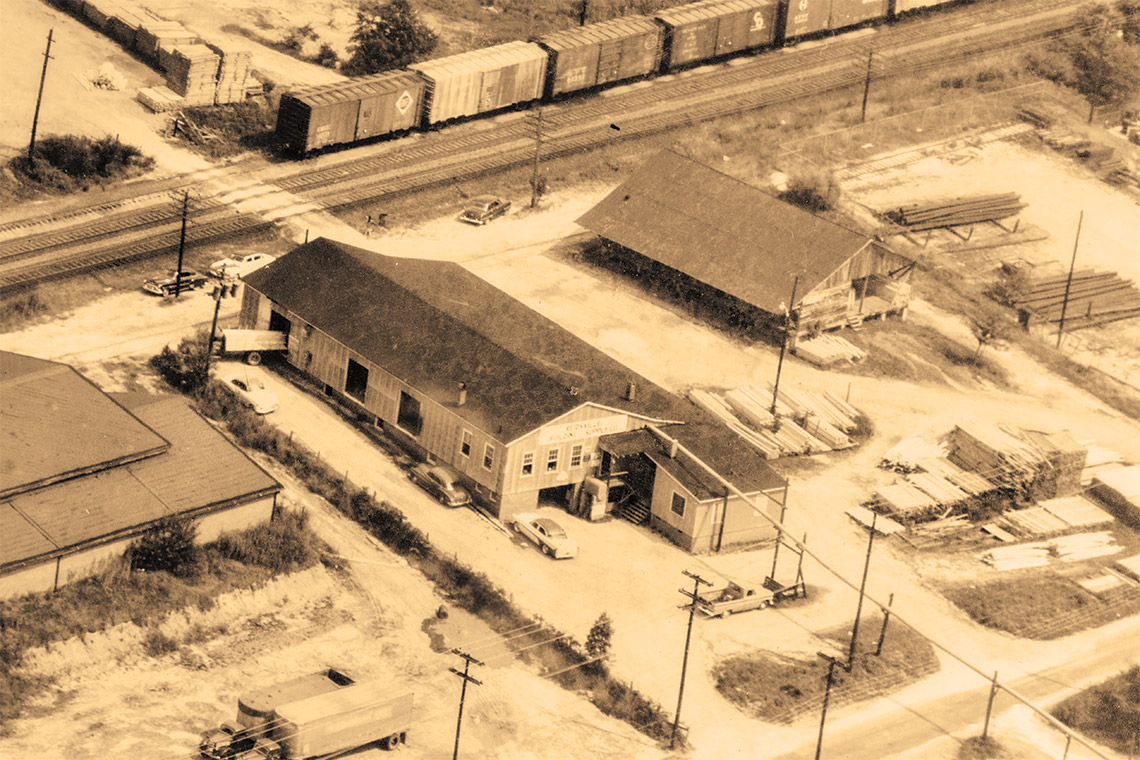
Butler grew up accompanying her father to the building supply company where he and her grandfather worked. Photography courtesy of Louise Butler, Photographed by Jerry Wolford & Scott Muthersbaugh
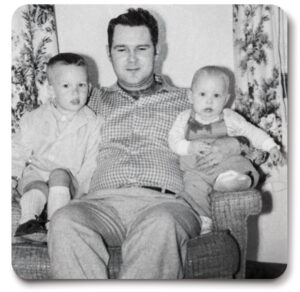
Butler with her father David. Photography courtesy of Louise Butler, Photographed by Jerry Wolford & Scott Muthersbaugh
Determined not to let that happen, she’s carving out a place to teach near downtown Reidsville — in a shop just across the railroad tracks from the building supply company where her father, grandfather, and great-grandfather worked. In 2021, she bought a former garage with three bay doors where, occasionally, someone still pulls up looking for an oil change. For more than a decade, she’s collected tools and machinery, and she hopes to open for classes in early 2026.
“Teaching is in my soul. It’s the thing that keeps me going,” Butler says, perched on a chair in the cluttered office of her shop. “I like for somebody to bring me a piece of wood that they want something done to. But I’d rather take it and say, ‘Why don’t you come help me with it?’”
• • •
Some Saturdays when Butler was a little girl, her father would drive her to the building supply company in downtown Reidsville. There, she and her brothers might get a Sun Drop from the basement drink machine. They’d listen to the whine of equipment as it planed the lumber unloaded from the freight trains that rumbled through town morning and night. She recalls stories of her great-grandfather, who was said to be able to calculate board feet of lumber coming off a train car just by looking at it.
Her father and grandfather died less than two months apart in 1974, when Butler had just turned 14. But those Saturday mornings — the smell of wood that made her “spine tingle,” the piles of sawdust, the clacking of the Norfolk Southern line — ingrained something deep within her.
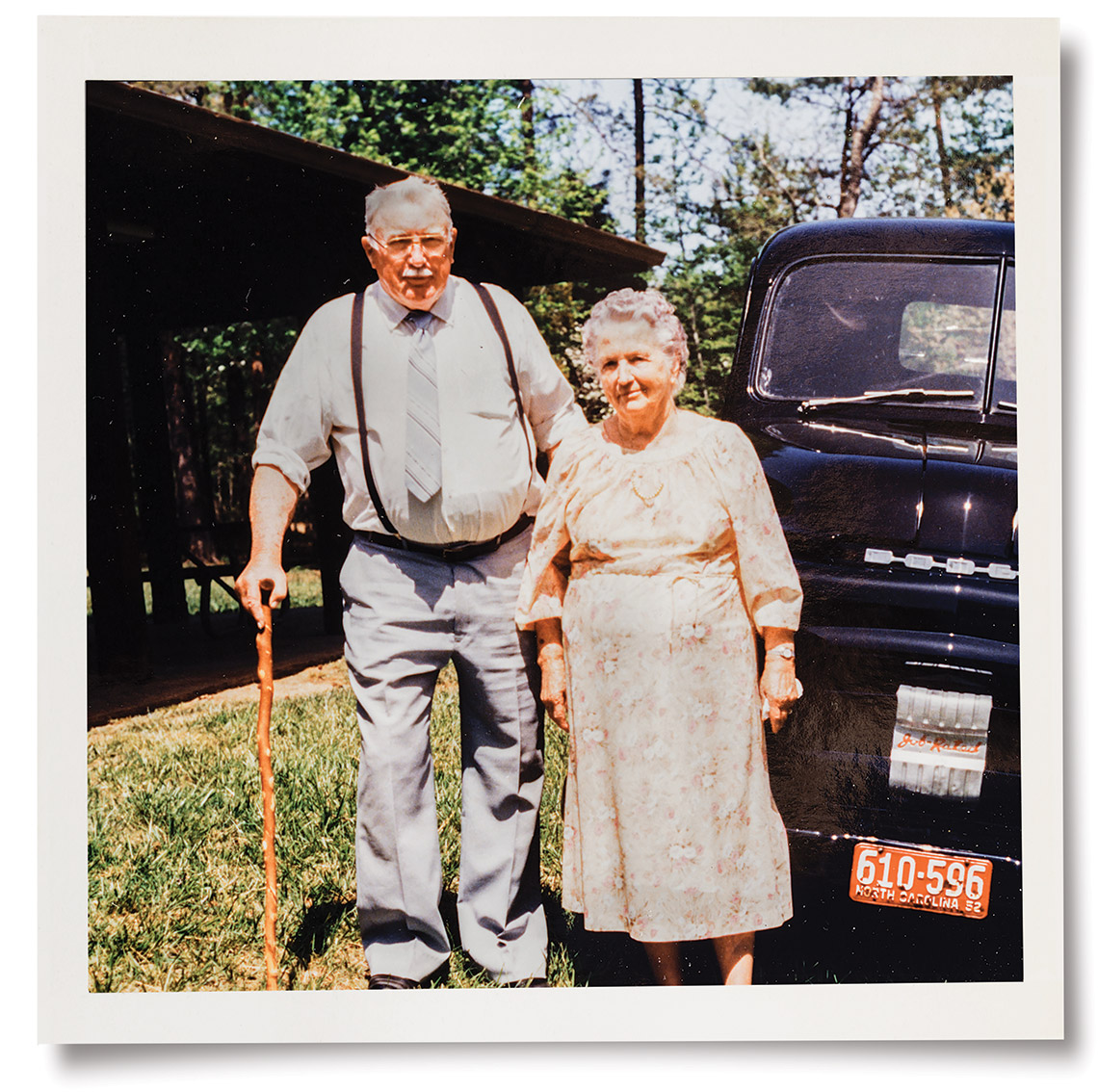
Butler’s grandparents Photography courtesy of Louise Butler, Photographed by Jerry Wolford & Scott Muthersbaugh
“When you see the striations in figured maple, you know that only God put that there,” she says. “You won’t know what you’ll find in the wood until you start turning it. That’s when the magic happens.”
She’s held fast to this place, too. Except for her college years in Boone, Butler has spent her entire life in Reidsville, and she’s seen it change as downtown businesses emptied and knitting mills shuttered. But, her devotion as solid as oak, she’s spent her life at the lathe and in the classroom, helping to keep woodworking alive in her hometown.
• • •
After college, Butler returned home to teach math at the local high school. “When I started teaching, I needed a computer stand, and I said, ‘I can take care of that,’” she remembers.
She constructed one of wood, like the bookcases her mother made. When she renovated her first house several years later, she built the cabinets, trim, and door casings herself — all the while thinking of the house her father built, the one where her mother still lives.
Beginning in the 1990s, she taught woodworking at the old Woodcraft store in Greensboro, including a series of classes just for women. “We used to call it ‘sawdust therapy for women,’” she says. “It was a judgment-free zone where these women could come learn to use a hammer without someone telling them they weren’t doing it right.”
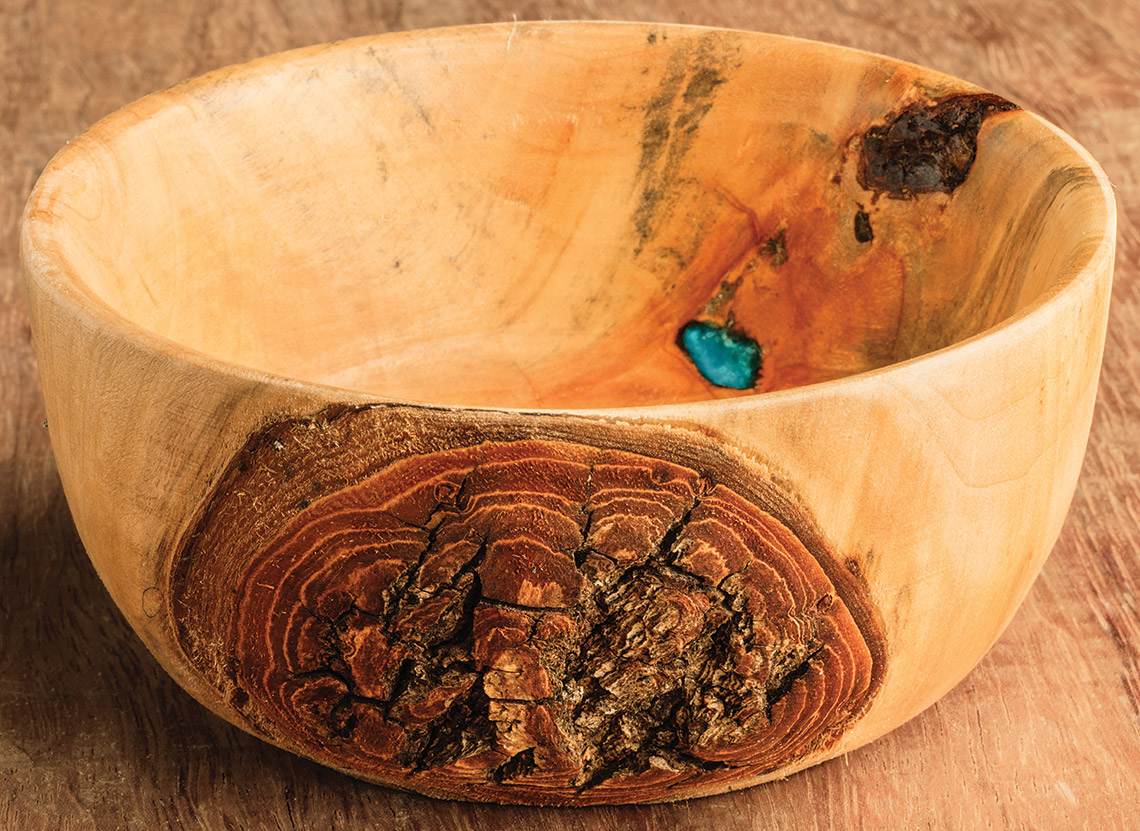
Butler’s works include pens and bowls, like this one crafted from maple, with natural bark and a turquoise-blue resin in the gaps. photograph by Jerry Wolford & Scott Muthersbaugh
She also taught math at Rockingham Community College for 37 years — holding night classes after her work at the high school. And she watched as graduates from the college’s fine and creative woodworking program fed North Carolina’s voracious furniture industry.
“Those people were being snapped up just as quick as we could get them out the door,” Butler recalls. But enrollment waned as production shuttered or moved overseas, and woodworking became more of a hobbyist’s game than a sought-after skill for pay.
Three years after the college ended its associate degree program in 2010, it opened the Center for Creative Woodworking in downtown Reidsville, with Butler as director. Some of the students who came through were hobbyists; some were homeowners who wanted to turn their own staircase balusters. Still others hoped to turn a career from the sawdust, degree or not. When the center shifted after the pandemic to focus on construction skills, Butler stepped away.
But she remained at the lathe, determined to share her craft in one way or another.
In her office, she points to a smoothed-out bowl that’s coated in a thin layer of sawdust. “This is a piece of maple from a tree that was in this woman’s yard her entire life. She had her swing on it. I was able to give her something back from that tree.”
She’s made urns for people to bury their loved ones — “We all have to go back to the earth somehow,” she says — and pens for writers to sign their published books.
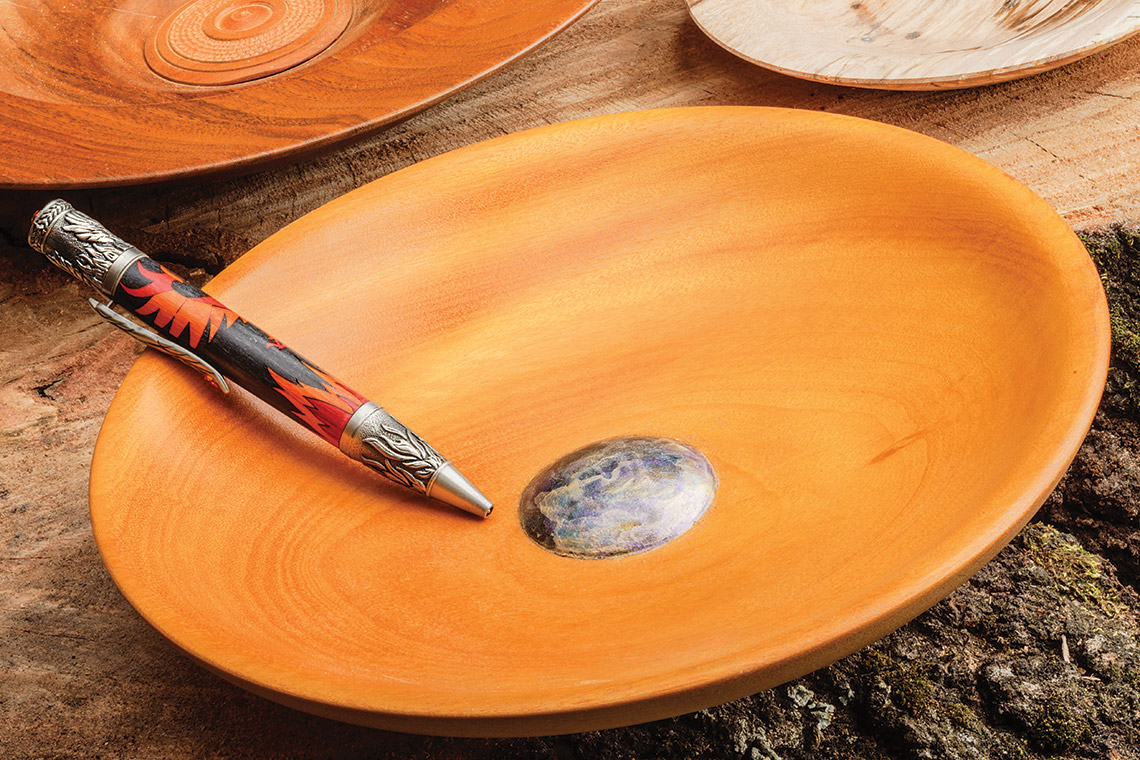
Butler’s work photograph by Jerry Wolford & Scott Muthersbaugh
The granddaughter of a tobacco farmer, Butler was especially moved when she heard a retired Army officer turned author talk about “priming” tobacco as a child. “You can tell someone grew up around tobacco if they say ‘priming’ tobacco as opposed to ‘picking,’” she says. Then she grins like someone who does not suffer the unserious and adds, “He had me then.”
She made him a pen from an old oak tobacco stick. “The man had tears in his eyes,” she recalls of giving it to him. “That’s what happens when you give something to a person that really means something to them.”
Imagine, she says, that you have a piece of wood from a tree that your grandfather felled 65 years ago. “That wood will not be lost but is living on in pens, platters, and boxes. I love wood with a story.”
• • •
When the kudzu dies back in the fall, Butler can see her family’s old building supply company across the tracks from her shop. It’s here that she prepares to teach what the college no longer does — what she refuses to let end.
“I admire jazz musicians who can stand up and riff. If I don’t have music in front of me, I can’t play,” Butler says over the racket of a noontime freight train. “But I can do that with a piece of wood. I’m just looking at it from the outside, and I can find the tune. Mm-hmm.”