Beside the campus road lined with willow oaks, in an open-air practice space that’s the pride of Haywood County, a 28-year-old woman is looking for what she calls a “good chop.”
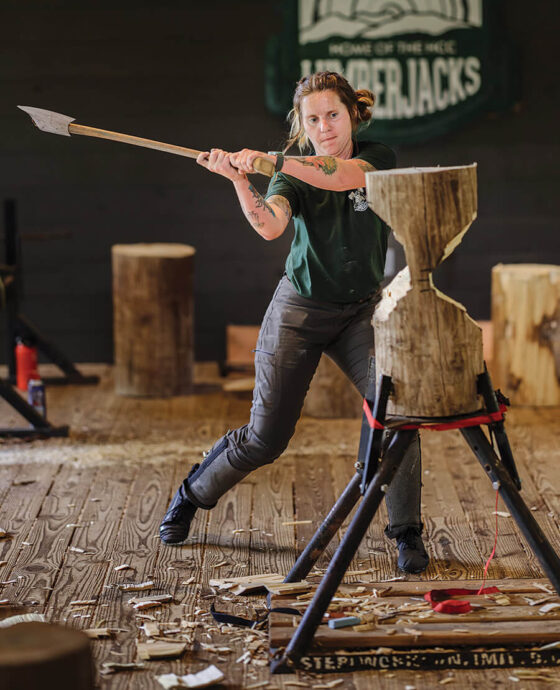
As she works her axe, Dana Charles looks like a baseball player at home plate. She rolls her hips into her swing, rotating her wrists and using her leg strength to get enough power behind the blade. Wood slivers fly off a stout log that’s 10 inches in diameter. As her eyes lock on one spot, each rhythmic stroke of her axe echoes like a miked-up metronome inside the cavernous space:
Thunk.
Thunk.
Thunk.
In minutes, Charles splits the log in two. She drops her axe by her side, finishing yet another workout in the home of the Lumberjacks of Haywood Community College.
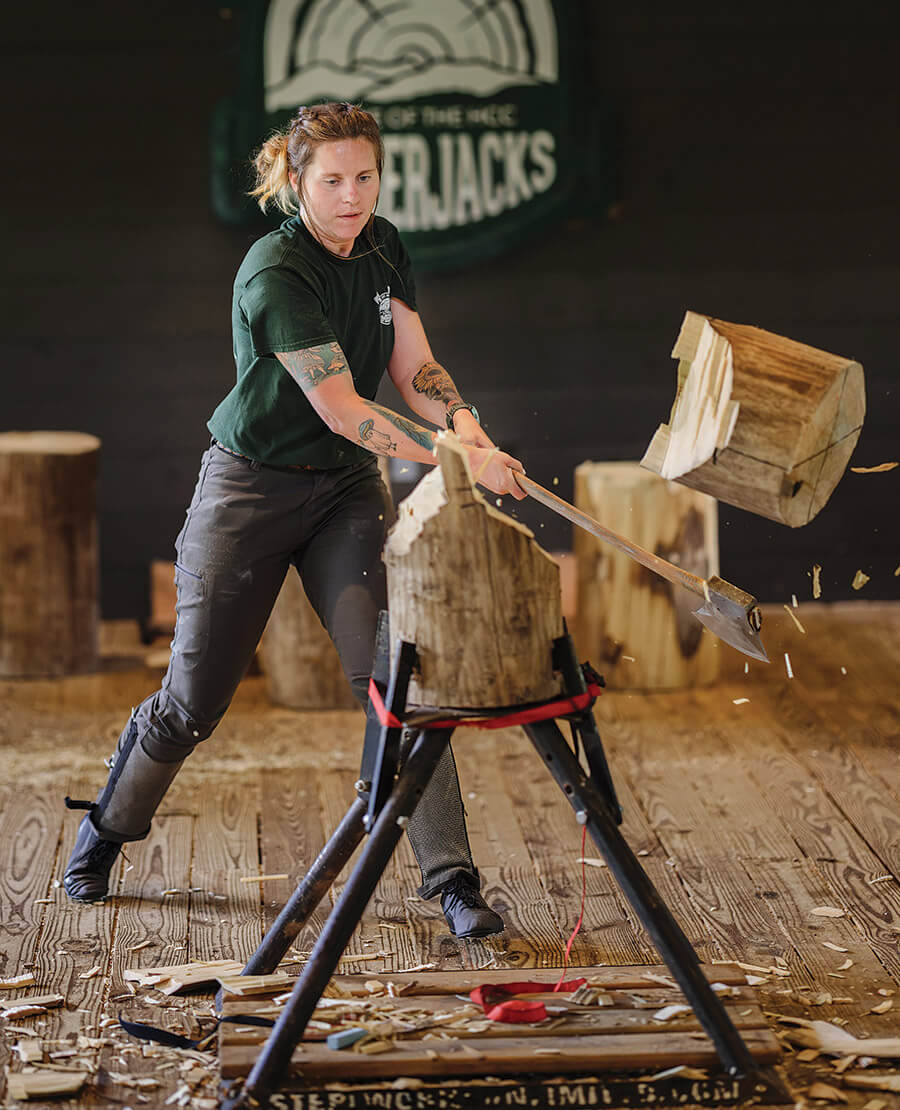
Dana Charles joined the Haywood Community College Lumberjacks two years ago. She’s now a mentor to her teammates, offering encouragement and pointers on form and technique as they master events like the Standing Block Chop. photograph by Scott Muthersbaugh
“It’s the end that always gets you excited,” she says, her face shiny with sweat. “That’s what drives you on. You want to get it done.”
In Clyde, a town of fewer than 1,400 people, Haywood Community College draws students from across the state to earn a two-year degree in forest management technology. As one of three schools in North Carolina offering that program, HCC has quite the reputation. So does its lumberjack team.
In a sport foreign to so many Southerners, the HCC Lumberjacks have excelled. In 2021, the Stihl Timbersports U.S. Rookie Champion came from the college. Today, HCC’s timber sports athletes continue that tradition of excellence.
Charles does. As do her teammates. All with the help of a teacher they call George.
• • •
Dr. George Hahn teaches forest management technology. Several times a week, though, he leaves the classroom and circles a big, wide-open practice space, guiding his students by using athletic aphorisms that only make sense to them.
“Swing through the block.”
“Use the whole saw.”
“That chop is your chop and no one else’s chop.”
Hahn coaches the HCC Lumberjacks and helps prepare them for four competitions every year. They compete against about 10 teams from other colleges and universities in more than a dozen events with names that always need an explanation: Double Buck, Single Buck, Standing Block, and Underhand Chop. Just to name a few.
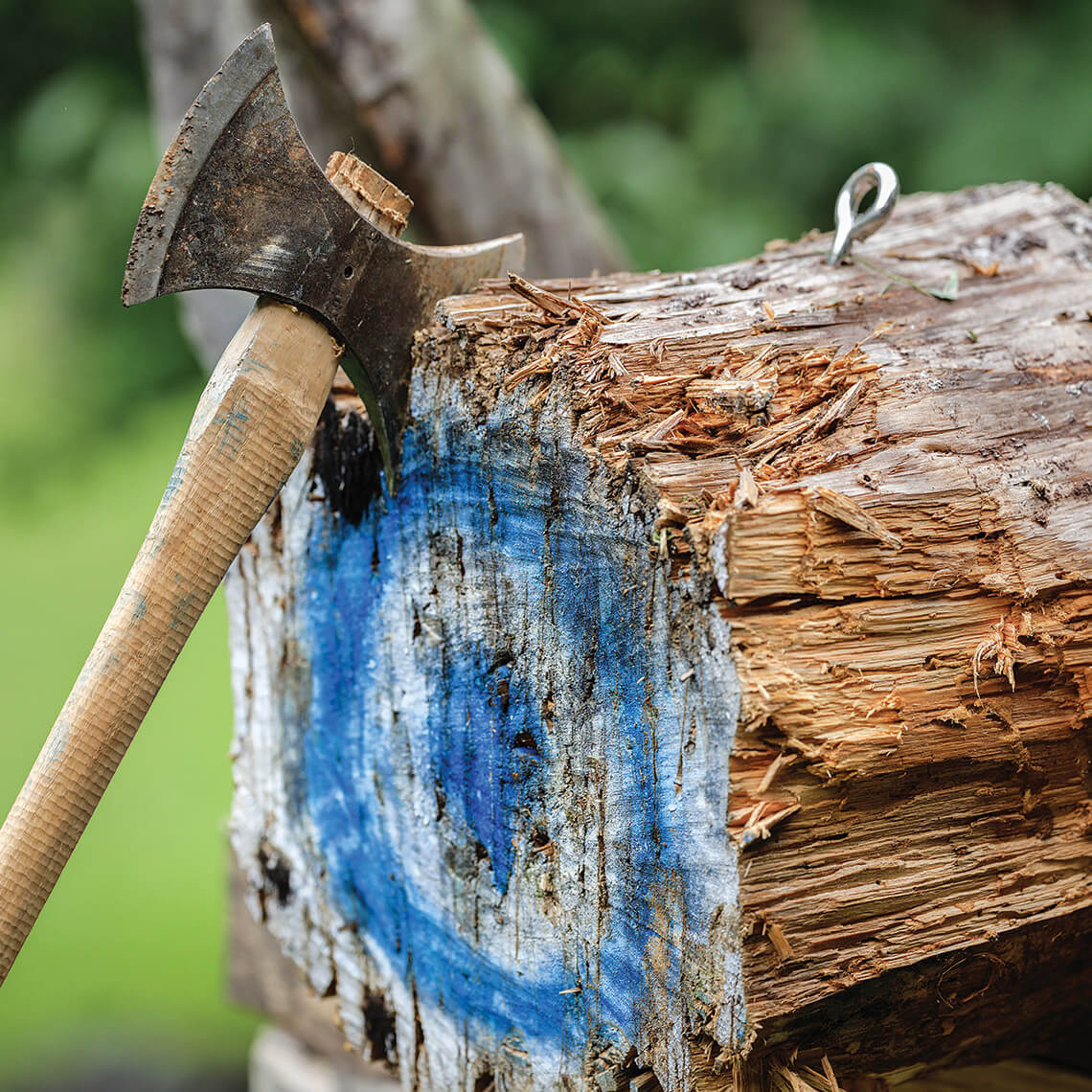
Students practice competitive lumberjack skills, like throwing axes aimed at targets. photograph by Scott Muthersbaugh
But those events need no explanation to members of the HCC Lumberjacks. At practice, they work on those skills. As they do, Hahn teaches them the form and techniques of chopping, sawing, throwing axes and knives, operating a gas-powered chainsaw, and scaling a skinny pole 30 feet high in seconds.
“They don’t know the nuts and bolts of what forestry really is,” Hahn says. “But here, they’re learning new skills and concepts and applying them. Every day is different; every day is a new challenge.”
Grayson Smith likes a new challenge. He joined the team 18 months ago, and he’s done well in competitions statewide — third place in Single Buck (one person with a crosscut saw) and first place in Double Buck (two people with a crosscut saw).
On this particular morning, he gets ready to chop through a 10-inch log secured in a metal stand. It’s an event known as Standing Block Chop. Hahn stands a few feet away. Just over Smith’s shoulder is Charles.
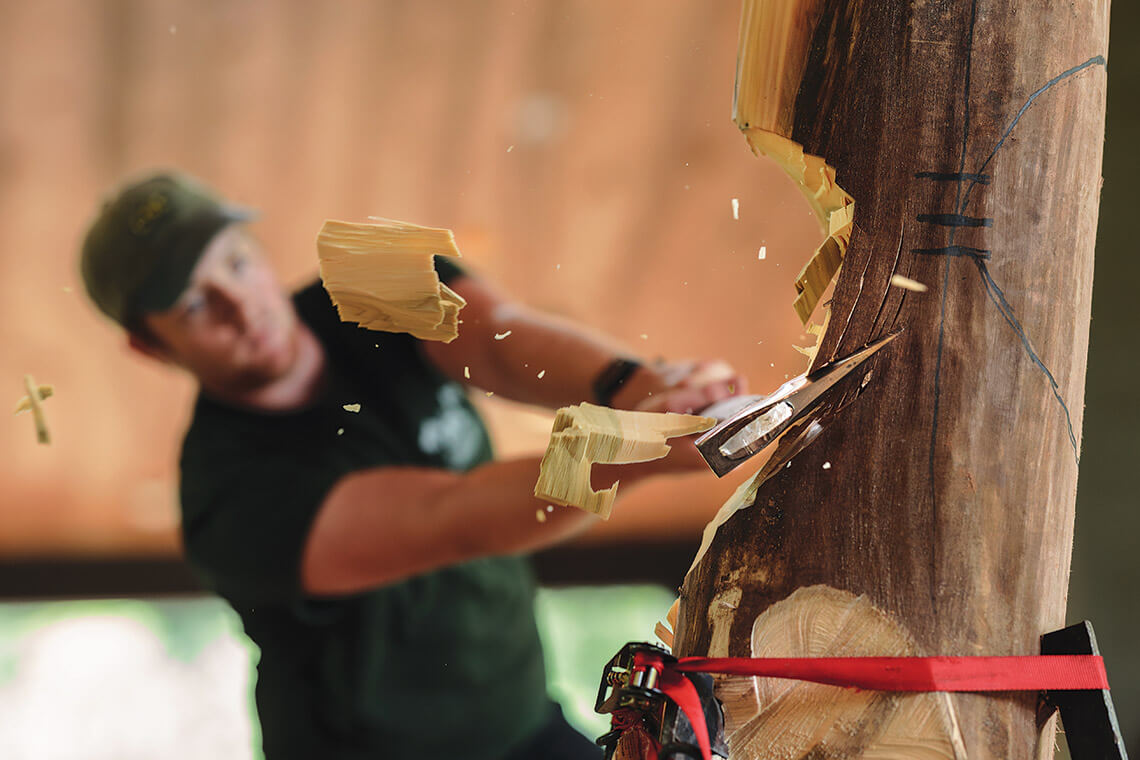
Grayson Smith says he joined the team because of what he’d learn. “It’s the utilitarian part of it,” he says. “It’s real skills that you’re honing.” photograph by Scott Muthersbaugh
“Follow through with your body,” she tells him. “You know what George says: ‘Activate your legs.’ Ever throw a baseball? Same thing. Strong wrists. Arms tight.”
“Remember,” Hahn interjects. “Look at where you’re aiming.”
Smith listens. He takes a few practice swings, letting the head of his axe come an inch or two from where he wants to hit. With his eyes focused on one specific spot on the log, he follows Charles’s advice. He rears back and lets his body do the work.
Thunk.
“There you go,” Charles says, nodding. “Nice hit.”
• • •
While notoriety of the Lumberjacks’ talent grew far beyond Clyde, their practice space on campus left a lot to be desired. Matt Heimburg remembers that when he came to the college 21 years ago, the team’s headquarters was just a shed.
“But that’s generous,” says Heimburg, HCC’s dean of college transfer, natural resources, and professional crafts. “It really was just a shack with a dirt floor and a flimsy tin roof, and it barely protected the students from the elements. It looked like a much smaller version of one of those abandoned barns you may see when you’re driving down the highway.”
John Palmer knew that shed well.
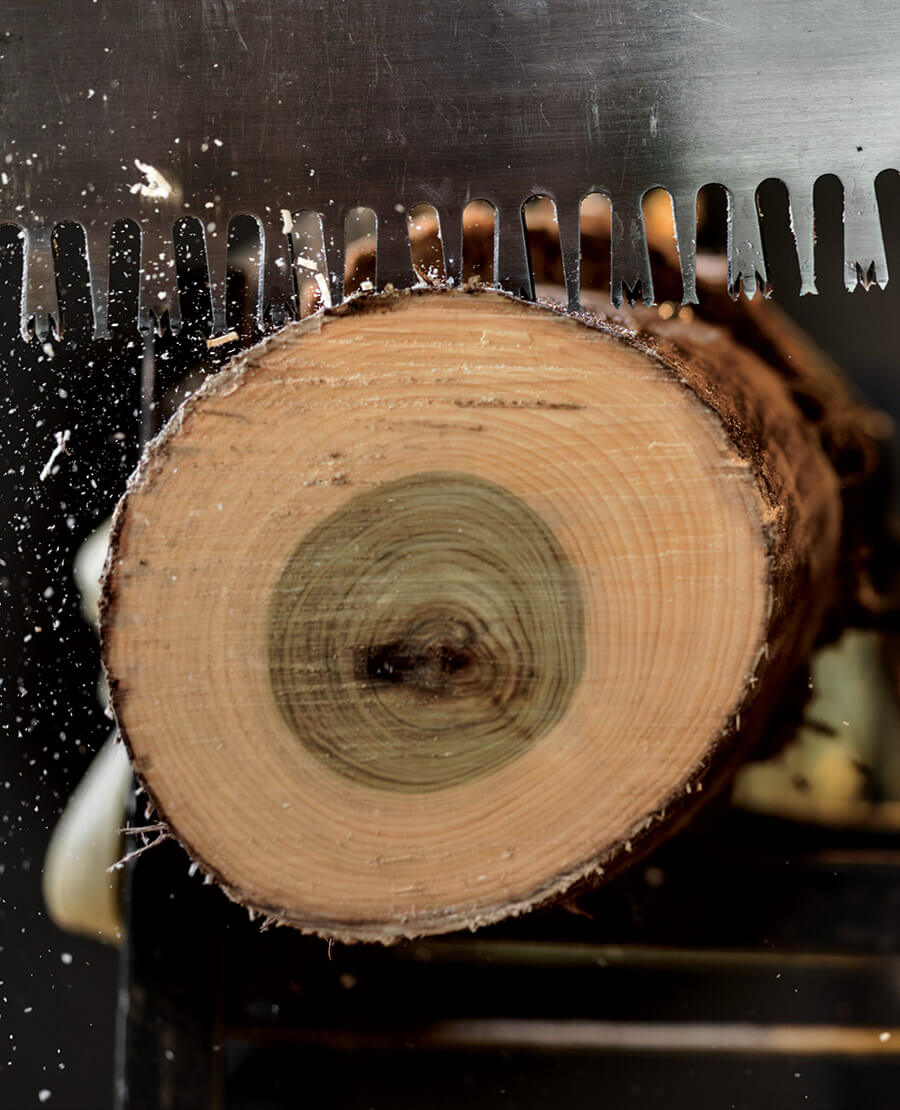
Students train to practice events like the Double Buck, in which two people use a crosscut saw to cut through a log as fast as possible. photograph by Scott Muthersbaugh
In 1977, he came to HCC to become the director of the school’s campus arboretum and forestry professor. He planted the 27 willow oaks lining the main road into campus and began teaching classes in botany and forestry management, among others. In 1990, he founded what back then was known as the woodsmen’s team.
At their first competition in Maryland, the only piece of equipment HCC students brought with them was a hatchet. They borrowed everything else from other teams. Five years later, the HCC Lumberjacks won the Mid-Atlantic Woodsmen’s Meet.
“Haywood has always attracted such good forestry students, but they come with no experience in timber sports,” says Palmer, who retired from HCC in 2008. “So you teach them, show them how to do it, and have old students teaching new students. We all do it together.”
And they did it together in a tin-roofed shed with a dirt floor.
Today, the shed is no more.
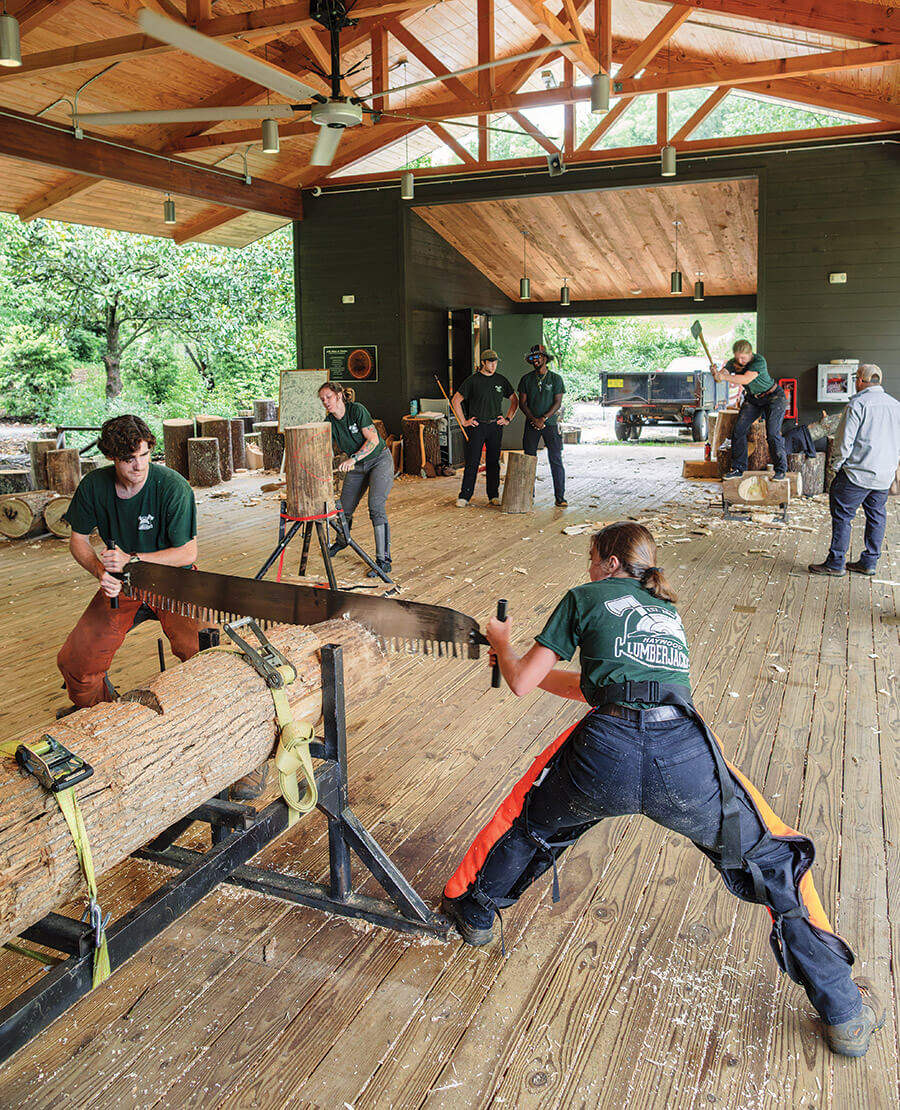
At least twice a week, the Lumberjacks gather in the 2,000-square-foot J.M. West Jr. Center. photograph by Scott Muthersbaugh
In April 2020, HCC unveiled a space as big as half a basketball gym and as cozy as a barn. It covers 2,000 square feet underneath a two-story ceiling of wooden beams, with a storage room full of safety and practice equipment. The team’s new headquarters happened because of a fundraising campaign the HCC Foundation began in 2017. In less than three years, it brought in $230,000.
Today, the J.M. West Jr. Center bears the name of its biggest benefactor: West, a Haywood County native, worked 42 years for various trucking companies. After his death in 2017 at age 76, his trust awarded the HCC Foundation $150,000. That gift made the team’s long-standing need no longer a wish.
“We had an old shed,” Palmer says. “But my goodness, that new building is like a cathedral.”
• • •
In and around the team’s cathedral of wood and steel, Hahn’s athletes hone skills that have become a part of them.
They all want to earn a paycheck under a wide-open sky, and timber sports will help support their career. Yet they also see the intangible benefits of wielding an axe or scrambling up a 30-foot pole of yellow poplar. It feeds their spirit, gives them confidence, builds relationships, and shows them that no challenge they face is ever insurmountable.
“It’s that self-actualization,” Heimburg says. “They’re finding out what they’re capable of, and they’re realizing it’s more than what they ever expected of themselves. And when those moments happen in education, that’s a great thing.”

Team member Adrian Houston practices the Axe Throw. photograph by Scott Muthersbaugh
Unlike his four older sisters, Smith didn’t even want to go to college. After graduating from high school, he spent a season working at Beech Mountain Ski Resort and two years working full-time as a program coordinator at a camp in Brevard.
In spring 2023, though, he visited HCC. He was curious about finding a job in nature. In December, he’ll graduate with an associate degree in forest management technology, and he plans to transfer to NC State to earn a bachelor’s in forest management. He wants to become a forestry consultant.
Then there’s Charles.
Six years ago, she moved to Waynesville from Ormond Beach, Florida, to live with her dad. He was a directional driller, and growing up, Charles often worked alongside him. When she came to Waynesville, she joined him once again on a job in South Carolina.
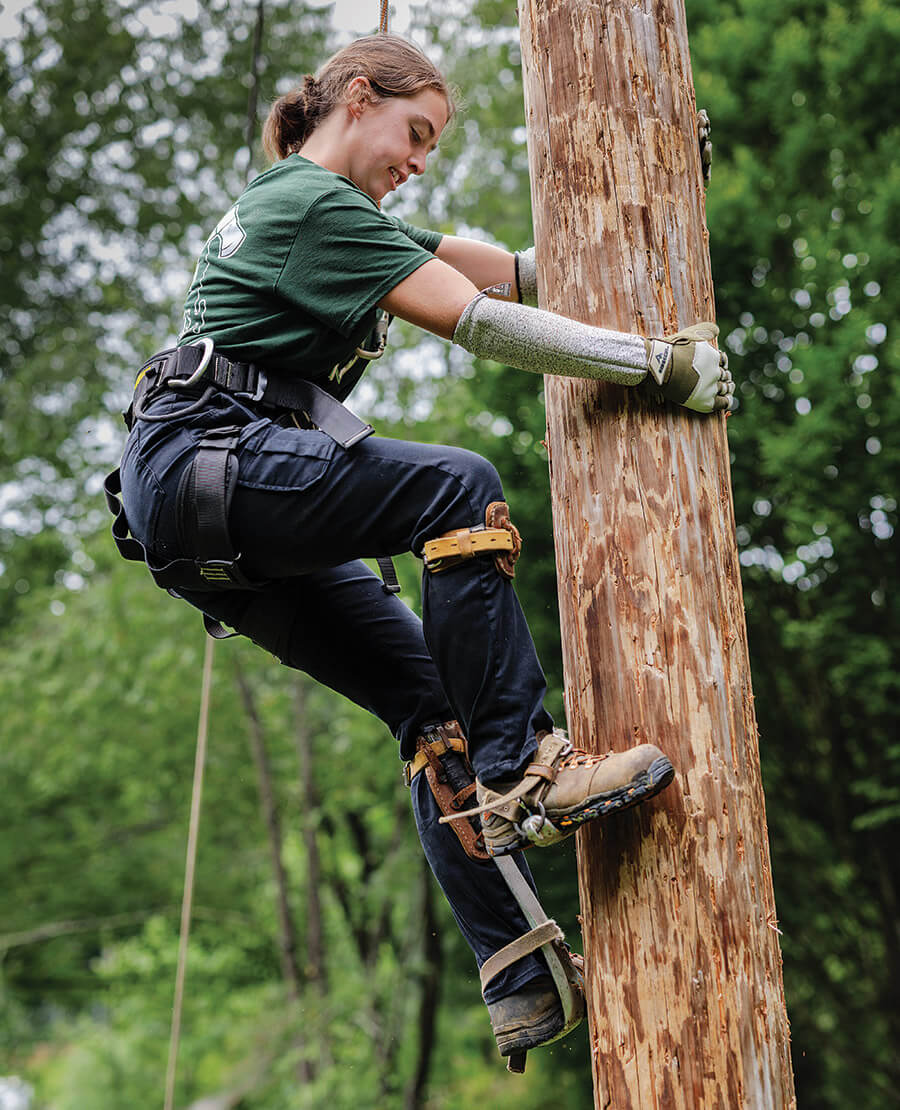
Abbie Almstead works on the Pole Climb. Almstead can scale a 30-foot pole in less than 12 seconds, earning her first place in competitions and the nickname Princess Courageous. photograph by Scott Muthersbaugh
Every day on their way to work, they’d pass HCC, and her dad reminded his daughter of what he wanted her to do: continue her education. This could be the place to do it.
“That’s Haywood,” he’d say, pointing. “That’s the college right there.”
Two years ago, Charles heeded her dad’s advice. She enrolled and joined the school’s lumberjack team. Today, she’s a mentor to her teammates and competes at least once a month in timber sports competitions from North Carolina to Pennsylvania. She’s won prizes, money, and respect, and made friends with competitors from as far away as Canada.
At HCC, she’s completed her high school diploma. Next May, she’ll graduate with associate d
print it