Neal Smith pulls into the parking lot at the end of Henderson Drive in Atlantic Beach, 10 miles east of his home in Salter Path. He turns the dial to switch off his headlights, plunging the two-door Chevrolet into darkness, and eases the pickup to the dune line. The dashboard lights cast a glow across the lines of his face as he shifts into four-wheel drive and climbs the narrow path onto the beach.
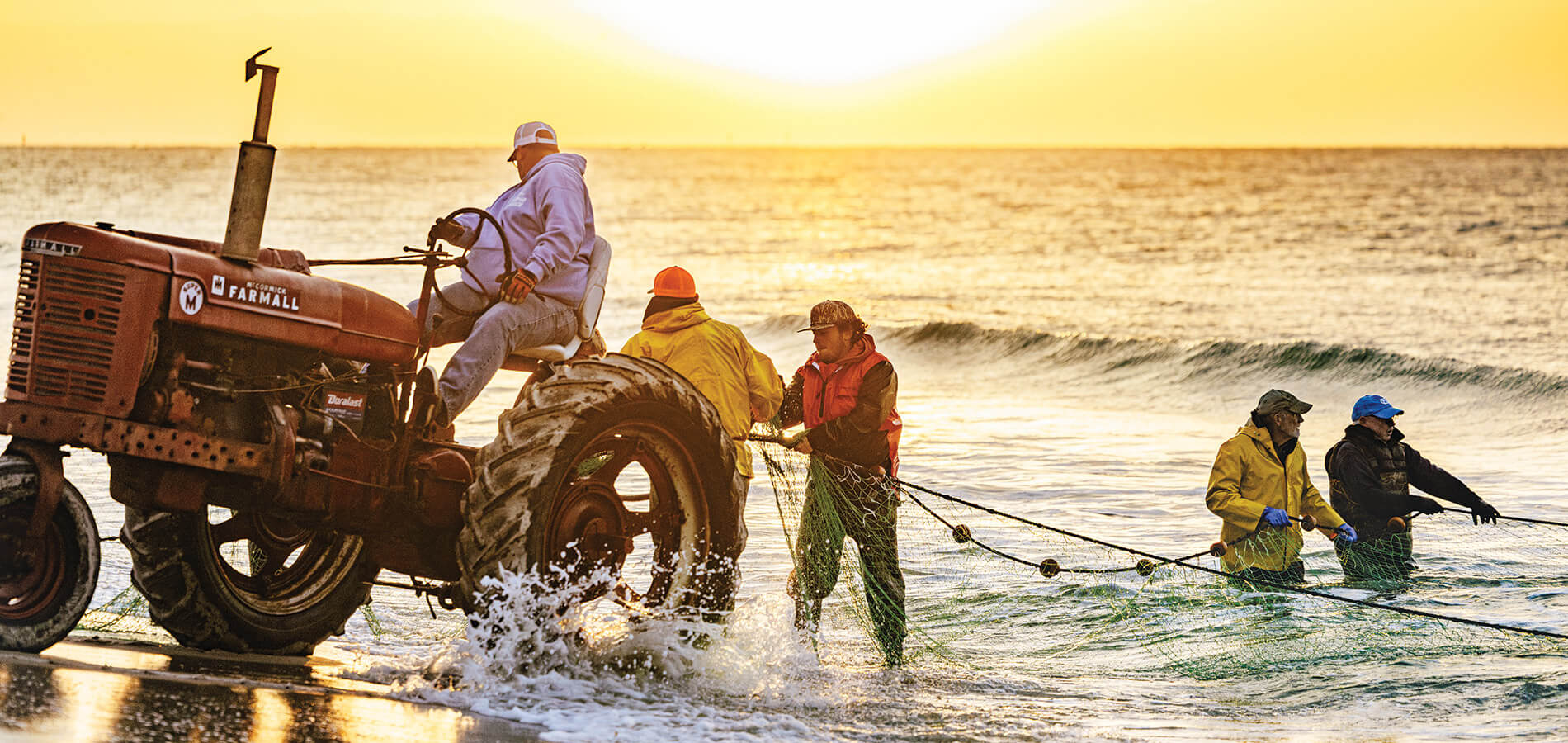
It’s mid-November, just ahead of a full moon. A cold northeast wind blanketed the coast the day before, bringing with it the first chill of the season. As the night sky fades to deep indigo, Smith, one of the oldest members of the Salter Path mullet fishing crew, scans the beach to find the silhouette of an old McCormick Farmall tractor hitched to a wooden dory boat perched at the high tide line.
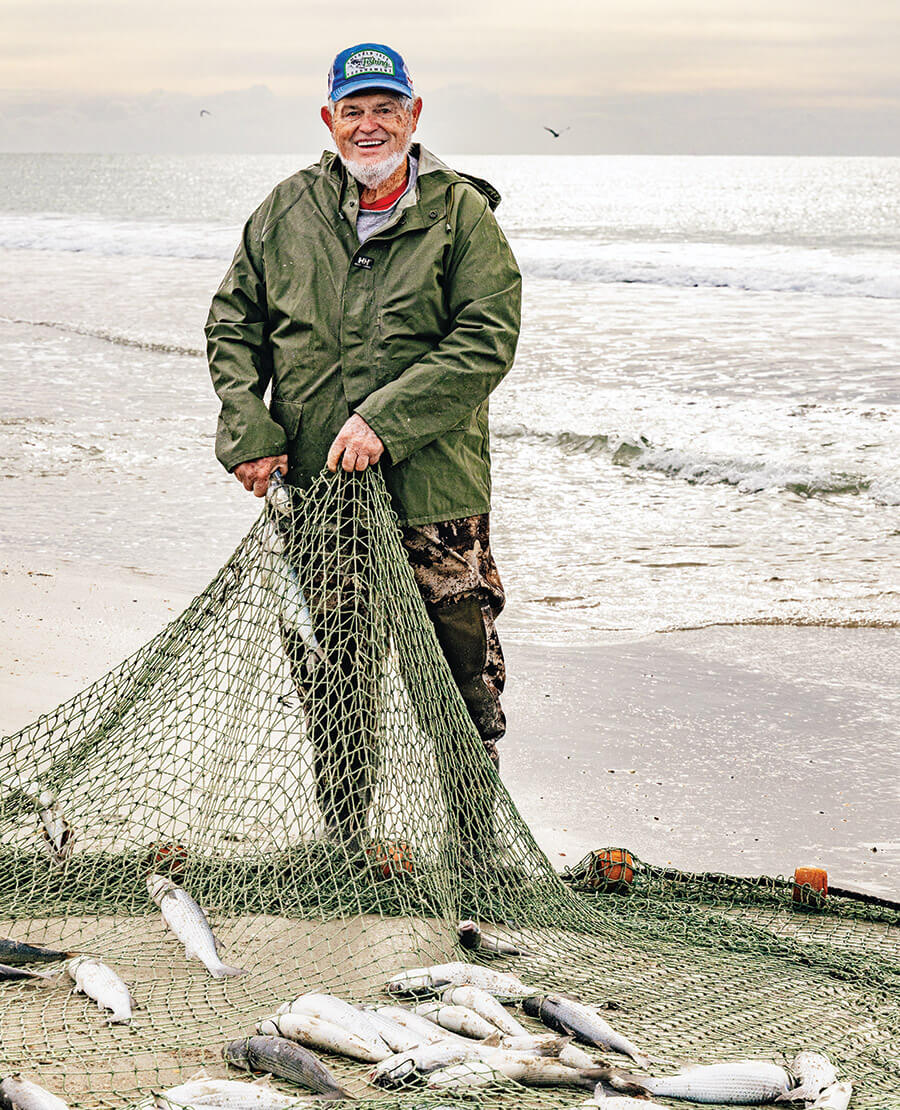
Neal Smith collects jumping mullet from the net following a successful haul. After attending East Carolina University, he returned home to become a commercial fisherman and work the same beach his father and grandfather fished. photograph by Baxter Miller
He pulls up alongside the tractor and idles parallel to the beach, facing Cape Lookout. Soon enough, schools of mullet with bellies full of roe will run past the rock jetty that protects Fort Macon, heading west along the beach before turning offshore to spawn. The wind has laid out this morning, and as the sun climbs over the shelf of clouds weighing down the horizon, Smith scans his eyes across the calm Atlantic, his gaze broken by a low-flying squadron of pelicans.
The flip phone in his pocket rings, and he pulls at the end opposite the hinge, prying it open like the tab of a soda can. It’s time to convene with the rest of the crew — perhaps the last beach-based seine net fishermen using tractors on the East Coast. He drives a little way up the beach and joins a cluster of F-150s and Silverados, where another Farmall sits.
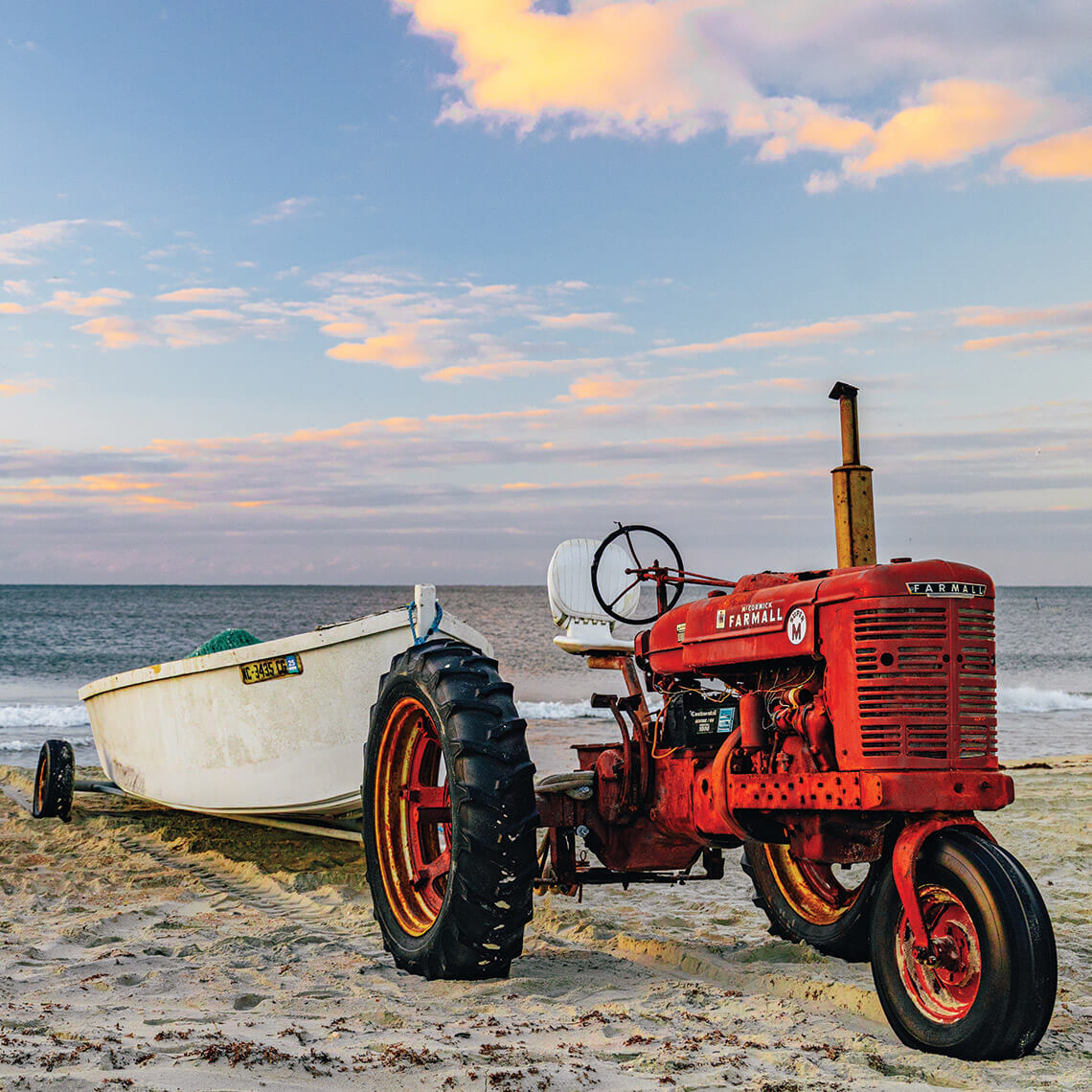
Aging Farmall tractors and wooden boats are maintained for the annual seine net harvest. photograph by Baxter Miller
About a dozen men mill about, most with the last names Frost, Guthrie, Willis, Lewis, Salter, Mason, or Smith. Deep, full-bellied laughs punctuate the quiet morning as the men trade good-natured jabs. Along this stretch of beach, the air heavy with the smell of salt and algae, a sense of celebration mingles with mourning for the future, for an unknown time when this dying tradition will exist only in their hearts.
But for today, the surest sign of fall in Carteret County is alive and well. As it has for more than a century, the sacred ritual of cotton nets and wooden boats, of tractors and fish scales, has begun once again.
The men and women who have called Salter Path home for the past 125 years are connected to place, time, and each other by jumping mullet. Officially named striped mullet, they are known for their acrobatic displays, leaping as high as three feet out of the water. One of the Atlantic’s great schooling species, this pop-eyed, oily fish is often considered to have fueled the state’s first commercial fishery.
At the turn of the 20th century, Salter Path was little more than a strip of barren sand in the middle of Bogue Banks. After the storm of 1899, it was among the places where residents of Diamond City on Shackleford Banks sought safer ground, forging a life similar to the one they’d left behind. They traded whaling for mulleting, taking advantage of the thousands of fish that migrate out of the estuaries every fall to spawn.
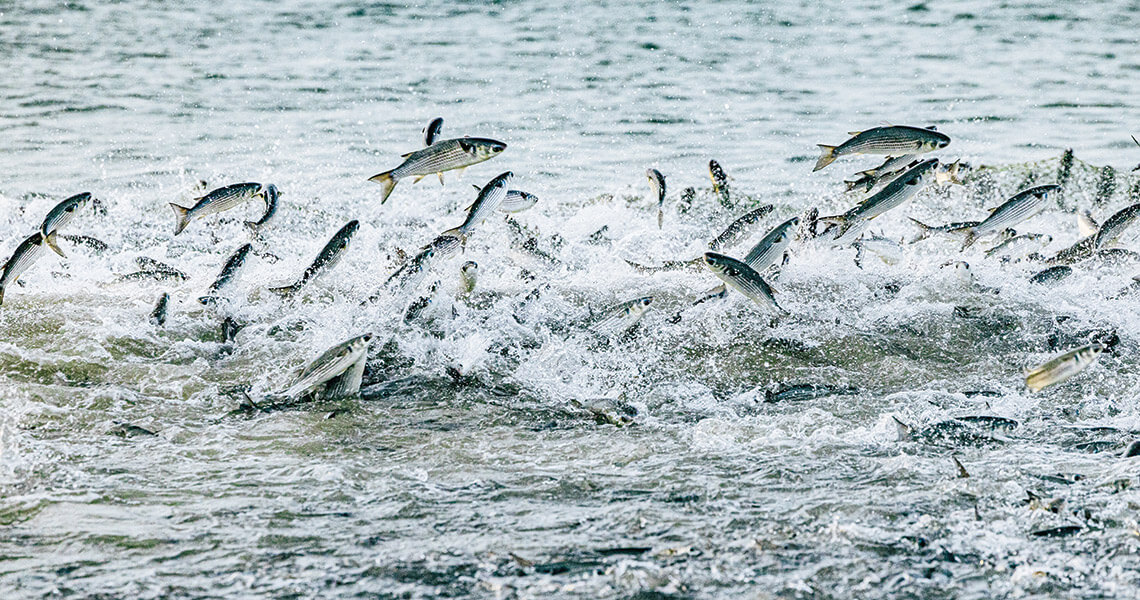
A school of striped mullet, corralled by the fishermen’s net, jumps into the air — an instinct that isn’t fully understood. Theories include that jumping improves oxygen intake, serves as a form of communication, helps avoid predators, or, during spawning season, aids in breaking egg sacs. photograph by Baxter Miller
Using a seine net — a wall of net used to encircle a school of fish — men would harvest thousands of pounds of mullet just beyond the surf. “My father and grandfather did this,” Smith says, “but back then, there weren’t any tractors. They used oars to row the net around the fish and would pull the net in by hand when the tide was falling. They’d get them in as far as they could, and then the water would ebb out and leave the fish there on the beach for them to pick up.”
With no trucks or roads, fishermen walked cotton sacks of mullet from the beach to a designated place on the sound side, where the fish were packed in wooden barrels of salt and sailed to the mainland. “One of the tote paths went past a house owned by a man with the last name Salter, and that’s how we got the name Salter Path,” says Joey Frost, one of the crew’s captains, whose forefathers worked the same beach that he now works with his son and grandson.
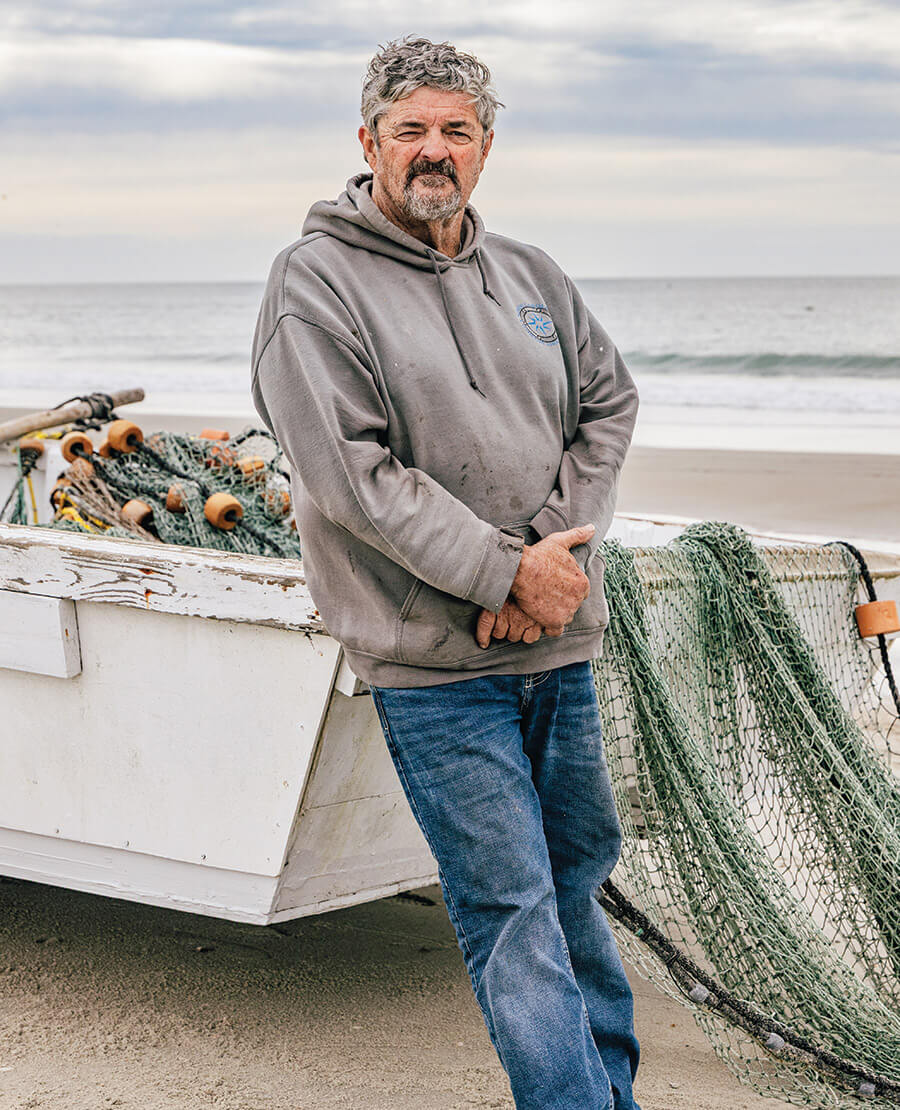
Joey Frost, the crew’s leader, diligently maintains the tractors and cotton nets. His family has been beach seining for seven generations, but he fears he is among the last of a dying breed. photograph by Baxter Miller
Along Bogue Banks, mullet grew from a bartering chip for mainland commodities into a bona fide fishery, prized not only for their flesh but for the females’ bright reddish-orange roe. Morehead City was at the epicenter of the trade and shipped so many barrels of salted mullet inland that the 96-mile stretch of railway between Morehead and Goldsboro was called the Mullet Line. At its height, jumping mullet supported at least eight crews that dispersed across Bogue Banks every fall, each named for a landmark on the section of the beach they fished: Clam Rock, Red Bird, Tea House.
Identity, income, and community were bound to mullet fishing.
At the cluster of trucks, Smith pulls up and rolls down his window. He’s joined by Chris Lewis, who leans a shoulder onto Smith’s truck cab, and the conversation turns to weather.
The first few weeks of November had been unusually warm, with highs in the 80s. The crew had been anxiously waiting for the water temperature to drop below 65 degrees — the catalyst for the fish to move out of the estuary. “The weather has changed so much in recent years. It is killing us. Fifty years ago, they’d be done fishing come this time of year,” Lewis says.
“When I was growing up, we’d have to bust ice out of the boat in mid-November,” Frost adds.
Smith nods along. “The weather rules here.”
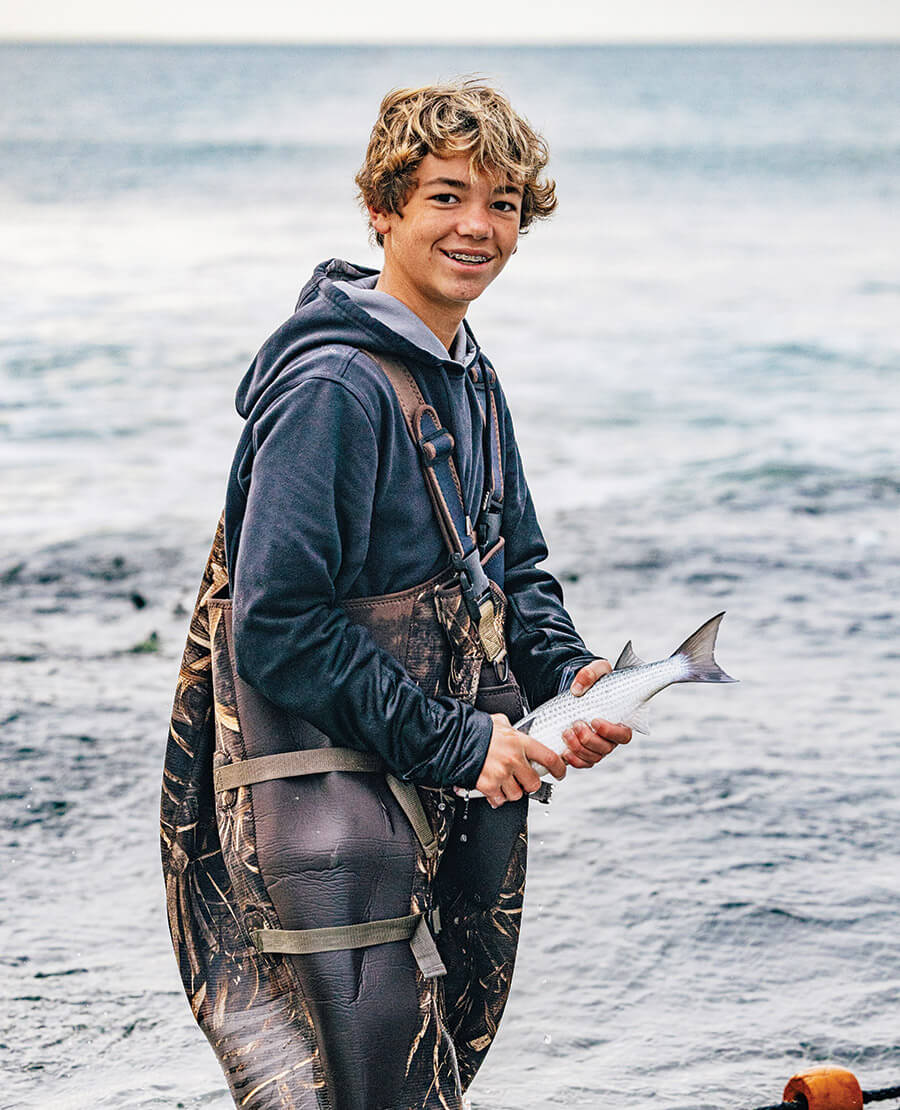
Hunter Fiorini and the other crew members fill truck beds to the brim, their back ends sinking under the weight. photograph by Baxter Miller
After weeks of waiting, conditions are finally in their favor — the water is cooling down, there’s a breeze from the northeast, and the moon is nearly full. But forecasters are predicting an impending front to bring high winds and rough seas. The crew will have to remove their gear after today or risk losing it altogether. Between the weather and regulatory limits on when they are allowed to fish, it will be at least another week before they can try again. By then, it might be too late. “The fish can move in an instant,” Lewis explains.
Smith shifts on the cloth-covered bench seat. There is an innate sense stirring in him. He narrows his gaze to focus on the stop net — the 400-yard stretch of net that runs from a stake in the surf straight out toward the horizon. Spotting a school before they hit the stop net is a skill that can be learned, but it was born into Smith and honed over a lifetime.
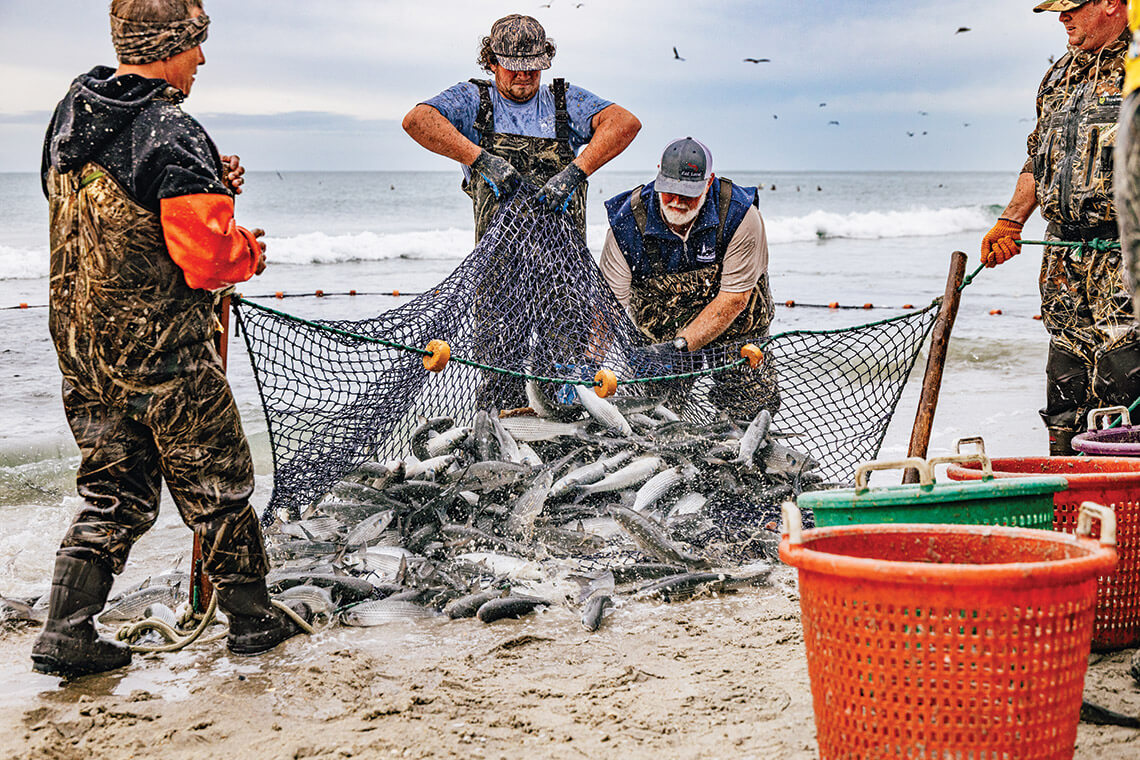
Crew members use a net strung between two staffs to transport mullet, their bellies fat with roe, from the surf onto the beach. photograph by Baxter Miller
As he scans the topwater, a section begins to darken as barely noticeable ripples form across the surface. The ripples begin building, stirring from below, until finally, the water ruptures. A mullet pierces the surface, an age-old instinct, sailing skyward before plunging back down. Dozens more follow, and a frenetic display unfolds.
The men begin shouting and, as if following their ancestors’ calls, disperse in different directions toward their rightful stations.
Just as he first did when he was 14 years old, Lewis hoists himself up onto the decades-old tractor, patinaed with rust that marks the long-held tradition. He settles into the bright white seat. The engine turns over, and a little cloud of smoke sputters from the exhaust stack. Behind him, half a dozen men race to slip into their chest waders and flank the dory as Lewis backs the wooden boat into the surf.
Smith ushers the men toward the breakers as the homemade trailer groans against the incline. The waves lap at the base of the tractor’s wheels as the men launch the boat and guide it by hand as far into the surf as their waders allow. Just as the water threatens to overtake their bibs, several men heave themselves over the gunwale, clambering into the belly of the dory, its aft piled with a seine net.
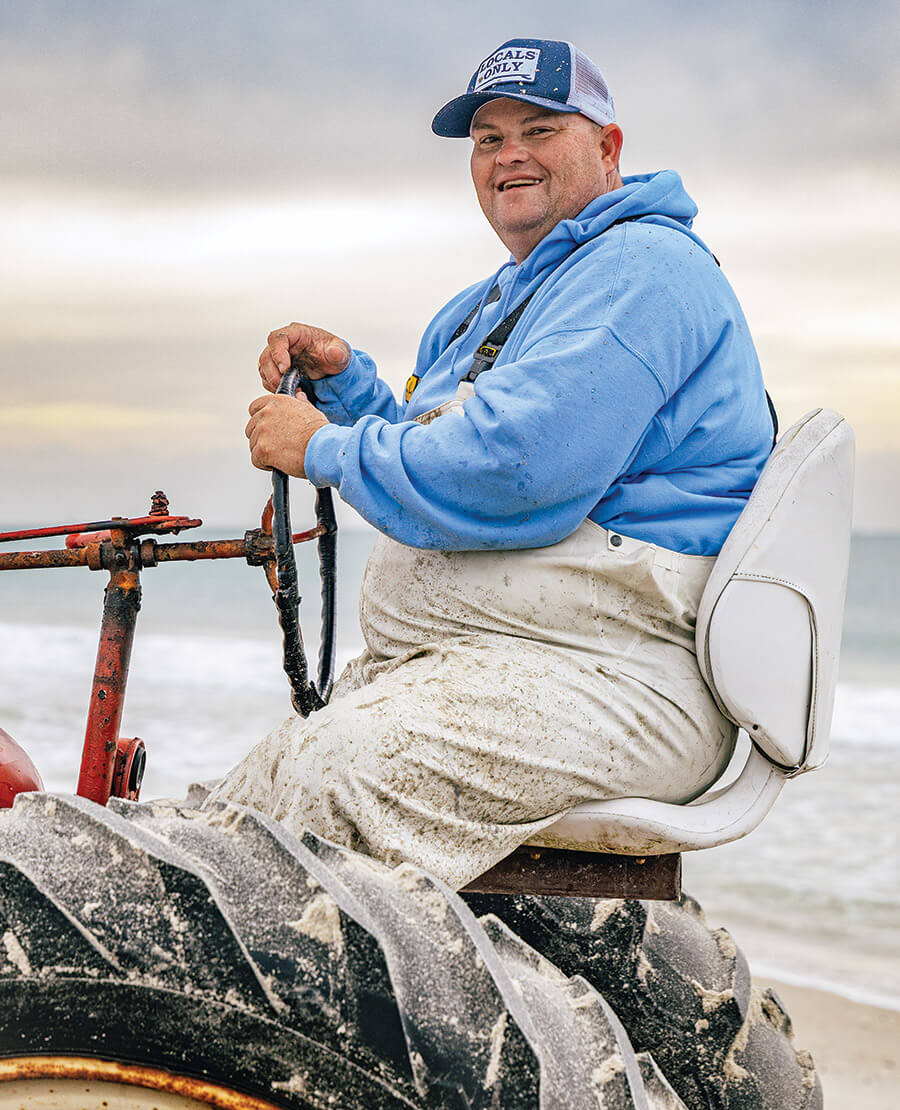
Chris Lewis has been driving tractors for the crew since before he could legally drive a car. The tractors lurch up the beach, straining against tens of thousands of pounds of mullet swimming in the opposite direction. photograph by Baxter Miller
“It’s organized mayhem,” Frost says, grinning. One end of the net is passed from the idling boat to be tied to the back of Lewis’s tractor. Then the boat putters off, net trailing over its side, a wall forming in its wake. Surrounding the school of mullet, the boat heads back toward shore, forming a wide horseshoe that traps the school.
Arriving about 200 yards down the beach from where it was launched, the boat’s job is done. The men hand the other end of the seine net overboard to be tied to a second tractor.
With the horseshoe complete and the mullet impounded, the tractors begin to pull in unison, hauling the net beachward in synchrony. The mullet, too, act as a unit, swimming as one against the net, tugging backward as the tractors lurch forward. Their wheels press hard into the wet sand, pulling ashore 50 feet of net at a time.
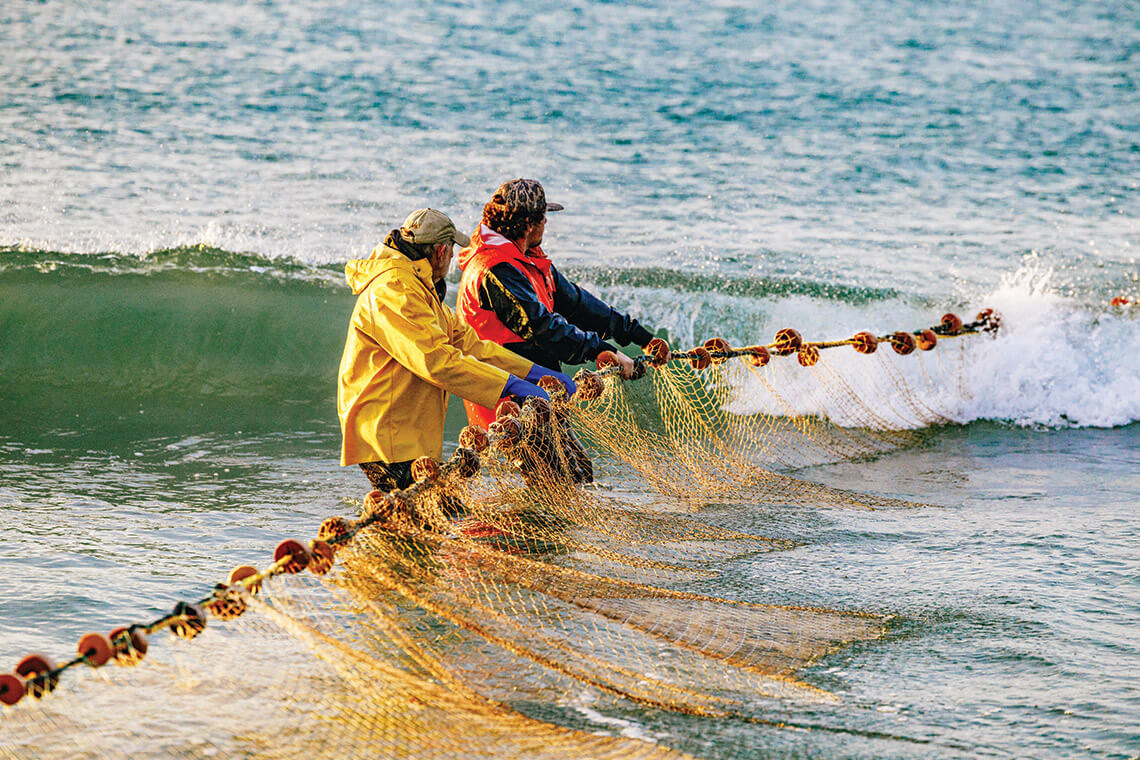
The scrappy crew braves the November surf to haul nets of fighting mullet. photograph by Baxter Miller
The rhythmic humming of the engines blends with the ebb and tide of the sea until the tens of thousands of pounds of fish bring the tractors to a stop. The corralled mullet are thick in the shallow water. Frost’s son, Matthew, and cousin Ritchie grab a stretch of net strung between two staffs and begin sweeping the fish onto the beach. Tails and fins scatter damp sand skyward, the sound of their flapping like a quiet, steady rain on a tin roof.
Kneeling, the crew gathers the fish into baskets, their faces soon covered in a layer of sand and scales. Frost’s grandson Noah, a basket hoisted on his shoulder, is among those hauling mullet to the back of a pickup truck, where he heaves its contents over the edge. The relay continues until the truck is mounded over with mullet bound for the fish house in Beaufort. Truck after truck, each holding 2,500 pounds or more, is filled basket by basket until all 35,000 pounds of mullet have been pulled from the water and cleared from the beach.
“I don’t want to say this, But we’re a dying breed,” Frost, typically animated and fast-spoken, says low and measured. It’s a bleak outlook, but one grounded in experience. They are, after all, the only crew left working Bogue Banks.
“Ain’t no young people in this anymore. Most had to get out because there’s no way to make a living in commercial fishing,” Smith says. “At one time in the ’80s, mullet got as high as $2.75 a pound. Last week, they were 95 cents.” Even with a good haul, the income is barely enough to keep the tractors repaired, the nets mended, and the boat maintained, year to year.
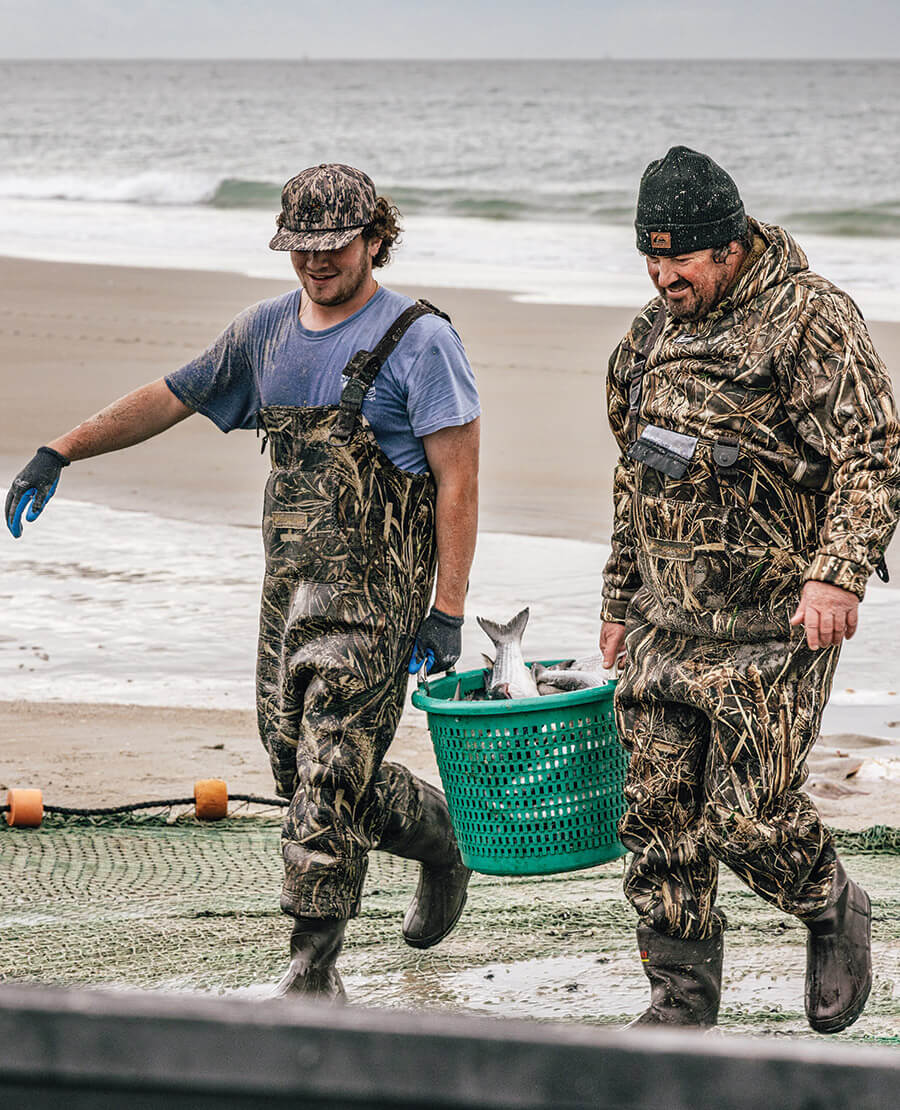
The typical haul from the harvest requires 10 or more trips to the fish house in Beaufort.
Environmental changes compound the economic reality — warming water, coastal development, and pollution have all taken a toll. With fewer allowable fishing days and ever-evolving regulations, beach seine fishing is an endangered tradition. But the Salter Pathers continue to adapt, as they always have. Some years, they never catch a single fish. Yet they persist.
“You’ve got to love this,” Smith says. “We’re not here for the money. We’re here to keep the tradition alive until they finally say we can’t do it anymore. We are going to weather it out till the end.”
As the last truckload of mullet leaves the beach, the occasional fish tossing itself from the back, a mix of celebration, satisfaction, and melancholy settles along the shoreline. There is a sense of deep gratitude for the gift of being born into a tradition that has shaped a community’s identity for more than a century.
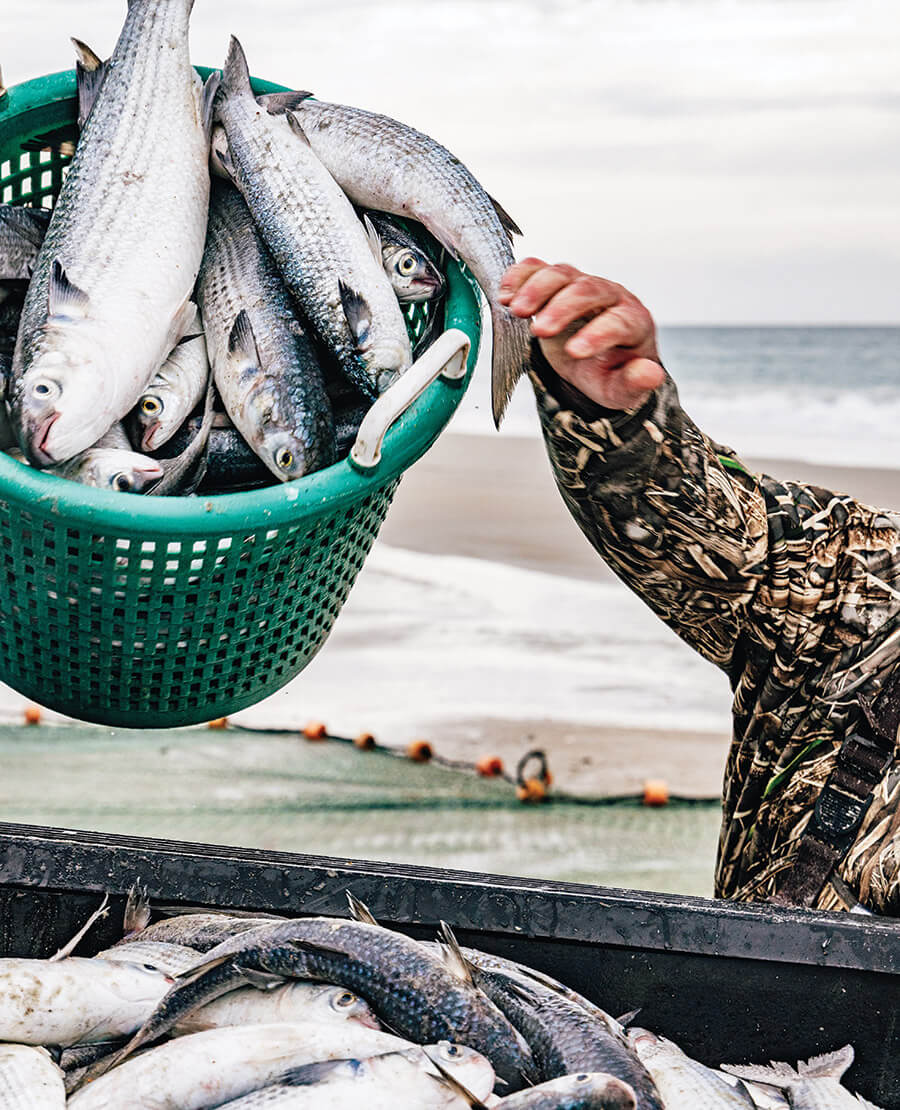
When filled, a truck holds 2,500 pounds or more of mullet. photograph by Baxter Miller
Frost watches with pride as his son and grandson wipe sweat and sand from their sun-drenched faces, just as his father and grandfather did on this same beach. This tradition has defined his family for seven generations. Despite the uncertainty, there is sincere hope that it will survive for an eighth.
For now, at least, just as surely as the mullet run, when fall’s first northeast winds blow across the beaches of Bogue Banks, you’ll find the fishermen of Salter Path with a wooden boat full of mended net and tractors at the ready.