Murphy to Manteo: Finding new adventures, historic detours, and the soul of North Carolina on the state’s longest highway: U.S. Route 64. Read the series.
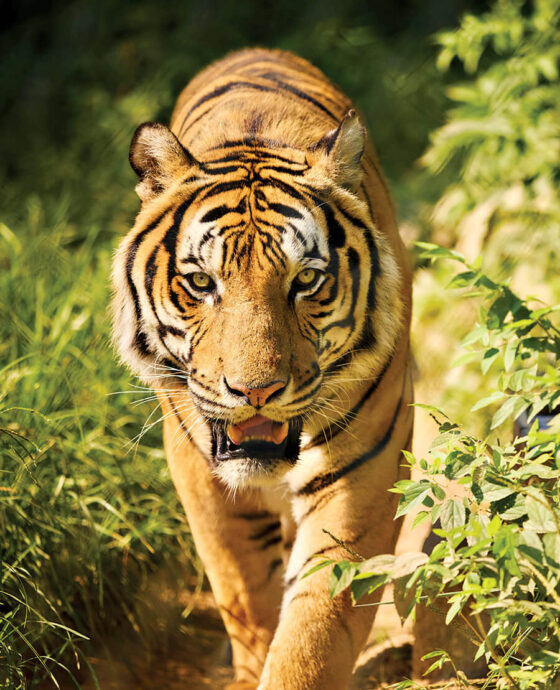
A tiger stalks through the tall, sweet-smelling grass of the Piedmont. The drone of cicadas fills the humid late-afternoon air. His tail flicks. His brilliant orange-and-black stripes seem out of place, yet he’s at home in the dappled shade of tall North Carolina oaks and maples.
Suddenly, he springs from the shadows quicker than I can blink, rumbling and chuffling deep in his chest. But it’s not me he’s after — it’s the white bucket that Madison Fales is carrying beside me.

Madison Fales photograph by Alex Boerner
As we walk along a gravel drive at Carolina Tiger Rescue (CTR) near Pittsboro, Fales prods a short wooden dowel into the bucket to spear a raw chicken drumstick on the end. The tiger leaps and bounds back and forth in a frenzy as he follows alongside the fence of his wide, grassy enclosure, which is big enough for him to run, jump, and play in. Fales pushes the drumstick through the fence, and the cat quickly swallows it whole.
“Samar!” Fales admonishes, laughing. “I was waiting [to hear] the crunch of the bone.”
Fales is the education director at CTR, and she knows the habits of each animal here in the same way you know the particular quirks of an old friend. In contrast, from the moment I turned off U.S. Highway 64 and onto the sunny country lane that led me to this 67-acre wooded sanctuary in Chatham County, the experience has felt unpredictable.
Though, in my defense, I suppose nothing can prepare you to come face-to-face with a 425-pound tiger.
• • •
Samar is of average size for a tiger, though he looks enormous to me. It’s stunning to see this wild, beautiful animal in motion from what feels like a breath away — even if he is safely behind a fence. The experience is somehow different than a zoo. To be this close to an animal that I know best from documentaries feels surreal. Perhaps coming here felt surreal to Samar, too.
In 2021, he was among 68 big cats rescued from the notorious Tiger King Park — the Oklahoma roadside zoo featured in Netflix’s Tiger King — after it was shut down due to numerous Endangered Species Act violations. Samar and three others came to live at CTR — in secret, until the case was finalized. When it was over, their names were changed.
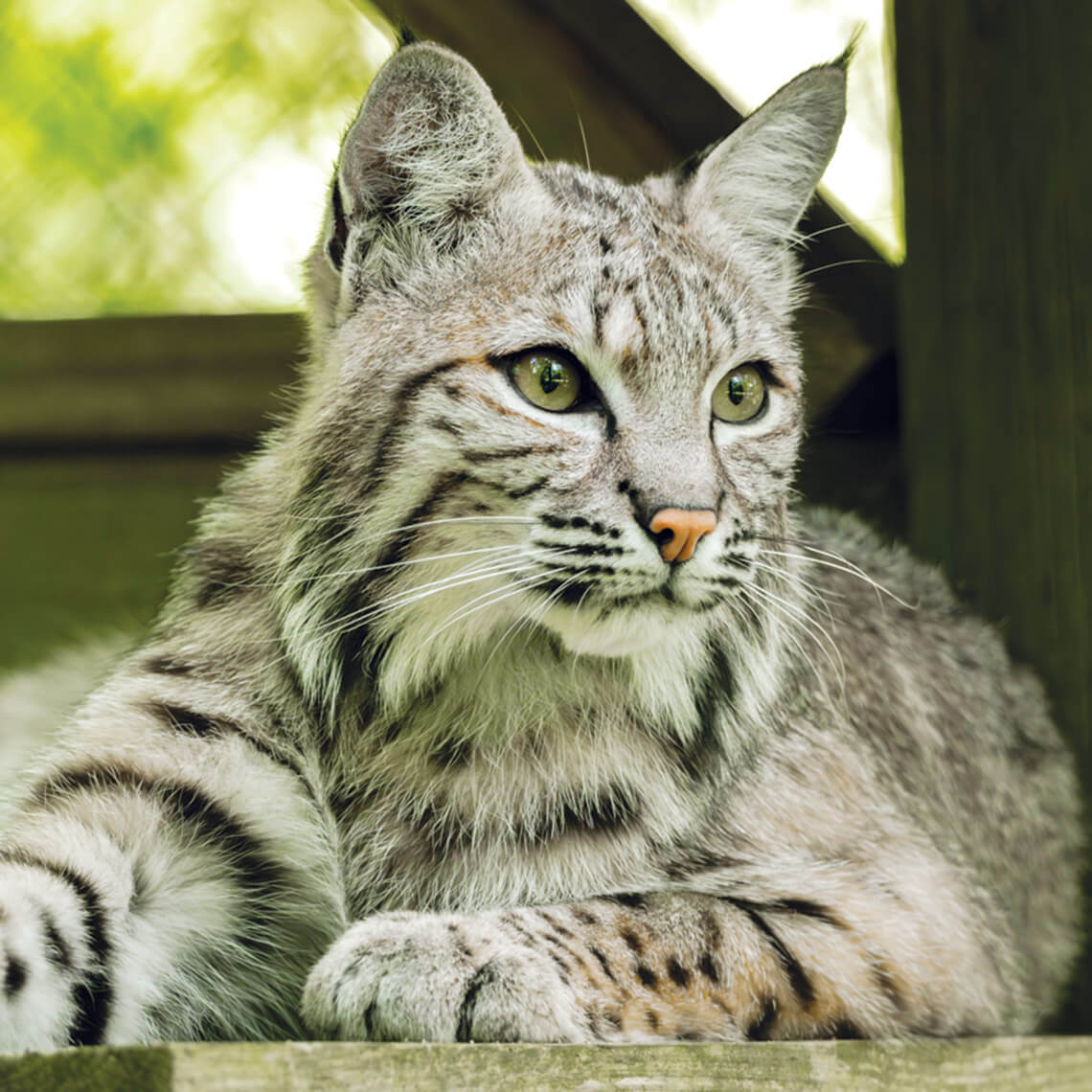
Molly, Bobcat Photography courtesy of Carolina Tiger Rescue
Samar continues to follow us along the fence, scratching against it like a gigantic house cat rubbing against its owner’s legs. The behavior elicits a grin from Fales.
“He’s here for the rest of his life,” she says. “We are their forever home.”
In addition to eight tigers, the sanctuary is home to 12 other species, including cats big and small, red foxes, coatimundis and kinkajous (both in the same family as raccoons), and more.
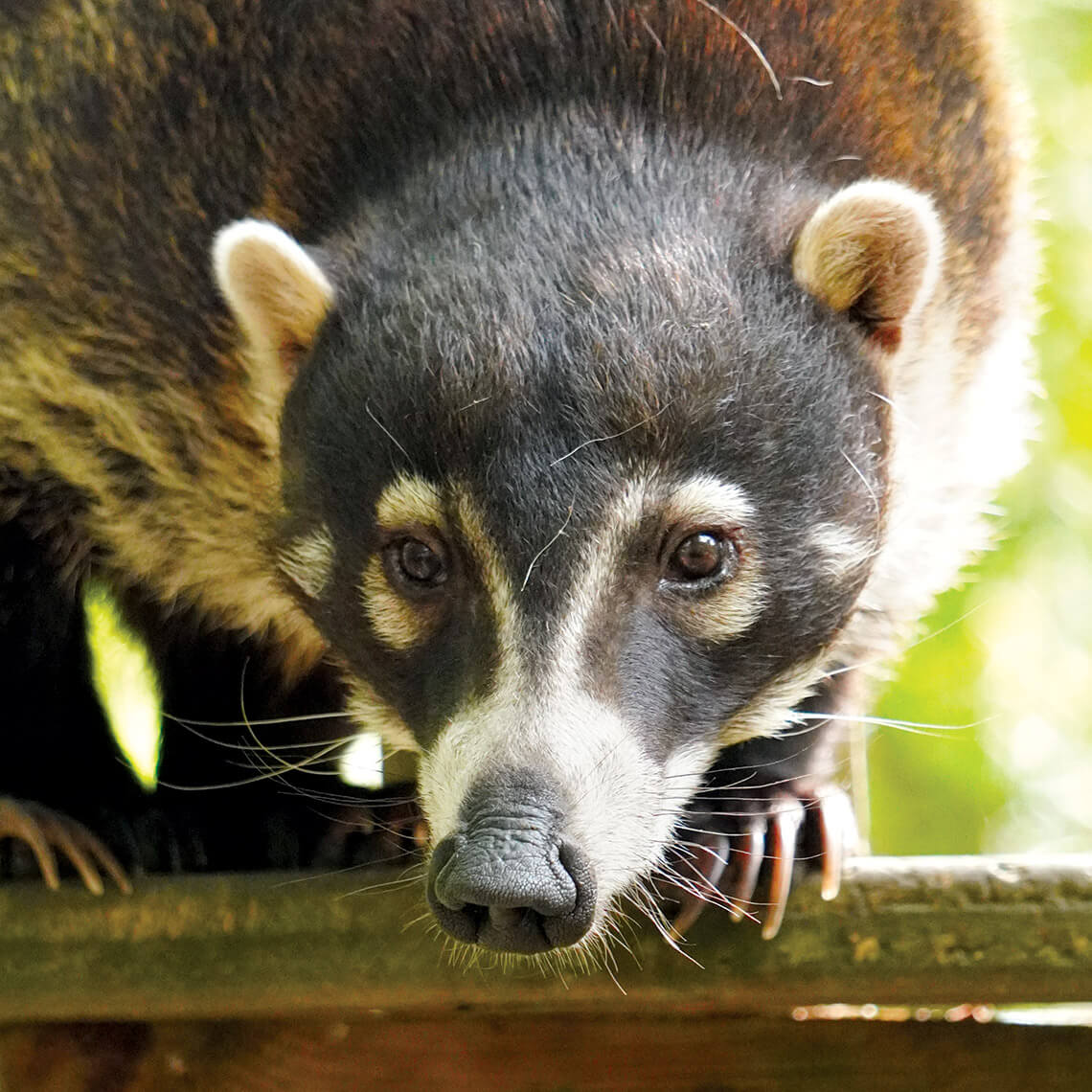
Bud, Coatimundi Photography courtesy of Carolina Tiger Rescue
UNC geneticist Dr. Michael Bleyman founded the sanctuary more than 50 years ago as the Carnivore Evolutionary Research Institute. Bleyman wanted to guarantee the survival of specific keystone species and began a breeding program for cats like caracals, servals, and more. But he soon recognized the need for a sanctuary and began rescuing big cats, too. In the early 2000s, the facility stopped its breeding program, shifting its mission fully to rescue and advocacy. In 2009, it was renamed Carolina Tiger Rescue.
Many of CTR’s residents come to the nonprofit sanctuary from harrowing situations when traveling circuses or roadside zoos, like the one Samar came from, are shut down. Others are transferred from failing sanctuaries, are orphaned rescues, or arrive when owners of exotic pets surrender them by choice or by force.
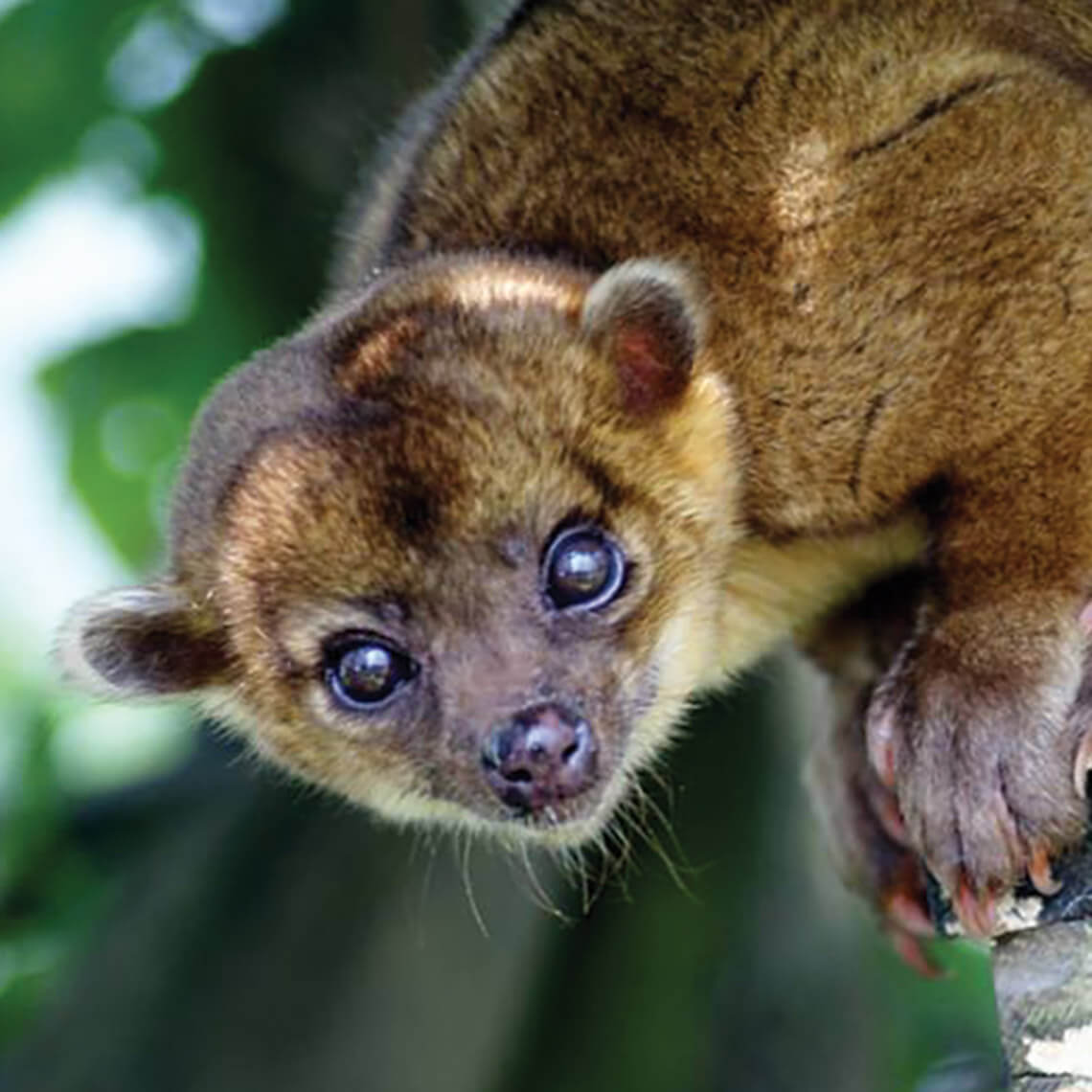
Albert, Kinkajou Photography courtesy of Carolina Tiger Rescue
Once a rescue arrives at CTR, they’ll never be reintroduced into the wild. It’s why the passionate workers and volunteers do everything possible to give the animals a gentler life, to tell their stories, and, perhaps most important, to educate the public during field trips, camps, and tours.
“We hope people leave a little more conscious of the places that they’re visiting and supporting,” Fales says. “When we know better, we do better.”
• • •
A bit farther down the road, we come to another grassy enclosure tucked into the shade with various platforms in the center.
“Beau is my personal favorite,” says Fales, who’s been training him for two years. She holds up a clicker, the same kind you’d use with dogs. “Beau!” she calls, adding that his full name is Beausoleil, but it’s only used when he’s naughty. “Oh, you’re being sneaky!”
I peer into the enclosure, searching for Beau, who was an orphaned cub found in late 2018 in Washington State. A sandy-brown cougar crouches low in the foliage, staring at us intently with his piercing pale green eyes.
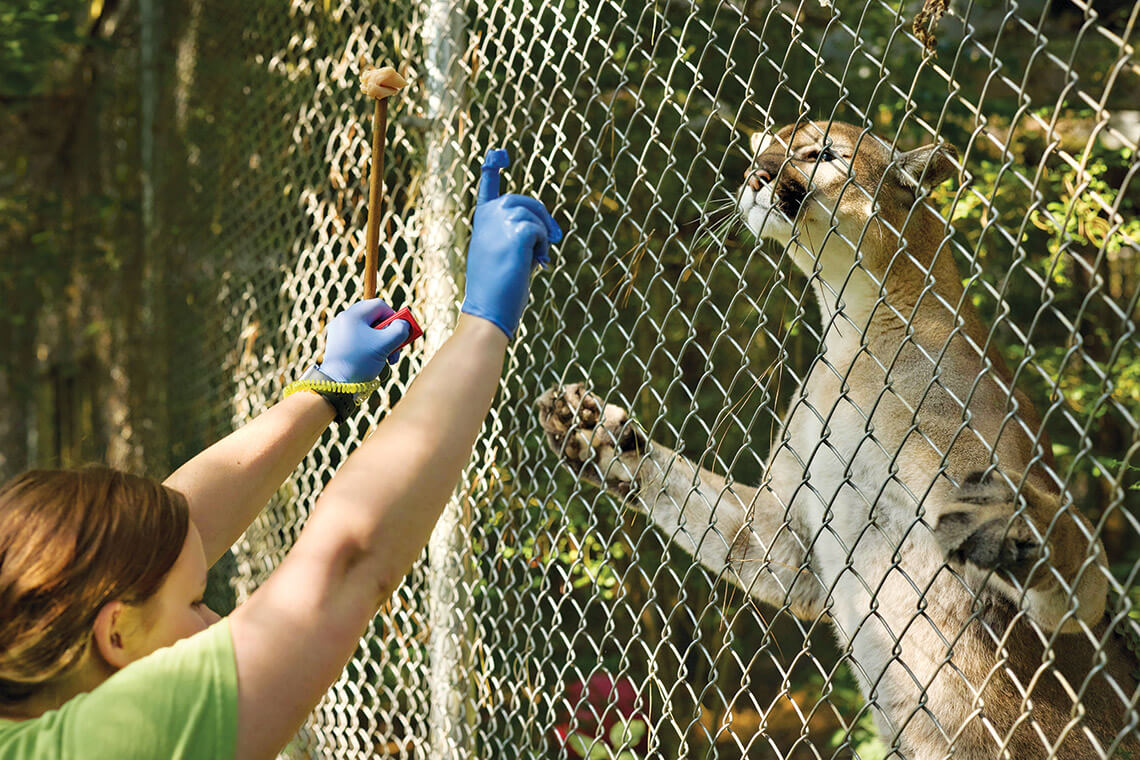
Fales feeds Beausoleil, or “Beau,” a cougar named for the wildlife officer who found the orphaned cub. Cougars can jump about 40 feet horizontally, and thanks to their tails, they can change direction in midair. photograph by Alex Boerner
For a moment, I imagine those calculating eyes in the wild, watching from the trees. Then he’s up, light on his feet, standing before us. Click. Using her pole, Fales passes a drumstick through the fence. All of CTR’s training, she tells me, is to help care for the animals — not for human entertainment. If Beau follows a command, he gets a click and a reward. If he doesn’t, there’s no punishment — Fales just doesn’t give him a reaction.
“Paw,” she says. Beau raises his paw and presses it against the fence. It’s the size of a salad plate. Click. “This allows me to get a look at his paws if I ever need to, or to do nail trims.” She passes another chicken treat to Beau, who, unlike Samar, crunches into his reward.
• • •
Over the next two hours, we meet Saber, a white tiger with bright blue, crossed eyes who spent his early life at a magic show in Las Vegas; Roman the lion, who lets out a series of territorial oofs so loud they’ve reportedly been heard miles away at Jordan Lake; and Naveen the tiger, who, like Samar, came from Tiger King Park and is known for chuffling and “mooing” at guests.
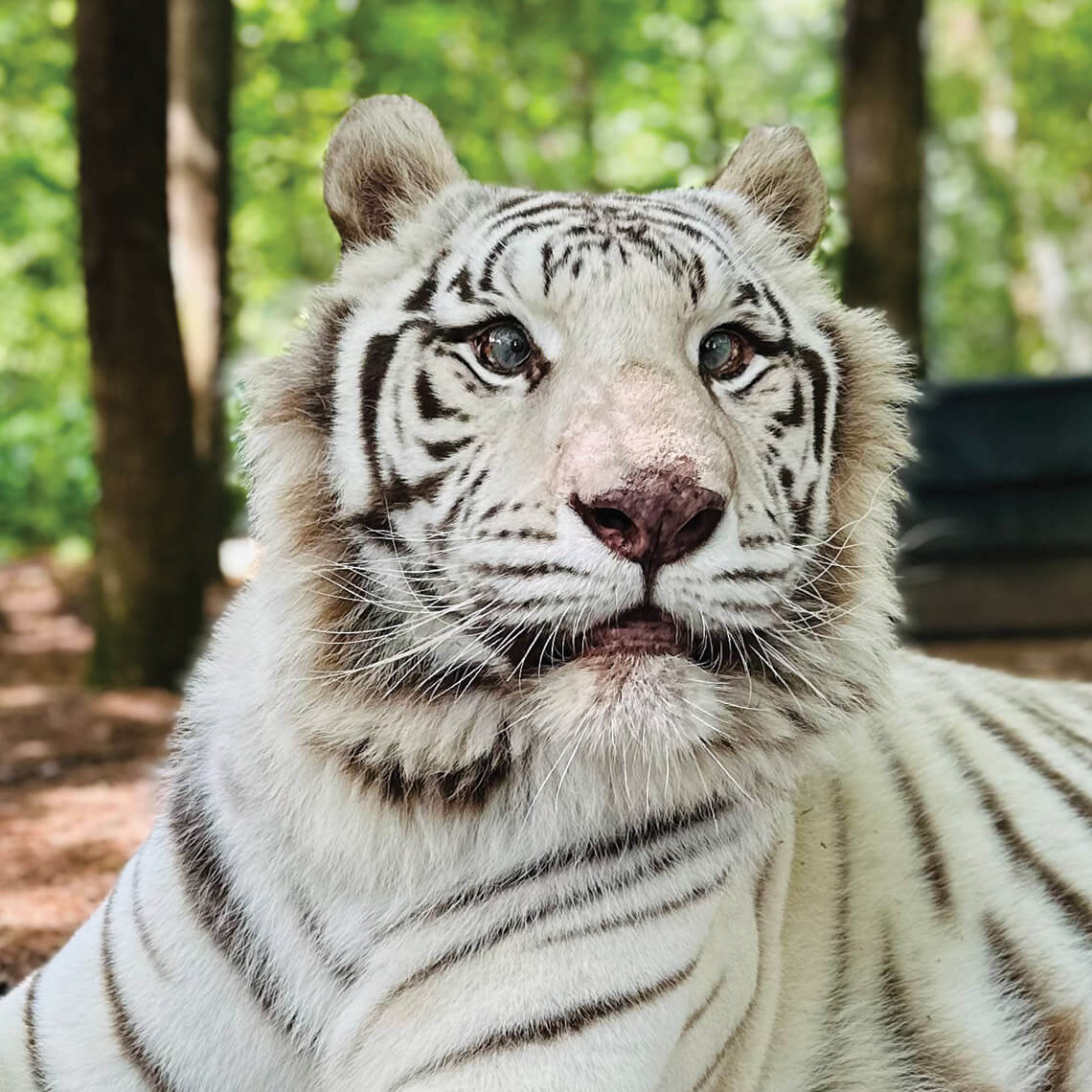
Saber, White Tiger Photography courtesy of Carolina Tiger Rescue
We also meet a caracal with tufted ears; servals with black-spotted coats and long legs; and eight bobcats who are, at turns, both shy and feisty, running and hiding and zooming around. These small cats are popular in the exotic pet trade — and often they end up at CTR when their owners realize their pet is, in fact, a formidable predator.
The folks at CTR hope that, someday, they’ll see an end to private ownership and unregulated breeding of wild animals. “People think that they can love the wild out,” Fales says, eyeing a serval who was once contained in a living room. “But if you could love the wild out, none of our animals would be wild.”
• • •
The gravel drive eventually leads us back to where we began. I have dodged both poison ivy (successfully) and fire ants (unsuccessfully). Fales, while sympathetic, is unfazed. The challenges of this job are often more emotional than physical.
Earlier this year, CTR rescued six red foxes from a fur farm. Normally incredibly social creatures, they’d lived their entire lives in filthy cages. After the foxes underwent the quarantine process and received veterinary care, Nick Keller, CTR’s marketing and communications director, witnessed their release into their new home.
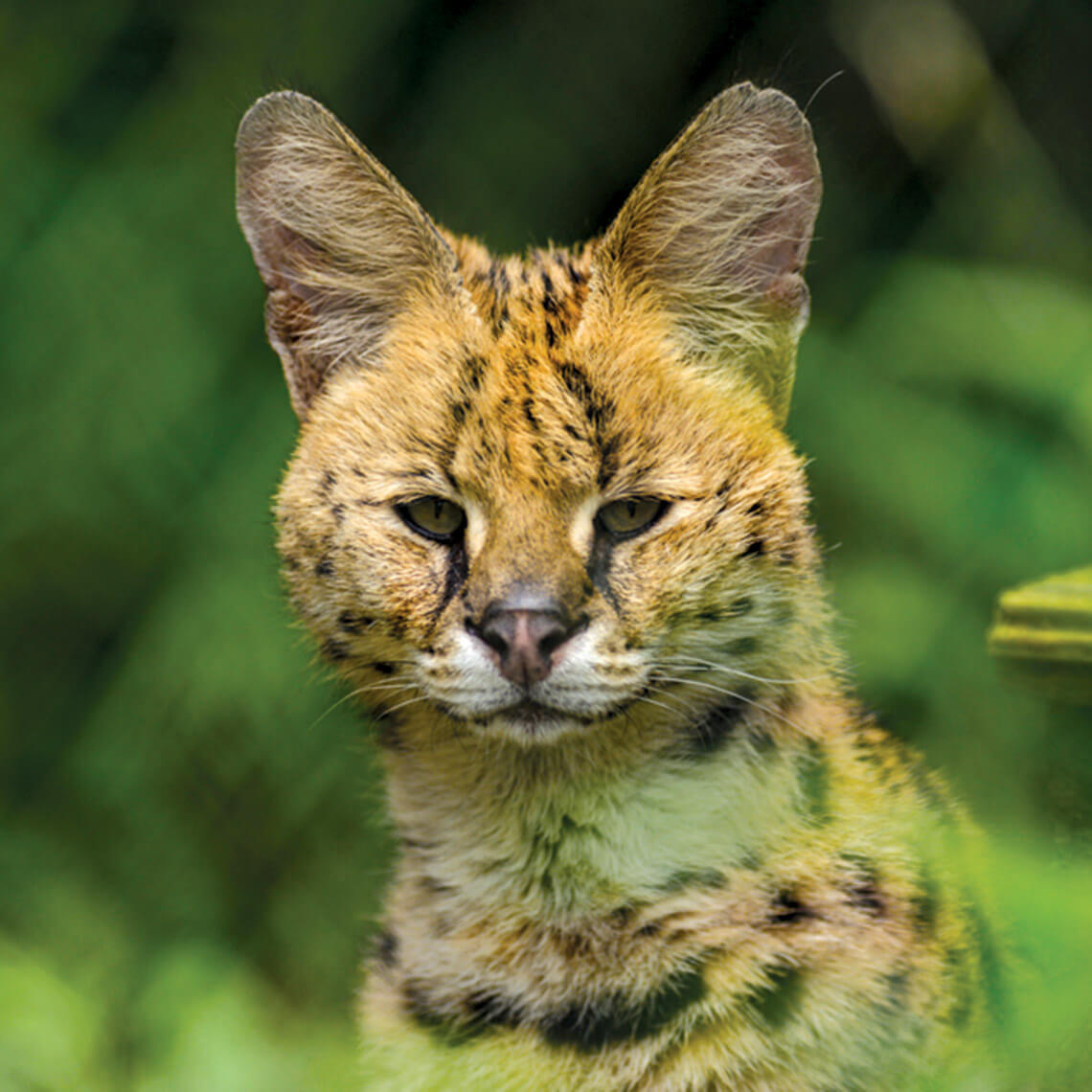
Zoey, Serval Photography courtesy of Carolina Tiger Rescue
As the door slid open, the foxes stepped out tentatively — and felt grass beneath their paws for the very first time in their lives. They looked up at the blue sky above them. They sniffed the fresh air as a new, kinder world emerged before them.
“It was a magical moment,” Keller recalls, “seeing the foxes experience the life they deserve.”
Around the bend, Roman’s call echoes into the Carolina twilight. It says, for all listening, This is my home.
Tours are by appointment only. To schedule, visit carolinatigerrescue.org/tours.
More to Explore: Extend your visit to Chatham County. Find our guide to a Pittsboro day trip at ourstate.com/a-guide-to-downtown-pittsboro-and-beyond/.
print it