 Listen as the pages of the magazine come to life in the Storytellers podcast showcasing the voices of Our State writers. Each podcast episode features a writer reading their column aloud, allowing each distinct voice to shine. Click below to listen to Sheri read her column aloud.
I don’t have an answer when people ask about my favorite recipe, but I’m certain that great gravy is the most satisfying thing I make. I’ll even admit that I’m good at it. Some of my friends kindly refer to me as “The Gravy Whisperer.”
Even though I understand the process and know what to expect, making gravy always leaves me wonderstruck. I marvel that it relies on the sticky leavings in the bottom of a pan, miraculously stretching those meager bits into the crowning glory of the meal, if not the meal outright. Making gravy leaves me feeling accomplished, like an alchemist who wound up with liquid gold.
I was raised on hearty, country-style gravies that started by frying a cast-iron skillet full of something dredged in well-seasoned flour, usually golden-brown chicken, tender pork chops, or savory cube steak. Or, often for Sunday supper, sage-scented breakfast sausage, smoky bacon, or salty chipped beef went into the skillet. We’d eat the meat because it would’ve been a shame to waste it, but I swear the point of cooking it was to get enough drippings to make gravy. Gravy believes that grease is good.
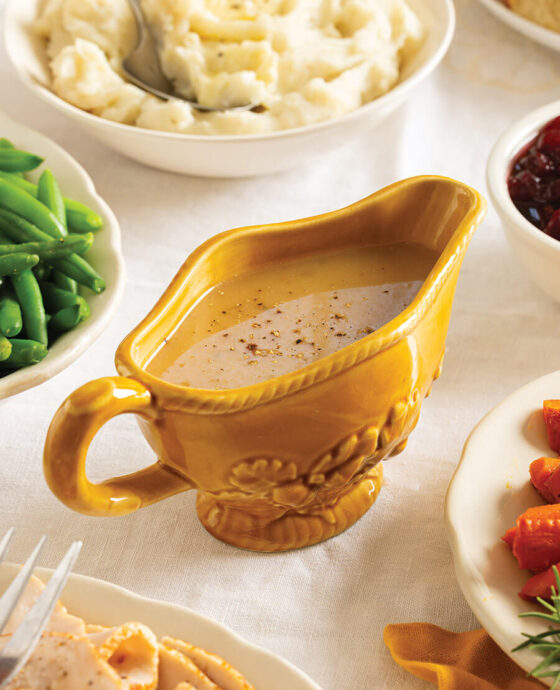
This isn’t to say that gravy can’t be sophisticated and lavish. My bronzed and silky turkey gravy is the most fully wrought thing I prepare for Thanksgiving. I start the recipe days in advance, yet it’s the last thing I carry to the feasting table before we commence. A little spouted boat is inadequate to hold such riches, so I serve it in a bigger vessel that I call the gravy yacht. This is the gravy that inspired my once little girl to say, “Mama, your gravy is what keeps Thanksgiving from being just another Thursday in November.”
• • •
My first lessons in gravy came from simply being an observant kid in the kitchen when my grandmother, mother, or beloved Aunt Jean were cooking. I was learning to listen for the right sizzle in the hot skillet, to see when bits were sufficiently browned. I still recall how the aromas rose up as the roux toasted and the flavors deepened into what we now call umami but that my grandmother called “the goodie.” The sounds shifted when the liquid went in with a steamy whoosh. I can still hear the rhythmic metallic scrape of a spoon skating on the skillet as the gravy thickened and gently bubbled, as though raindrops were landing on its surface.
Gravy requires mindfulness during each movement, akin to raking a Zen garden or walking a labyrinth. Slow, steady, observant stirring is key. These days, as I move my wooden spatula in concentric figure eights, I meditate on the gravies of my birthright and those who stirred them. I can now appreciate that the time those home cooks got to spend stirring were rare respites, a few minutes to focus on a single task amid the usual household hubbub. Cooks stirring gravy can only stir gravy. I eventually heard myself repeating to my young daughter what was said to me: “Now you need to ask somebody else about that, or hush and sit here and be still for a minute. I’m seeing to the gravy and can’t turn loose.”
My little girl is now a grown-up who lives on the other side of the globe and spends only a handful of days at my table each year. Biscuits and gravy is always the last meal she asks me to fix on the day I must somehow turn her loose. Even now, she still likes to sit on the wooden kitchen stool to watch me stir in the wordless quiet that says a gracious plenty. Everything else is gravy.
photograph by Tim Robison
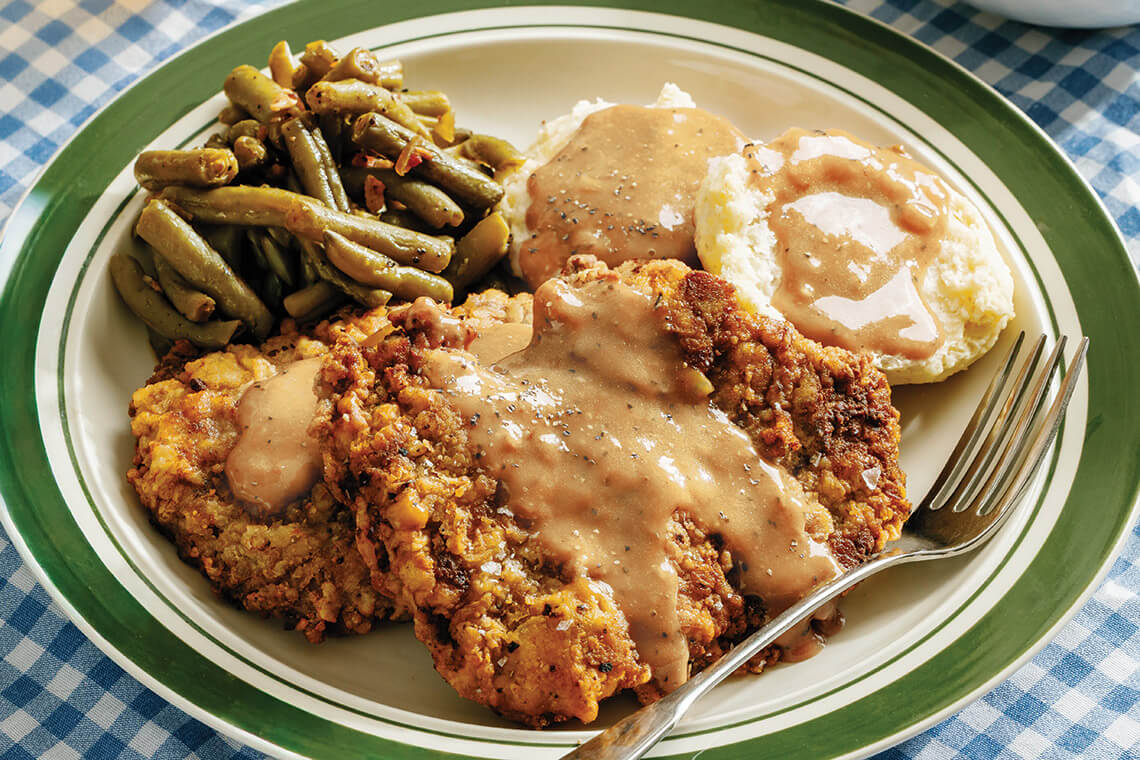
Cube Steaks with Milk Gravy
Cube steak smothered in peppery white gravy was a mainstay on my family’s supper table when I was growing up. While raising my daughter, I turned to cube steak when I needed a hot, comforting meal in a hurry. I could whip up a skillet full of the tender meat and savory gravy in the time it took the biscuits to bake.
Cube steak is budget-friendly beef, usually thin cuts of lean top or bottom round that are mechanically tenderized with a machine that uses small blades to punch many cube-shaped slits into the tough meat. Cube steaks are thin and cook very quickly, which is why some people refer to them as minute steaks.
This simple method for dredging and browning thin cuts of meat to create tasty drippings for pan gravy is a classic home cooking technique that also works with thin pork chops and pounded chicken cutlets.
Yield: 6 servings.
¾ cup self-rising flour (or 1 cup all-purpose flour and 1 teaspoon baking powder)
1½ teaspoons Lawry’s Seasoned Salt or 1 teaspoon kosher salt
1 teaspoon ground black pepper
½ teaspoon garlic powder
½ teaspoon onion powder
6 cube steaks (about 4 ounces each)
3 tablespoons vegetable shortening or vegetable oil
3 tablespoons butter
2 cups whole milk, warmed
Hot biscuits (for serving)
On a large plate, whisk together flour, seasoned salt, pepper, garlic powder, and onion powder. Working with one steak at a time, coat both sides in the flour mixture, pressing lightly to help it adhere. Set the dredged steaks aside in a single layer. Reserve 4 tablespoons of the flour mixture to use in the gravy.
In a large cast-iron skillet over medium-high heat, warm the shortening and butter until melted and foamy. Add the meat in a single layer and cook until browned, about 3 minutes per side. Work in batches, if needed. Move the cooked meat to a plate and tent loosely with foil to keep warm.
Reduce the heat to medium. Sprinkle the reserved flour over the pan drippings. Cook for 2 minutes, stirring continuously to loosen the browned bits. Reduce heat if the flour begins to scorch.
Whisk in the warm milk and cook, stirring slowly and constantly, until gravy comes to a boil and thickens, about 3 minutes. Add another pinch of pepper and taste for salt.
Return the meat to the pan, reduce the heat to low, partially cover, and simmer gently until warmed through, about 2 minutes.
Serve warm with hot biscuits.
print it