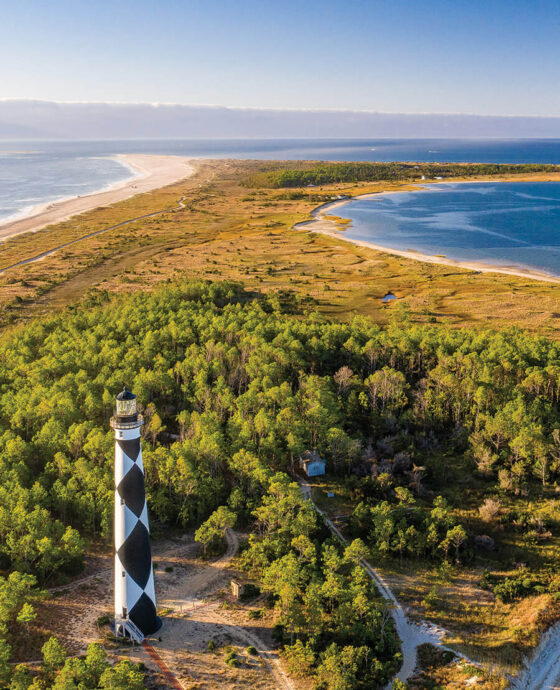
Charlie Smith loves what he sees. So do his two older sisters, McKinley and Mary Greaves, MG for short. We all stand steps from one another in the watchtower atop the Cape Lookout Coast Guard Station. With eight windows around us, we take in a sprawling view of a coastline untouched by development and kissed by Mother Nature. I slip my smartphone in my back pocket and listen to our unofficial guide, Jim Manly, tell us about currents, geography, and spotting ships in distress from our third-floor perch, our classroom above the trees.
The Smith kids came because of James H. “Bud” Doughton, their neighbor in Raleigh. They call him “Mr. Bud.” Their visit was his idea, and as they gawk at what’s around them, they begin to gush.
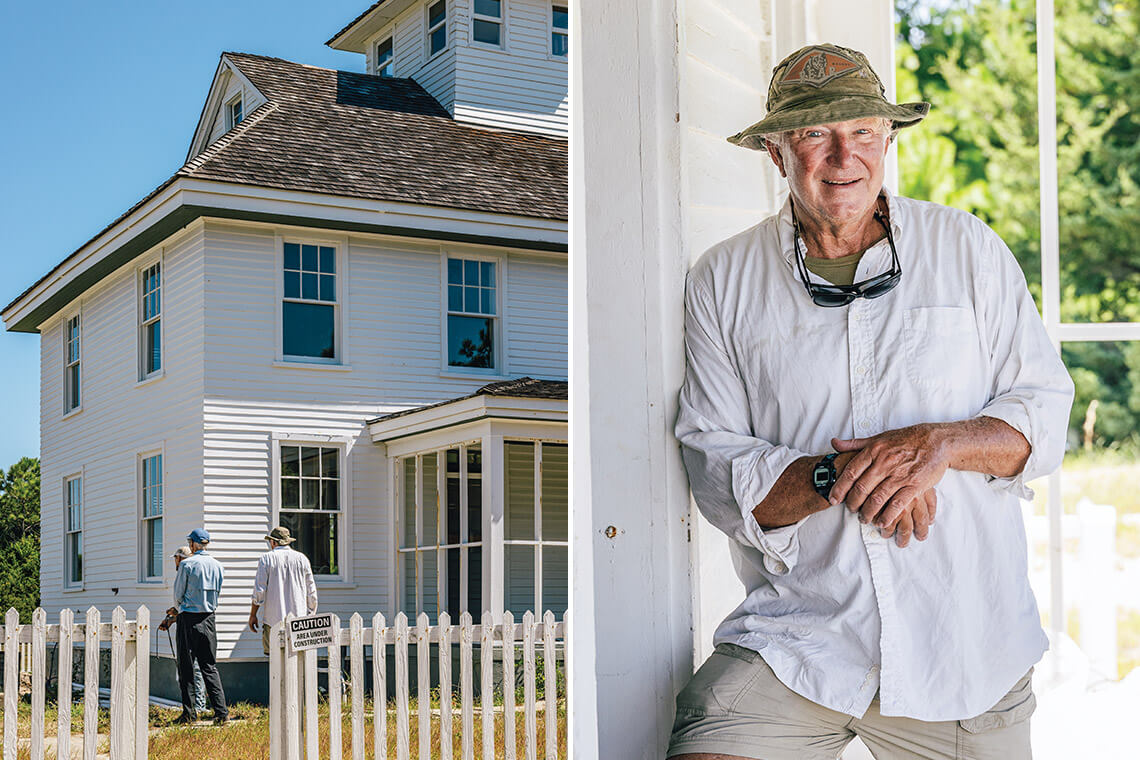
In 2024, James H. “Bud” Doughton (right) helped secure a 20-year lease for the Cape Lookout Coast Guard Station, reviving his longtime vision of an environmental studies program. photograph by Baxter Miller
“I’ve never been in a place like this before,” says McKinley, 12. “It’s really cool.”
“I like looking at the ocean,” says MG, 10. “It’s really pretty.”
“I like how you can see the ocean from here and spot things,” says Charlie, who turned 9 in March. “You can play a good game of ‘I Spy.’ ”
Charlie’s answer makes me laugh — and think about the possibilities here. The hope is to welcome visitors of all ages to the Coast Guard Station for environmental studies programs. Led by scientists, educators, and longtime Core Sounders, the effort would turn this stretch of Cape Lookout National Seashore into one big school of sand and sea full of goose-bump moments. Like this one: walking the beach at night as the waves — and even your own footprints — begin to glow. The source is a tiny bioluminescent organism called noctiluca. You can’t help but feel a sense of awe, a sense of wonder.
It’s, as McKinley says, “really cool.”
By mid-fall, program organizers hope to offer overnight stays in the former Coast Guard headquarters, which was completed in 1917 and saved many lives before it was decommissioned in 1982. The 2,000-square-foot, two-story building is being renovated and repaired with AC, heat, and bathrooms in all five rooms. A small building next door, which the Coast Guard used as a galley, will be home for lectures. Tucked between the two buildings is an observation deck where people can gather, share stories, or remain silent as they look up at night, maybe through the lens of a telescope, and marvel at a star-speckled sky.
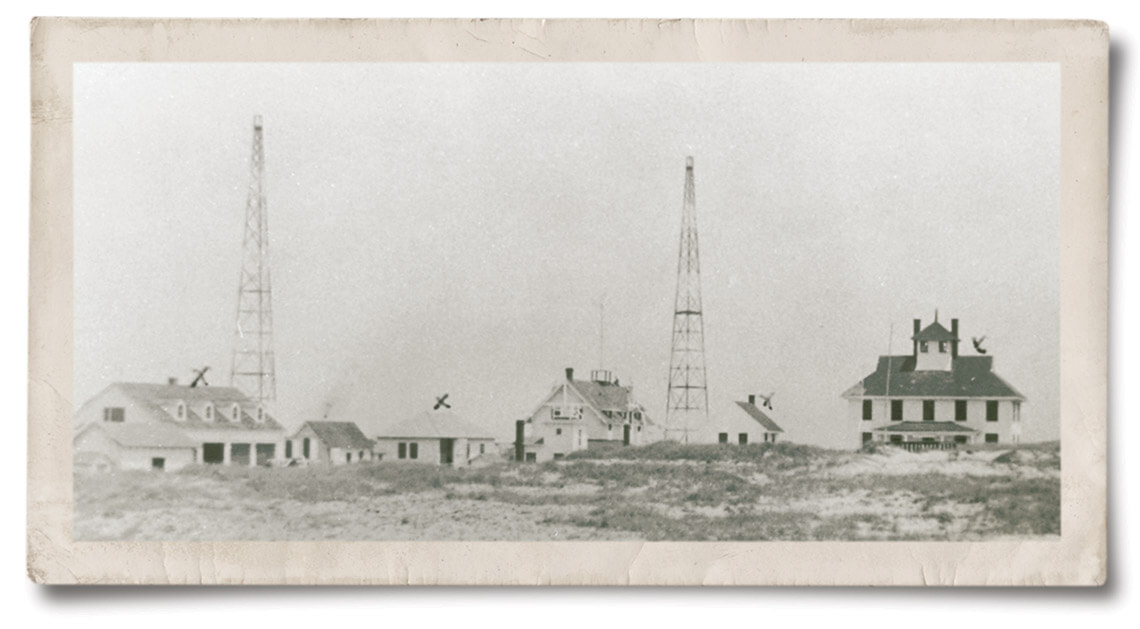
Visible at center in this 1941 photo, Cape Lookout’s 1887 life-saving station was where Coast Guardsmen once kept watch for storms, shipwrecks, and sailors in distress before it was replaced in 1917. Photography courtesy of Cape Lookout National Seashore/National Park Service
The Smith kids can only imagine such a sight. So, Bud helps. He first caught Cape Lookout’s star show when he was a young man. He’s now 72, a semi-retired commercial real estate broker with many stories about the North Carolina coast. He remembers.
“One of the most amazing things out here is a full moon on a clear night,” he tells them after they clamber down the watchtower’s ladder, assisted by Jim and their dad. “The sand reflects the light, and it’s unbelievable how bright it is. You can see everything. On the nights when there is no moon, you’ll see every star there is.”
As we all follow Bud through the old Coast Guard Station, all I see are skeletons of wooden beams; Bud sees a project awash in opportunity.
“If you don’t wake up every morning figuring out what you want to do,” he tells me, “you’re on your way to dying.”
• • •
Bud knows North Carolina. It’s in his genes. Some of his ancestors have lived here since before the Revolutionary War, and his family tree is chock-full of leaders and trailblazers. As a kid growing up in Raleigh, he and his family vacationed in Morehead City, and Cape Lookout became as familiar as his own backyard. He surfed, fished, camped, partied, and periodically crewed during the summers on a sailboat ferry owned by his mentor, Josiah Bailey, helping take visitors from Harkers Island to Cape Lookout and back. In 1974, Bud and his friend, Tom Coxe, brought in Jim Manly to form Domanco, a jitney service with a tractor and trailer. Along with another close friend, Anna DuBose, they toted visitors around the island. Bud and Tom later obtained their captain’s licenses and ran Josiah’s Diamond City, a sailing ferry named after the 19th-century whaling community on Shackleford Banks.
It was a four-year odyssey for Bud and a clutch of his best friends. They gained an even deeper respect from those who made Down East sparkle: locals Karen Amspacher and David Yeomans; Henry “Farmer” Styron, the station’s Coast Guard officer in charge; and Sally and Les Moore, who lived on Cape Lookout and ran its only store.
Bud and a clutch of his best friends gained an even deeper respect from those who made Down East sparkle.
In 1982, Bud married Anna. Eight years later, they moved to Morehead City, where they grew their family and introduced their kids, Lawre and Horton, to Cape Lookout. On the island, they met Keith Rittmaster, now the natural science curator for the North Carolina Maritime Museum in Beaufort, in addition to being the director of Bonehenge Whale Center. For the Doughtons and so many others, that encounter made all the difference.
Keith had started the Cape Lookout Studies Program in 1990, eight years after the closure of the Coast Guard station. Headquartered at the building, Keith offered overnight stays and environmental education field trips, giving participants a chance to see the science behind the beauty around them. For 17 years, the Doughtons participated and helped Keith in every way they could. When the program ended in 2008, Bud and his friends turned their attention to a goal they had begun pursuing four years earlier: securing a long-term lease for the shuttered Coast Guard station and creating a permanent home for Keith’s hands-on approach to environmental education and Down East history.
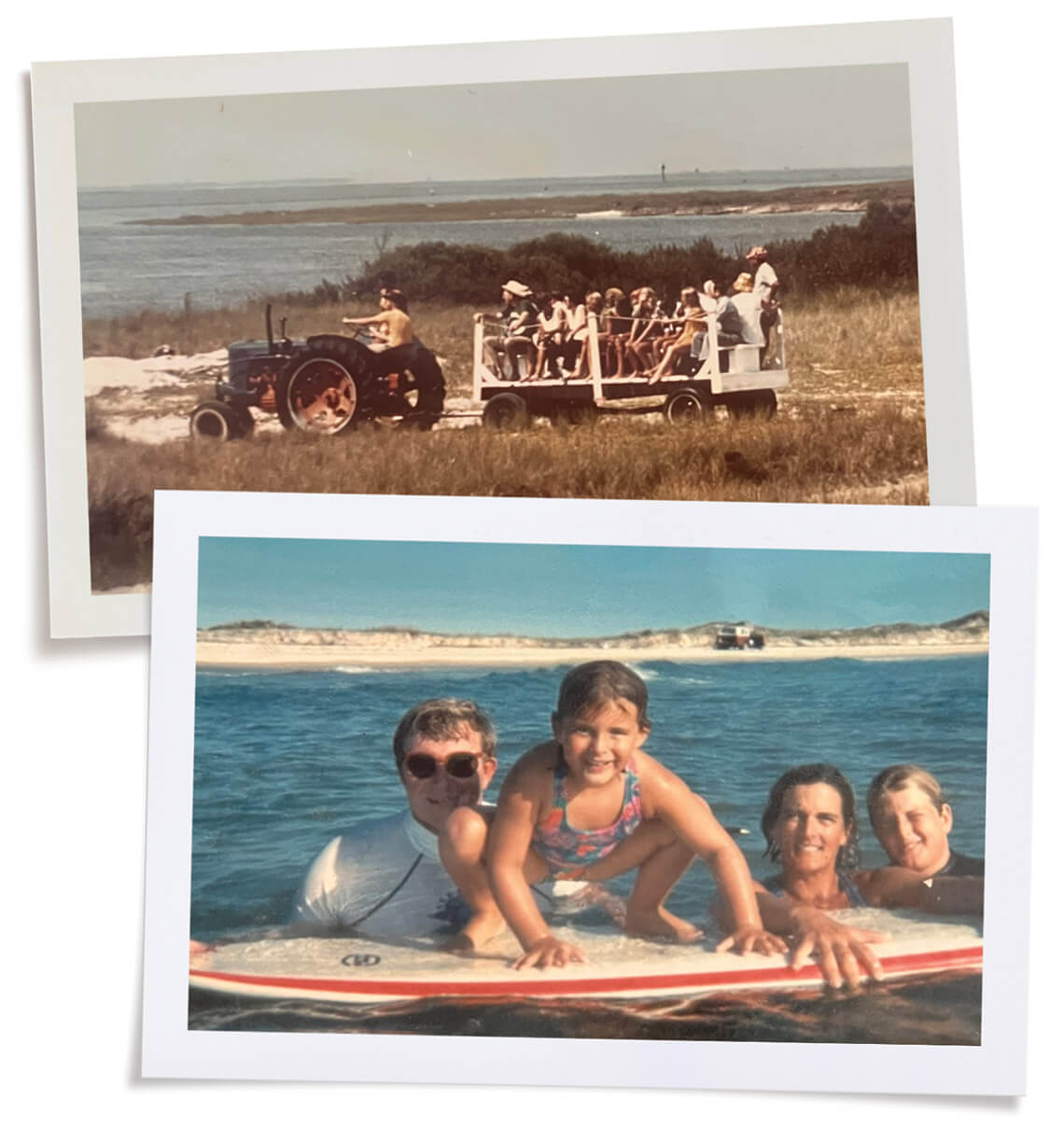
Bud’s connections to Cape Lookout include toting visitors on Domanco (top), the jitney service he started with friends, and joining his wife, Anna, in teaching their daughter, Lawre, and their son, Horton, how to surf. Photography courtesy of the Doughton Family
The path took time. The U.S. National Park Service, which manages Cape Lookout National Seashore, stayed in conversation with the group as their vision took shape. Out of that persistence grew the Cape Lookout Foundation, whose dedicated supporters volunteered their time, raised money, and helped make the dream real. Garry Brown, the former longtime facility director for YMCA camps Sea Gull and Seafarer in Pamlico County, became the nonprofit’s executive director; and Mason Williams, a commercial builder in Raleigh, agreed to be president. Garry would create the program, Bud and Mason would supervise the renovation, Keith would lecture periodically, and board members would continue their conversations with the National Park Service.
In 2024, the long-sought opportunity arrived. With support from Cape Lookout National Seashore Superintendent Jeff West, the Cape Lookout Foundation secured a 20-year lease for the Coast Guard Station. Soon, hammers started to swing.
• • •
The Coast Guard Station sits on a slight hill with a panoramic view of the coastline, and this morning, it smells of fresh wood. I catch up with the Smith family. We see the rooms, watchtower, galley, catering kitchen, and the skeleton of an observation deck. No matter where we look, we realize the wishful thinking from decades ago is in the past.
“It’s exciting,” Bud says. “In my opinion, there’s nothing like this on the East Coast. And this gives Down East kids a chance to come and hear about their own history and not let that history go.”
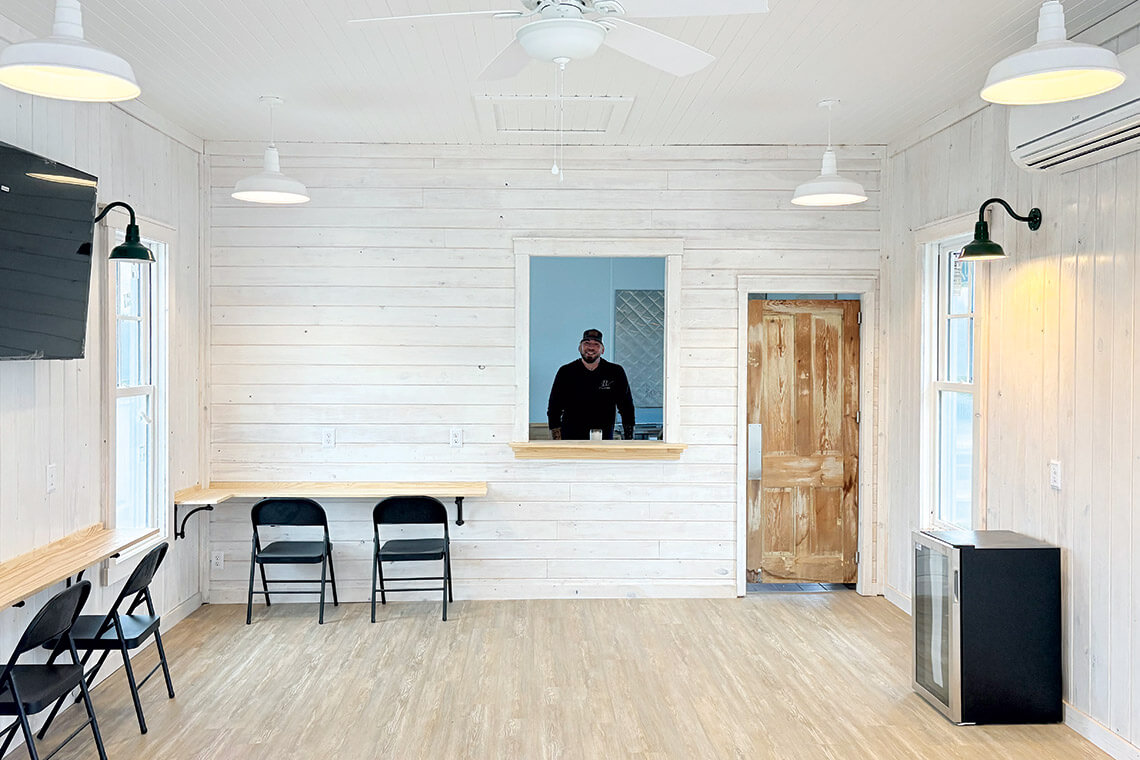
Once a galley where Coast Guard members cooked, ate, and gathered, this building is being renovated into a classroom and meeting space. Photography courtesy of Cape Lookout Foundation
Bud reminds me of a favorite relative at a family reunion, the one you gravitate to because they’re a charismatic raconteur who’s always quick with a quip that makes you laugh. Yet Bud’s humor doesn’t mask the determination he and his friends have. After working together decades ago on Domanco and Diamond City, they collaborate today to inspire others to appreciate and protect the island they love. For Bud, this slice of land as crooked as a broken finger is a place he feels connected to. Bud’s son, Horton, now 38 and a personal trainer in Raleigh, has an idea why: “He feels free out there. He’s immersed in what is so beautiful.”
• • •
As morning ebbs into afternoon, the Smith kids bolt through the dunes toward the beach. Immediately, McKinley shouts: “It’s a whole thing! I found a whole thing!”
Like a prize won at a carnival, McKinley waves a perfectly intact whelk shell. Charlie finds one as big as a softball; MG finds one that fits into the palm of her hand.
“It’s a baby one,” Charlie says.
“Baby ones are better than big ones!” MG counters.
A goose-bump moment. Bud and his friends know all about that.
For more information, visit ourstate.com/cape-lookout-foundation.
FOR JULY: Behind Durham Bulls Athletic Park’s Blue Monster, Chris Ivy keeps baseball’s past alive, one hand-placed number at a time. Doing so, he finds that his game-day perch offers much more than a score.
print it