It’s 20 days before Christmas, and Gregory Gilgo stuffs the last of about two dozen wreaths into the hold of his boat. The night before, temperatures bottomed out in the 20s, and in the early morning light, ice clung in a thin sheet around the oyster beds along the shore of Cedar Island.
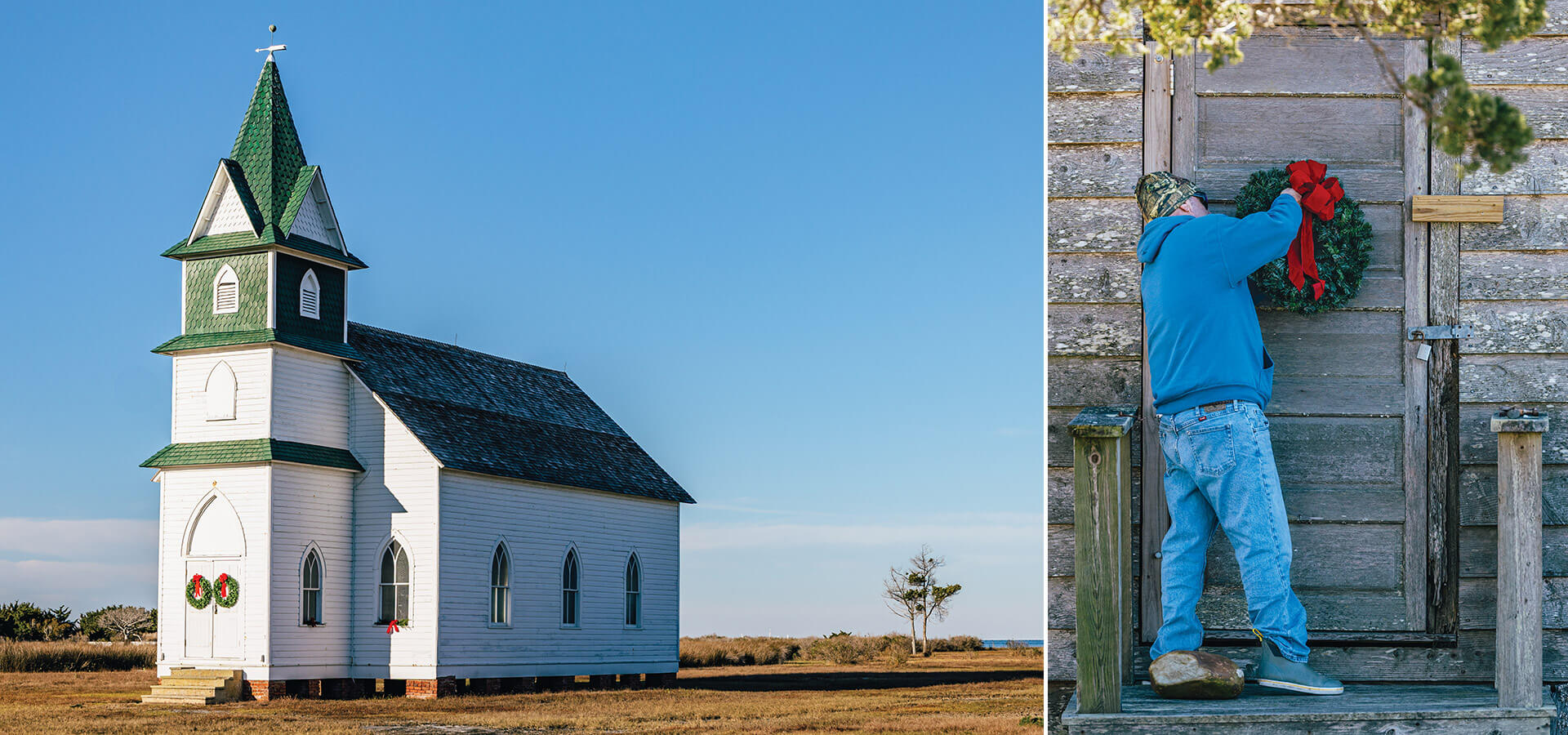
Tucking a red bow into the compartment, Gilgo is ready to go home to a place he has never lived to decorate an island village where no living soul remains. He’s returning to Portsmouth — once one of the largest settlements along North Carolina’s string of Outer Banks — where now only sacred memories and about 25 structures remain. Although few, if any, folks will ever see the decorations, the village will be trimmed for Christmas thanks to Gilgo’s dedication and the support of Friends of Portsmouth Island, a group devoted to preserving the history of this place.

Gregory Gilgo photograph by Baxter Miller
Gilgo’s gloved hand pushes off the dock, and he heads toward Pamlico Sound, zipping his camouflage jacket all the way up and cinching the hood tightly over his toboggan, leaving only his cheeks exposed. The sun hangs at a 30-degree angle, casting a cone of diamonds across the water, leading Gilgo to his destination 45 minutes north and east. It’s the kind of bitter cold that cuts through layers, paralyzing the face and stiffening fingertips until the painful sensation of pins and needles fades into a dull numbness. The occasional spray of saltwater pellets his jacket, freezing into tiny drops where they land.
Speeding through a maze of pound nets and duck blinds, the Banks hover like a mirage in the distance. Once, these waters would have teemed with wooden boats coming and going, their masts silhouetted against the bright blue sky. But this morning, Gilgo is the lone boat, welcomed only by two porpoises breaking the surface as the church steeple in the heart of Portsmouth Village comes into sight.
• • •
Chartered by the legislature in 1753 as a port to serve a growing royal colony, Portsmouth Village, on the southern side of Ocracoke Inlet, was once the epicenter of maritime trade in North Carolina. The primary access point to Pamlico Sound, Ocracoke Inlet was the critical conduit through which ships and goods reached settlements like New Bern, Bath, and Washington. As a vital link in the state’s economy, Portsmouth flourished. By the turn of the 19th century, it was the largest community on the Outer Banks, with a population of more than 200 and a federal customs house to oversee commerce.
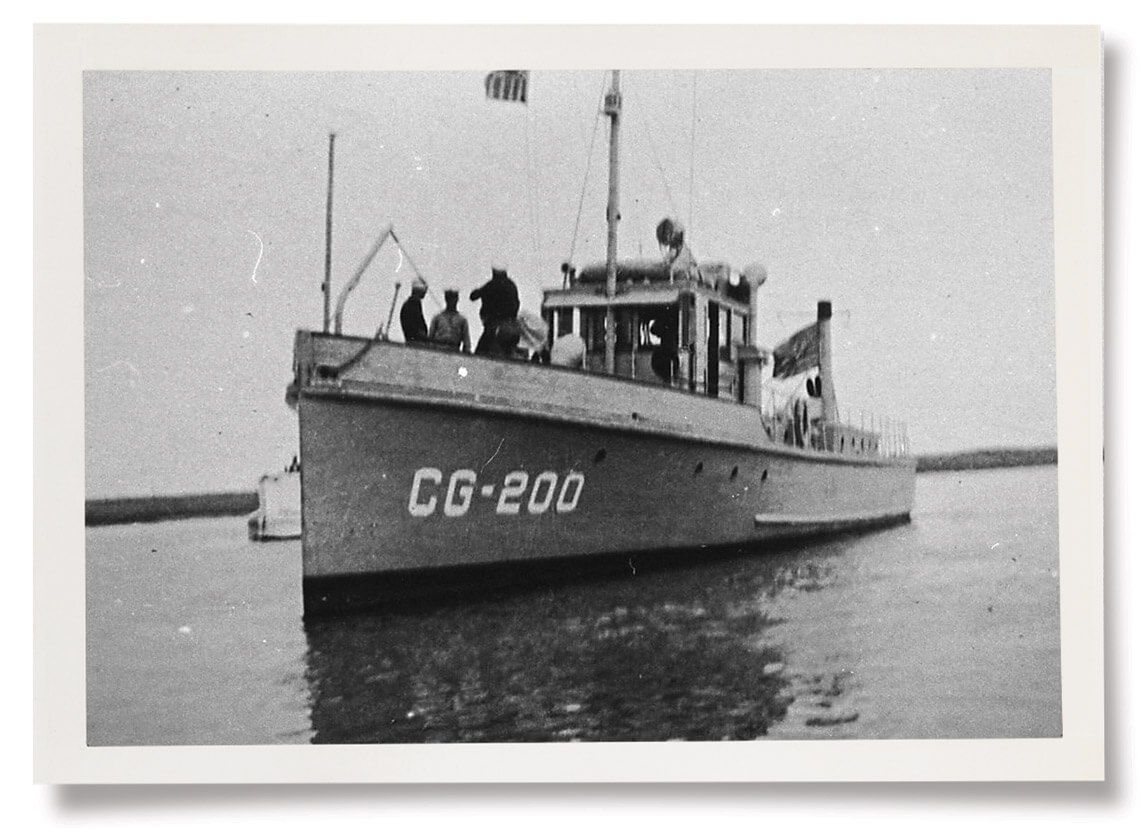
In the early 20th century, the U.S. Coast Guard conducted drills in the waterways surrounding Portsmouth Island. Photography courtesy of THE NORTH CAROLINA DEPARTMENT OF NATURAL AND CULTURAL RESOURCES
The nature of Pamlico Sound created a thriving lightering industry: Shallow water prevented large cargo ships from navigating beyond a certain point, so small boats would transfer cargo from bigger ships and transport the goods to inland seaports. Growth continued through the first half of the century, and by the early 1840s, two-thirds of the state’s exports exited through Ocracoke Inlet. As trade swelled, so did Portsmouth’s population, peaking at 685 residents in 1860, most connected to the town’s shipping industry. The village was so significant to maritime trade and national defense that, in 1842, Congress appropriated money for a hospital at Portsmouth to care for sick mariners. It was the first building in the state constructed as a dedicated hospital.
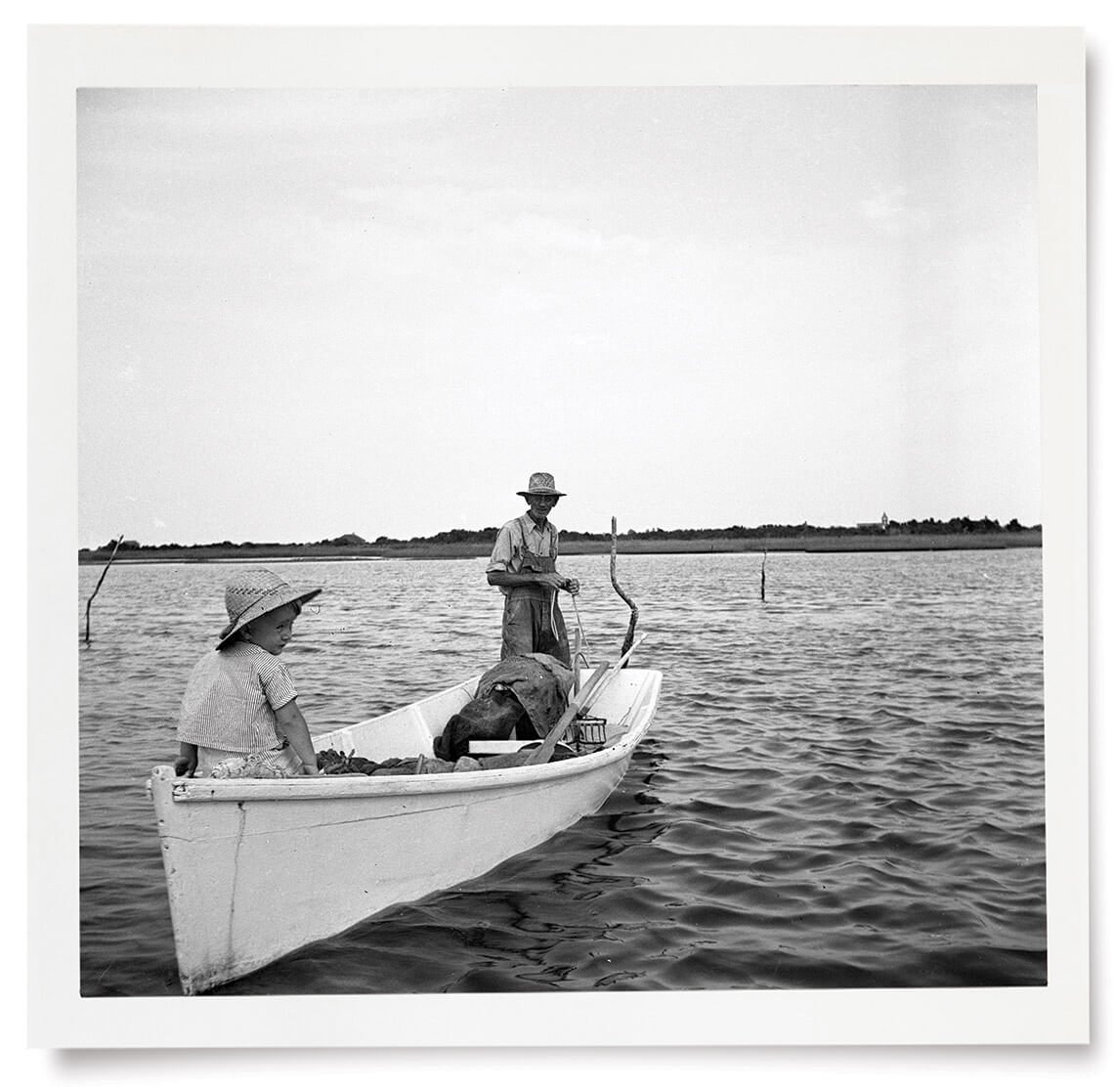
By the 1940s, Portsmouth’s shipping industry was long gone, and its population had dwindled. The residents who remained continued to rely on the water. Photography courtesy of THE OUTER BANKS HISTORY CENTER, STATE ARCHIVES OF NORTH CAROLINA
But the same geography that gave prosperity to Portsmouth would be its ultimate demise. Shoaling had begun to choke the inlet, and in 1846, a hurricane carved the new, deeper Hatteras Inlet to the north. As trade routes began shifting, the era of Portsmouth’s maritime reign was ending.
• • •
Gilgo loops the bowline several times around the dock’s piling and pulls it taut. He unloads the wreaths, tossing them onto the concrete dock littered with fragments of clam shells discarded by hungry gulls. With the sun higher, temperatures have climbed. He sheds his outermost layer and, wreaths in tow, sets off into the quiet village, now part of the Cape Lookout National Seashore. In the desolation of winter, there are no rangers, no tourists — only the sounds of birds and a light wind.
The imprints of Gilgo’s Xtratuf boots join the tracks of raccoons who’ve long retreated in the morning light. Summer’s bright green marsh has turned brown and rigid, and the mosquitoes and no-see-ums that typically swarm thick are gone. His shadow follows behind him on the trail, and sand fiddlers rush to their chimneys, disappearing into the mud. It’s low tide, and oyster beds punctuate the silence as they snap shut in succession. Yellow-rumped warblers join the percussion with their polite tat-a-tats, flitting among blades of needlerush.
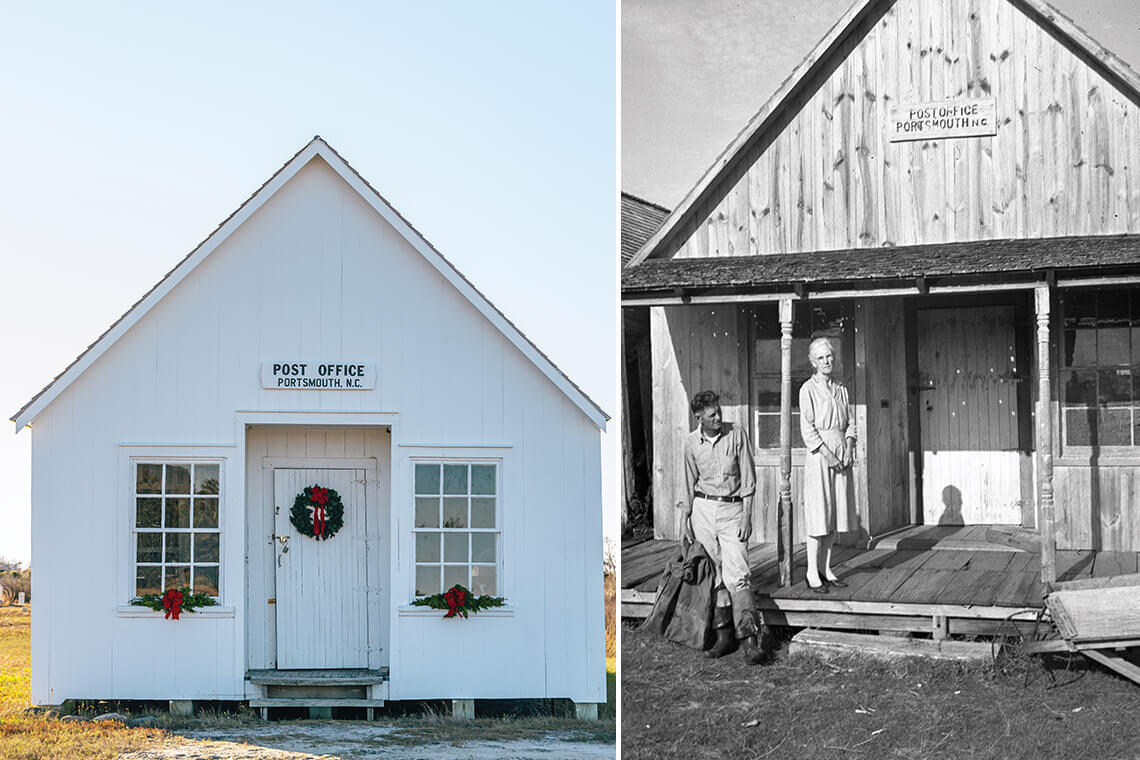
In the 1940s, one of Portsmouth’s few ties to the outside world was its post office and general store — the village gathering place. photograph by Baxter Miller; Historical Photo Courtesy of the Outer Banks History Center, State Archives of North Carolina
Gilgo passes the small white post office and crosses over Doctors Creek. He bypasses the village’s landmark icon, the Methodist church, with his attention fixed on a small gray home a little ways up. There is a reverence and deep pride in his step that can only be born into a person.
He crosses the yard and climbs the two wooden steps up to the porch of the board-and-batten cottage where his grandparents Lionel and Emma Gilgo once lived. The Gilgos called Portsmouth home for generations, but the local school closed in the early ’40s. So when their oldest son was ready to start school, they were forced to move to the mainland.
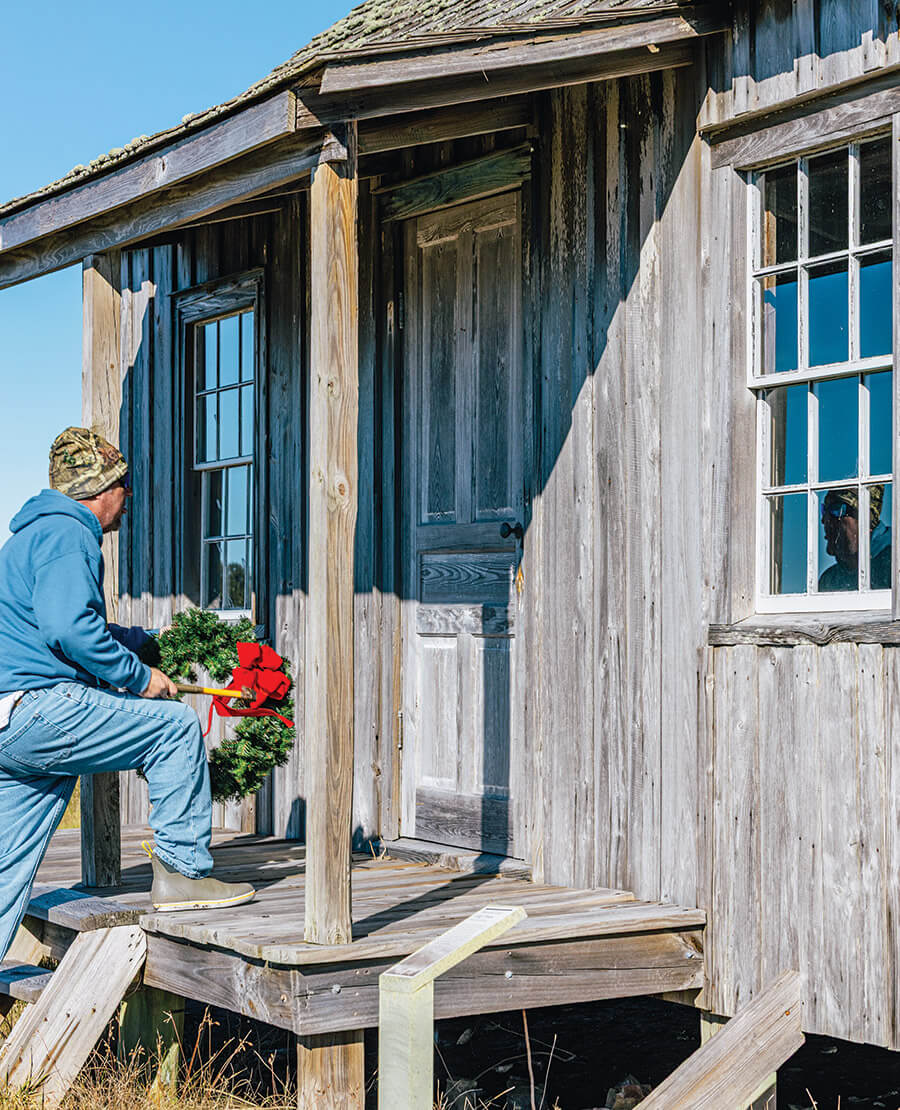
Gregory Gilgo hangs a wreath to the home of his grandparents, Tom and Lucy Gilgo. photograph by Baxter Miller
Gilgo holds a wreath up to the door and steps back as far as his arms allow. Satisfied, he grabs the nail he’s been holding between his teeth and hammers the wreath into place. Once it’s secure, he adds a bow tied by his 79-year-old mother. He adjusts it till it sits just right. Soon, the wind will have its way, but for this moment, the wreath is picture-perfect.
Taking in the place where his uncle first celebrated Christmas morning, he backs off the porch and sets off across the village. As the face of the hammer finds the head of the nail, the ring reverberates across the marsh, its pitch changing as the nail’s shank sinks into the wood. Tap, tap, thud — a notice that the hammer has missed its mark — crisscrosses the village as Gilgo works his way from house to house toward the easternmost edge of the community.
• • •
By the 1880s, shipping routes through Ocracoke Inlet had vanished, and Portsmouth’s population declined as livelihoods disappeared. But those who stayed still depended on the waters around them, and boats remained their salvation. They traded shipping jobs for commercial fishing, and, in 1894, they received a lifeline: a U.S. Life-Saving Service Station.
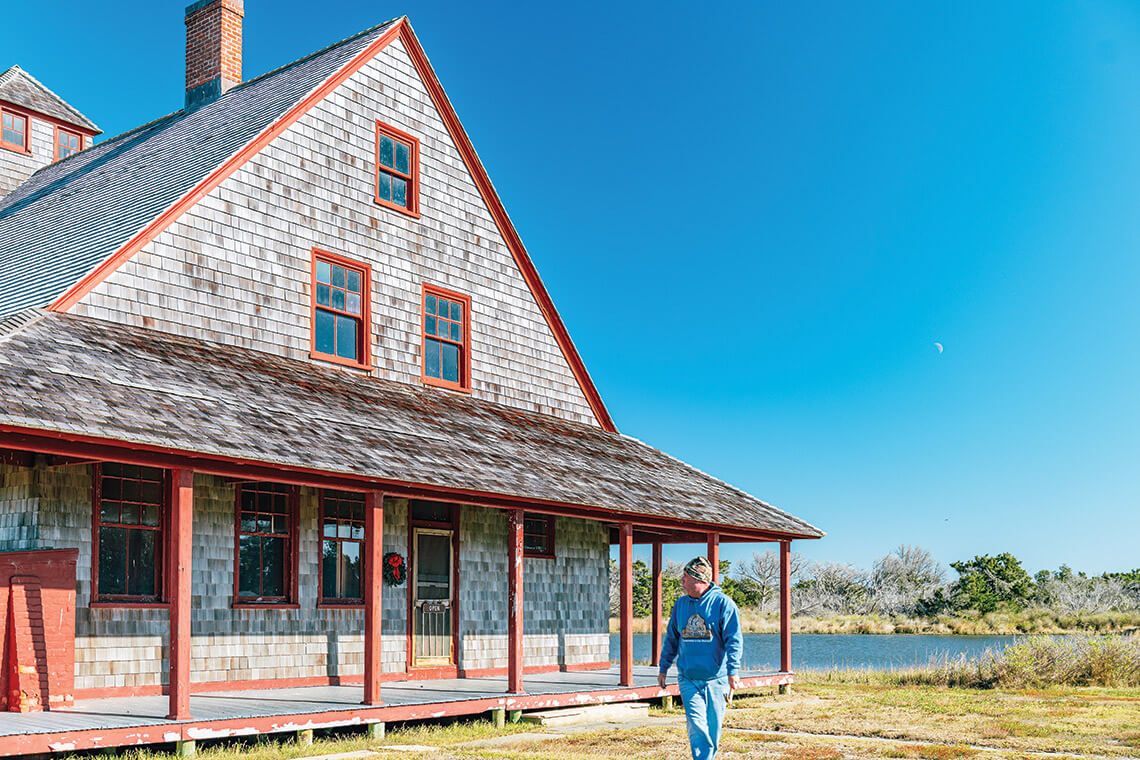
The 1894 Portsmouth Life-Saving Station is the largest building on the island. photograph by Baxter Miller
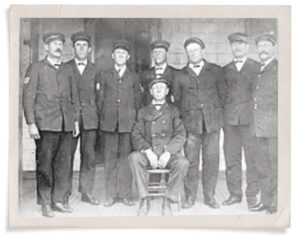
Portsmouth Life-Saving Station’s 1910 crew included Wash Roberts (far left), who participated in the record-setting rescue of the Vera Cruz VII in 1903. Photography courtesy of National Park Service
Erected to aid shipwrecked mariners, the largest building in the village holds countless maritime stories — some tragic, some fortunate, all heroic. Among them was the 1903 rescue of the Vera Cruz VII, in which 421 victims were saved from peril. To date, it remains the largest rescue from a single vessel in North Carolina’s history.
The Life-Saving Service provided reliable employment, served a vital role in the community, and, in its ultimate purpose, saved countless lives. But it could not save the community itself. By 1940, with the station decommissioned and shipping gone, only 42 permanent residents remained. Among them were Gilgo’s grandparents.
• • •
After hanging the final wreath on the Life-Saving Station, Gilgo still has the village’s crown jewel, the Methodist church, left to decorate. He heads east, following the hollow roar of the ocean toward the grove of cedars and yaupon separating the village from the Atlantic. He passes a path leading to the graves of two sea captains from the early 1800s and climbs into the edge of the brush, past prickly pears and sandspurs, in search of tender cedar boughs.
Piece by piece, he selects young shoots, their fresh growth tinged with chartreuse, tucking them underneath his arm as he goes. When he can fit no more, he turns back toward the village, the steeple his guide, a piney scent tinging the salt air in his wake.
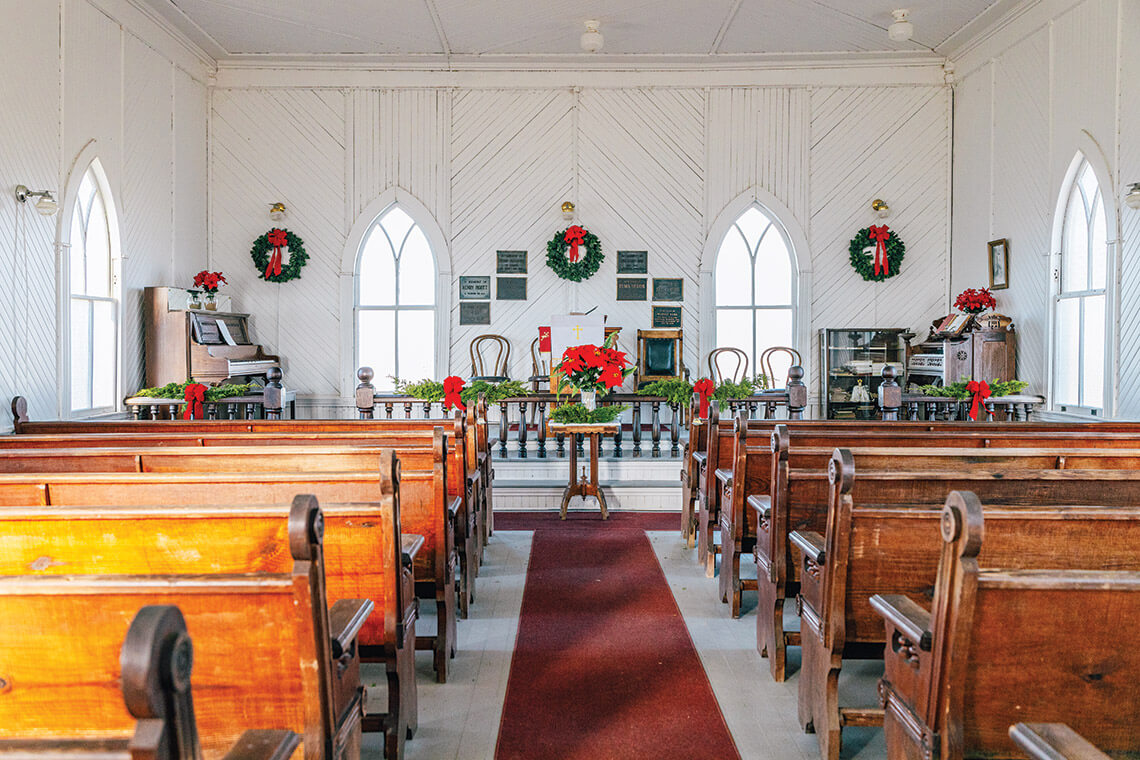
As Gilgo works, he reflects on his family’s ties to the village at the Methodist church. photograph by Baxter Miller
On the steps of the church, the center of spiritual and community life, Gilgo assembles boughs of greenery for the windowsills and altar. He opens the double doors leading into the vestibule and steps inside the 1915 building, where the floors tilt slightly to the right — a lasting reminder of a hurricane that shifted the foundation 80 years prior.
The quiet loneliness of the village is amplified here. In the shelter of the sanctuary, Gilgo goes about completing his work, carrying on a tradition started many years ago by Pat Austin and Chester Lynn of Ocracoke, both steadfast guardians of Portsmouth Island history and heritage. He decks the piano with faux poinsettia stems, adorns the wall behind the pulpit with wreaths, and lines the altar rail with freshly tied boughs.
Now, as the late afternoon sun shines through the starburst-patterned glass windows, a warm light spills across the old wooden pews, creating sharply angled shadows that complement the dramatic diagonal pattern of the tongue-and-groove walls. The faint scent of crisp cedar bleeds from the altar to the vestibule. Finished, he assesses his work, standing in the stillness with dust motes suspended in the surrounding light.
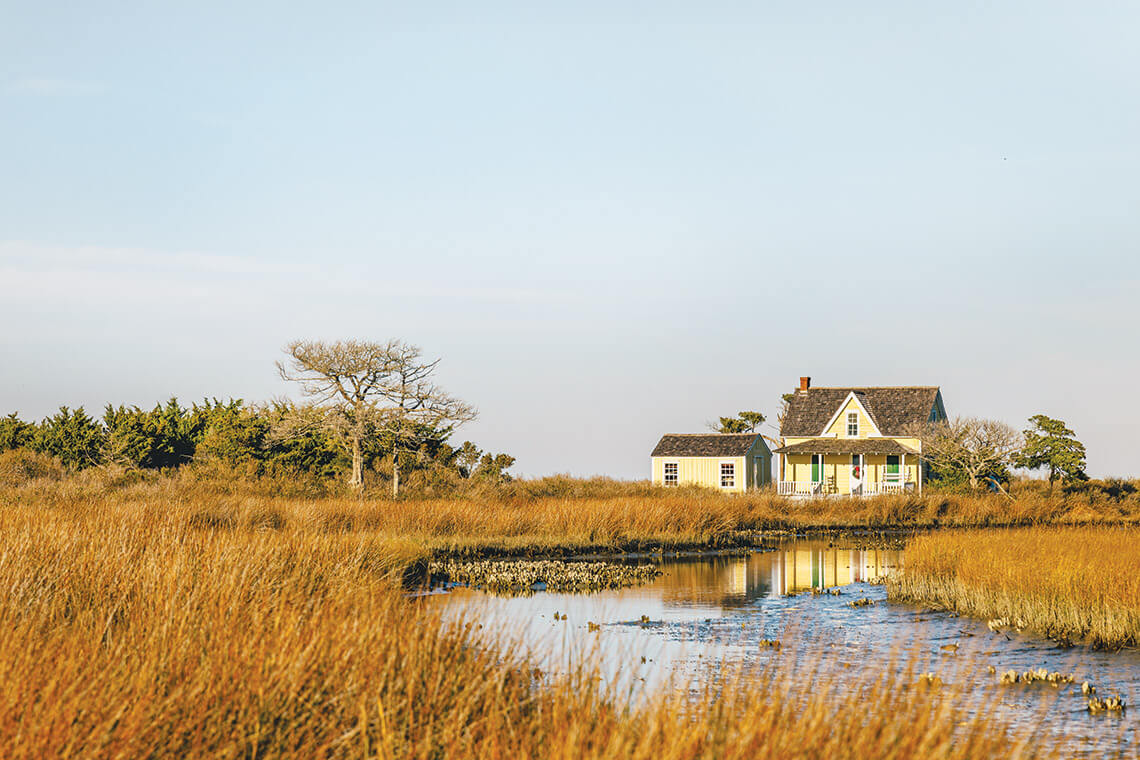
Gilgo decorates Portsmouth landmarks like the circa-1902 Henry Pigott House. Pigott was one of the village’s last three permanent residents. photograph by Baxter Miller
His father — a carpenter and commercial fisherman who worshiped during homecomings in this same church — passed away about six months prior. In this moment, the loss deepens Gilgo’s connection to this place and the meaning of the Christmas season. Satisfied with the job, he turns to leave, his work now done. He may be one of only a few handfuls of people who ever see these decorations, and that is enough.
The last two residents of Portsmouth Village left in 1971, marking a new chapter in this sacred place’s history that spans more than two centuries and today lives on only in the hearts and minds of those connected to these shifting sands. As Gilgo returns to the dock, following the same path as the two women who left 50-some years earlier, the wind has died down, and the water is slick ca’m, reflecting the golden light. In the quiet, you can hear the sandy dirt settling beneath your shoes and, if you listen closely, the sounds of generations of islanders celebrating the Christmas season.