Put ramekins on a baking sheet. Bake for 25-35 minutes, until puffed and golden. Remove from oven, and let stand for 5 minutes. With a flexible spatula, remove strata to
Listen as the pages of the magazine come to life in the Storytellers podcast showcasing the voices of Our State writers. Each podcast episode features a writer reading their column
Listen as the pages of the magazine come to life in the Storytellers podcast showcasing the voices of Our State writers. Each podcast episode features a writer reading their column
A blue crab sandwich reminds our editor in chief that North Carolina’s delicate coastline fuels the journey from water to hand — creating a seasonal flavor that lures us back time and again.
Listen as the pages of the magazine come to life in the Storytellers podcast showcasing the voices of Our State writers. Each podcast episode features a writer reading their column aloud, allowing each distinct voice to shine. Click below to listen to Editor in Chief Elizabeth Hudson read her column aloud.
I’ll admit, the name, I Got Your Crabs — the kind of phrase you’d expect to hear hollered from rowdy kids or see plastered on a bumper sticker — threw me at first. And the location seemed unlikely for coastal seafood: no dock, no weathered pier, but a storefront anchored to the end of a strip mall in Kitty Hawk, beside a Papa Johns along the busy stretch of U.S. Highway 158.
I’d come here for soft-shell season, and I’d heard this was the place for North Carolina blues — crabs pulled straight from Currituck and Albemarle sounds, likely by the owner himself, Hunter Stuart, a third-generation waterman.
Inside, I took a seat at the bar, and the server rolled out a sheet of brown butcher paper in front of me, a clean slate for the messy, beautiful work ahead.
A soft-shell crab sandwich is unlike anything else you’ll eat in North Carolina. It’s a chaotic assembly, the bun struggling to contain the whole thing, a simultaneous hit of salt, crunch, and tenderness. With that first bite, you realize you’re the end point of a long, unseen chain: water to crab pot, pot to boat, boat to dock, dock to kitchen, hand to hand. It’s easy to forget how much effort sits behind something this simple.
As I enjoyed my lunch, a man beside me leaned over, collapsing the space between strangers in that easy way people do in places like this, where the food is this good.
“They do it right here,” he said, meaning the catch, the quality, the cleaning, the care. And I understood that what made this sandwich so good wasn’t just the seasoning or the frying, but the fact that someone you could identify by name had pulled this meal out of the waters that morning.
How thankful I am to know that places like this — restaurants, docks, markets — exist up and down the entire coast of our state, each one another link in the strand, an interconnected sequence of people passing the harvest forward.
In the summer of 1985, I wore a puka shell necklace until the string grew thin and the shells began to gray. It was an inexpensive souvenir bought from a beach shop I’ve long since forgotten, but I loved that necklace, loved the weight of it, the way those tiny calcium-white fragments were strung together in a continuous loop.
Our coast is held together by that same delicate tension. It’s a fragile, circular line of work and weather, of grit and grace, bound by necessity and pride. It’s a labor that begins in darkness, way before dawn, in weather we don’t feel, in conditions we don’t see. We live, many of us, at the far end of that chain, far enough away that sometimes we forget there is a chain at all.
But in the height of beach season, when the screen doors of our favorite markets and fish houses swing open, we get a chance to trust that what holds together will keep holding — that if we pay attention, if we choose with care, if we honor what’s been placed in front of us, we might help keep the chain forever whole.
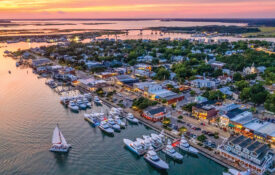
At both the turn of the century and today, Beaufort’s waterfront has attracted a hum of commerce and community. At its heart, a historic avenue tells that history, from the stately double-porched homes to the sound of ships announcing their arrival at port.





 Listen as the pages of the magazine come to life in the