Weil Sawyer always has a few pre-concert jitters when we collect in the parlor. Having played alongside Sawyer since I was 13, this gathering has become a bit of a ritual. He takes a seat next to the cellist and crosses his legs, his foot shaking with nerves. He wears concert black, including a new button-up shirt that his wife, Tara, picked out. The shirt doesn’t have to be tucked, which is good for Sawyer. Every bit the artist, he often falls victim to misplaced sheet music or untucked shirttails. He and I crack jokes, and he always gets the most tickled, his gentle nature never succumbing to the pressure.
Following the initial bow, Sawyer climbs the bench and begins gently tapping the keys. The organ sits on the sanctuary floor of Gordon Street Christian Church in Kinston, the church Sawyer and I attend and perform. As he presses a key, a signal travels to a pipe above, and a mechanism called a bellows pushes air through it. From their perch above the pulpit, the pipes exhale, yip, or belt. Weil pushes the tonal landscape outwards, filling the open air of our 110-year-old sanctuary.
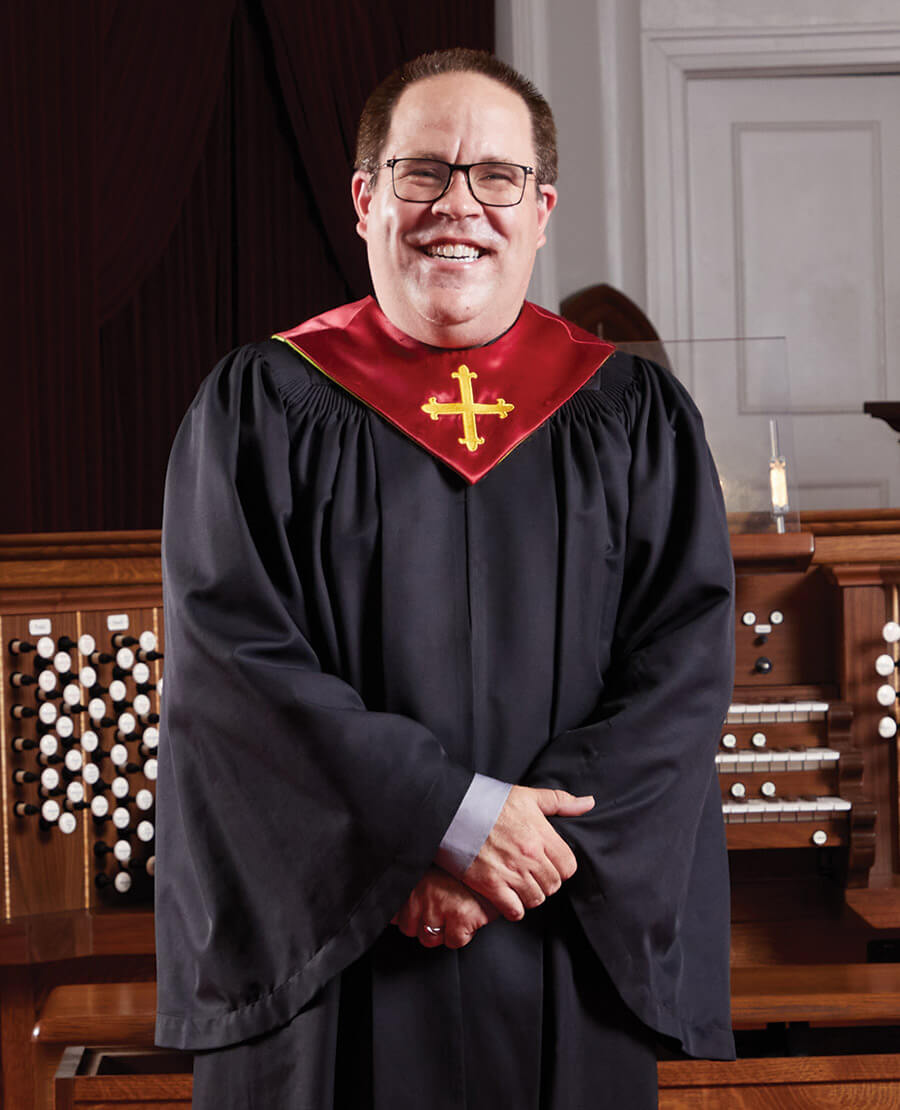
Weil Sawyer photograph by Chris Rogers
At the keys is a place that has always felt comfortable to Sawyer, having sounded out melodies before he learned to sound out words. He was just 10 years old when he first played for a church service at Salem United Methodist Church in his hometown of Goldsboro. “My granddaddy took me because my parents were tied up,” he tells me. “I’ll never forget that old country church.” Sawyer’s parents were both organists and had started him with piano lessons when he was 3.
By 2000, Sawyer had received his high school diploma, along with a few national and international titles from the National Guild of Piano Teachers of the American College of Musicians. He went on to pursue an organ performance degree at the University of North Carolina School of the Arts, but by his graduation in 2004, he had developed a calling beyond performance.
“I wanted to give back to my community what I had been given,” he says. So, he earned a master’s in organ performance from East Carolina University in 2008, along with his teacher license, before settling back down in Lenoir County. On weekdays, he works in the school system. On weekends, he’s at the organ — whether accompanying hymns or performing sonatas in our afternoon concerts.
• • •
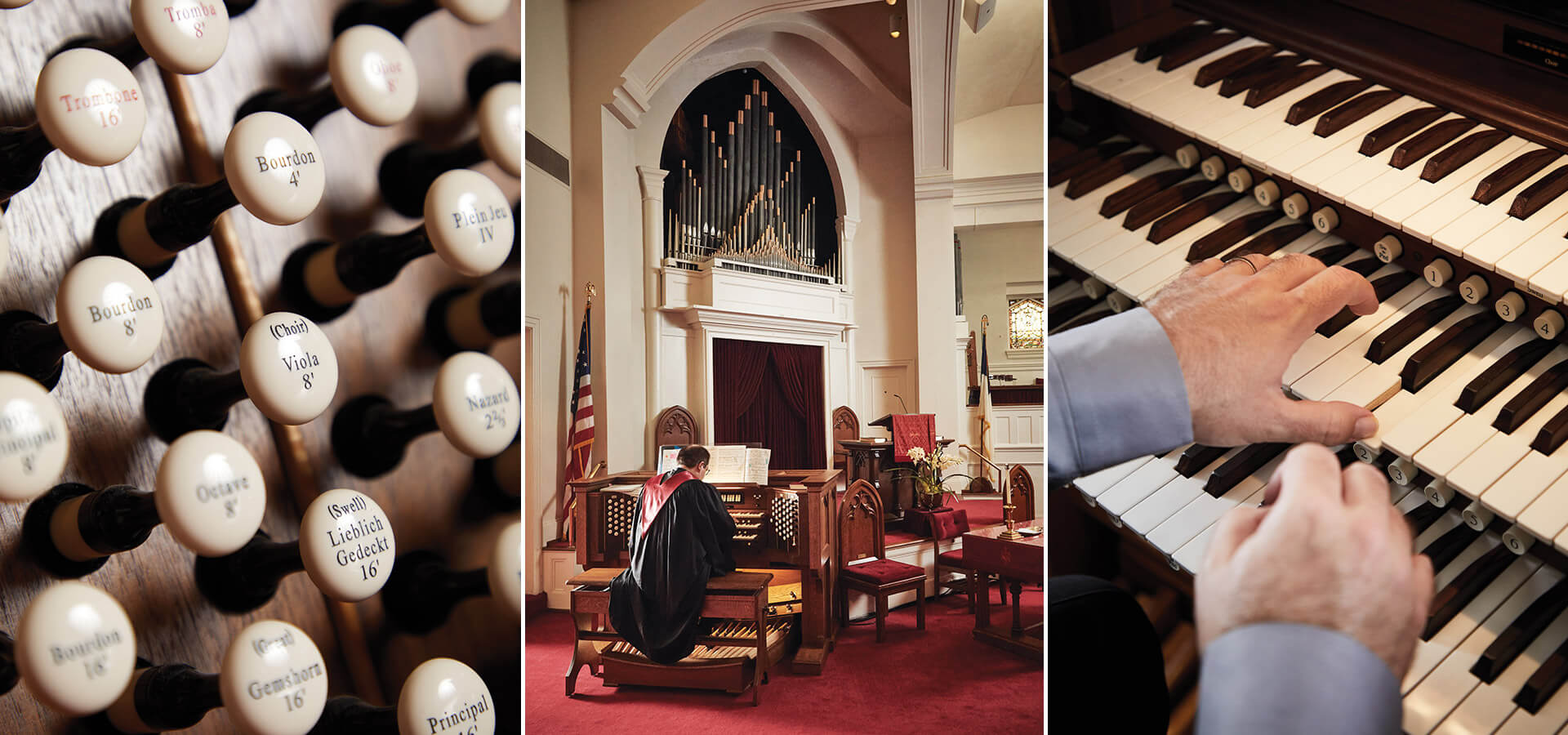
Keys, pedals, buttons, and pipes are Sawyer’s tools for creating his church’s soundscape. When he sits at the organ, three tiers of keyboards ascend in front of him. Each keyboard, called a manual, commands a division of pipes: the Choir, the Great, and the Swell. Stops line up to Sawyer’s left and right, each knob-like mechanism containing an electronic sound. Sawyer can select a horn for fanfare or a bell to chime the hour — whatever embellishment is needed.
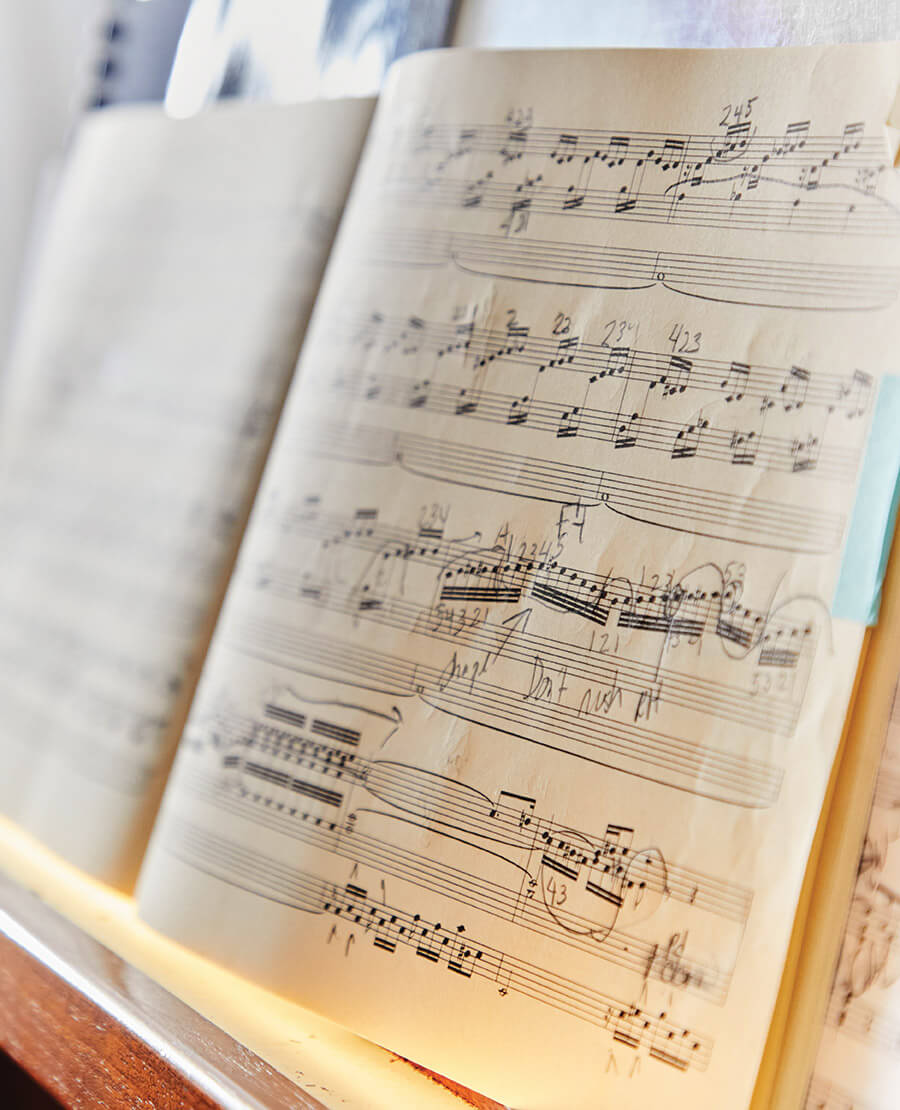
Sawyer’s annotated sheet music guides his Sunday morning melodies. photograph by Chris Rogers
The Choir, Great, and Swell each have their own register and distinct character. A composer may call for the musician to use one or lay them together using switch-like couplers. But much is left to the organist’s interpretation — painting the soundscape for milestones and celebrations.
“I like to use a wide variety of sounds,” Sawyer says. “Part of the artistry is registration, or how I orchestrate the sounds.” For the doxology on Easter morning, Sawyer may choose the joy and reverence of the Great. For a funeral meditation, the Choir’s lushness may feel more appropriate. At Sawyer’s hands live the voice of sorrow and the triumph of celebration.
• • •
While the organ has maintained its majesty through the ages, Sawyer feels organists are fighting for the instrument’s relevance in the modern church and concert hall. Having had a natural connection to the organ, he hopes to create that feeling for others.
“A lot of times, the organ is misunderstood … It’s a very musical instrument,” he says. “It can be expressive — the softest of the soft, the loudest of the loud. It can connect and invoke feelings of joy, melancholy, solemnity.”
“[The organ] can connect and invoke feelings of joy, melancholy, solemnity.”
Even as the organ’s favor wanes, Sawyer stands steadfast at its helm. He says our congregation’s support is what keeps him coming back each Sunday. With its arched ceilings and burgundy carpet, Gordon Street may be old and traditional, but it has a buoyant spirit and the same openness to the arts that first drew Sawyer in.
In traditional churches like ours, a bell chimes the hour to end the service and begin the postlude. Folks turn to catch up with neighbors while others herd family toward the door. This was our routine as well, until Sawyer arrived in 2013.
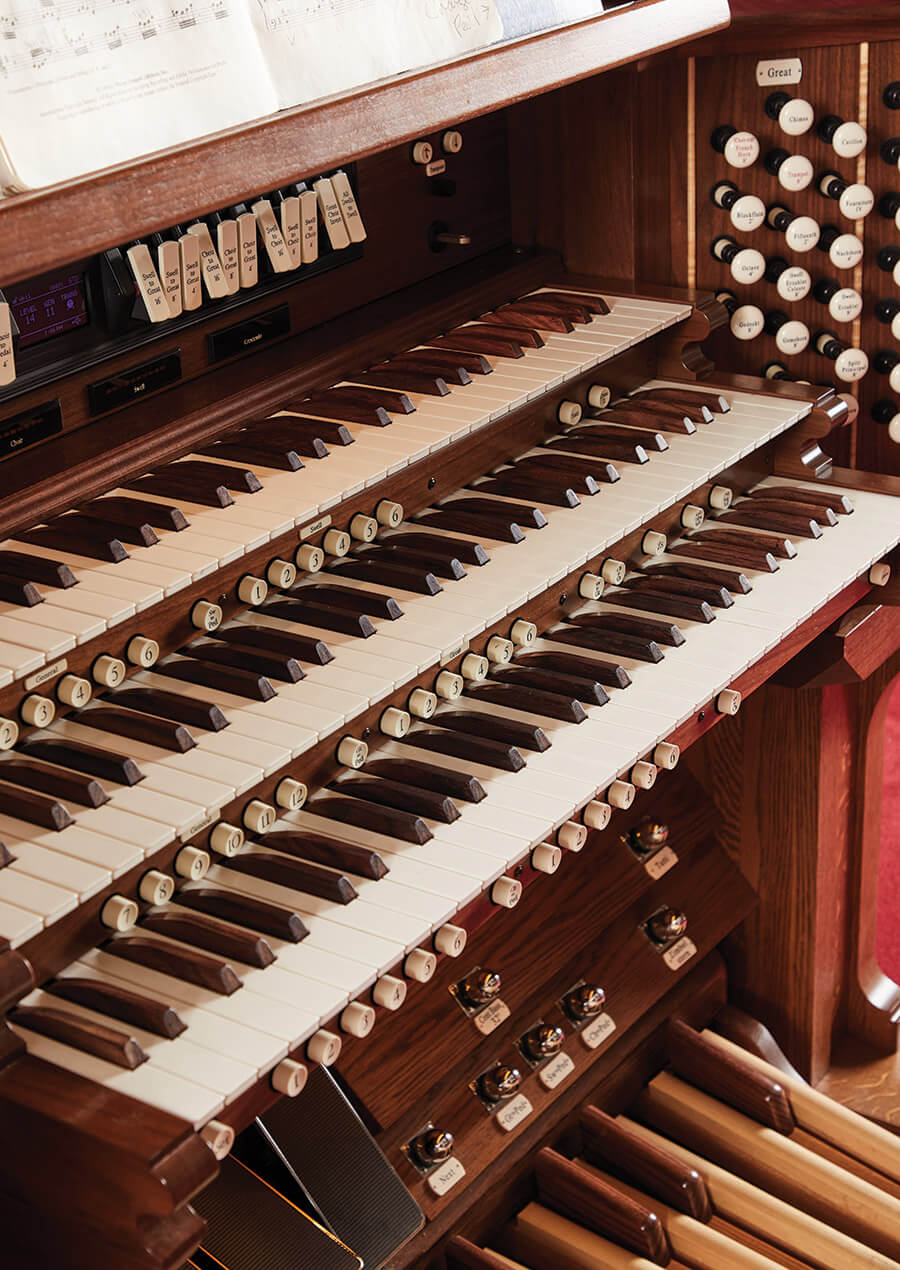
Sawyer plays a three-manual hybrid organ that combines electronic elements with parts from its predecessor. photograph by Chris Rogers
Early on, when the noon sun saturated the stained glass and the bell chimed the hour, the postlude began, and the congregation began their routine — then Sawyer put his hands to the keys.
He drew melodies out of the Great. Plucked motifs from the Swell. He danced on each manual, then layered them so. Pulling bell and horn stops, he never dwelled in one place for long. As whole fanfares erupted at his feet, his glasses barely clung to the tip of his nose. We watched, his soft nature eclipsed by an uninhibited celebration — his own joyful noise.
He sounded the final chords and let go, the air still. That Sunday, my church broke tradition, ending the service with great applause. I remember thinking, So that’s the organ. Sawyer dismounted the bench and faced us, seemingly tickled. It appeared the jitters had returned, but he was beaming.
Gordon Street Christian Church
118 East Gordon Street
Kinston, NC 28501
(252) 523-4143
gordonstreetchurch.com