 Listen as the pages of the magazine come to life in the Storytellers podcast featuring the voices of Our State writers. Each podcast episode features a writer reading their column aloud, allowing each distinct voice to shine. Click below to listen to Eddie read his column aloud.
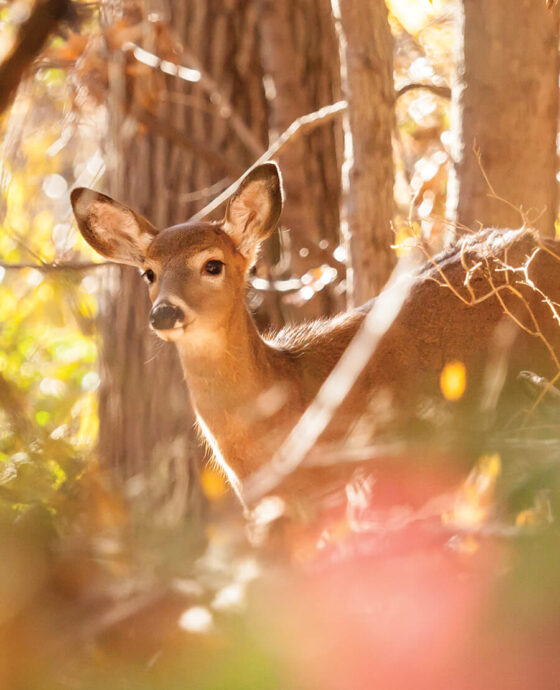
The deer emerge silent as fog, as if the mist and blackberry brambles and dark dawn shadows of the big oaks suddenly transform into flesh and tawny hide. I have been watching and watching, and there were no deer. They were not there in the field corner, and not there in the open woods, and not there by the pond dam — and then suddenly there are four of them. Right there in front of me. I am merely 50 yards away, 15 feet high in a tree stand, and my heart leaps. I love watching deer, and I love it when they materialize out of nowhere, as if these rolling Alamance County hills suddenly spat them out from Deep Earth.
I’m waiting for a buck, which is true, but I am waiting for one so large that my chances of seeing him are very slim. That’s OK. I knew that when my alarm went off at 4 a.m. So I watch. Two young deer feed side by side — siblings, I suspect, and small enough that they were likely spotted fawns just a few weeks ago. One saunters over to the other and horns in on a particularly green patch of some kind of goodness. The other takes a few steps back, submissively. I laugh to myself. I have kids. I’ve seen this before. “You’ll get yours one day,” I whisper to the feeding deer.
In November, in every corner of North Carolina, the secret societies of deer step out of the field mists and forest shadows.
I watch a lone spike buck — so young his antlers haven’t forked yet — skirt the field edge, unsure of himself, goofy and gangly. Then I follow Mama’s gaze toward the pond, and there he is, just a-walkin’ down the street: The troublemaker. The young kid from homeroom class, eyeing her girls. A four-point buck, spindly of antler, but young and full of it. He might not be a bad apple, but good moms take no chances. Mama stomps her right front hoof. I see you.
Am I anthropomorphizing? Heck, yeah. How else would I stay awake this early? I watch these deer — four, then six, then seven — until I realize that perhaps I don’t want to see a big buck at all. What I want to see is right here in front of me. In November, in every corner of North Carolina, the secret societies of white-tailed deer step out of the field mists and forest shadows.
They were not there and not there, and suddenly they are there. And this time of year, they seem to be everywhere.
• • •
If you’ve never sat in a tree before, in the hazy light of a November dawn, and watched deer in a Coastal Plain cornfield, or deer deep in a Piedmont hardwood draw, or watched a big mother doe stare down a pair of middling-size bucks atop an Appalachian ridgeline, I can only say: Wow, are you missing out.
When all you see are glimpses of white-tailed deer by the roadside or in your headlights, you are missing out. Just beyond the wood’s edge, entire societies of wildlife thrive. White-tailed deer most successfully breed during a brief window, called the rut, and individual does are typically receptive to bucks for only a single 24-hour period. That means the ancient clock of life for the entire species rides on a few weeks of intense activity.
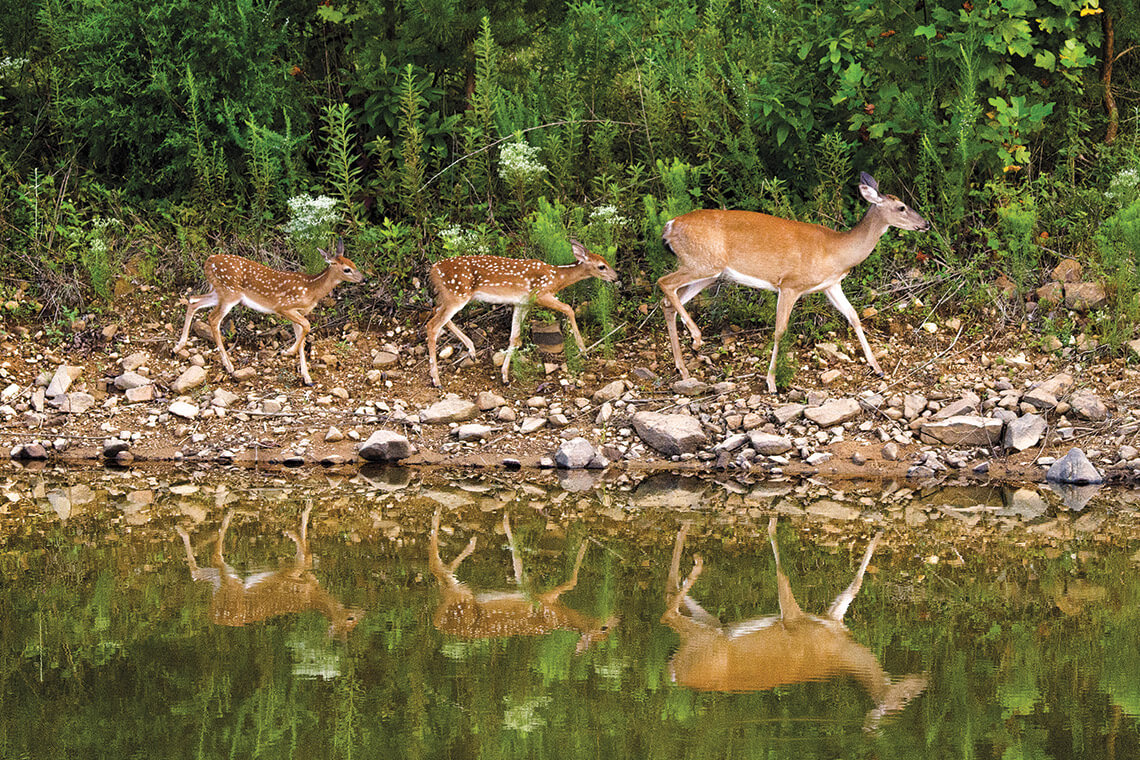
In Randolph County, does shepherd their fawns around the Lewis Tract, showing them how to forage, find water, and avoid predators. photograph by Eric Abernethy
In tucked-away corners of farm fields and meadows, deer snort and wheeze and mew to each other. They play like young goats, and fight like young boxers, and listen to their moms, and steer clear of their old man, who’s had a long day at work. The bucks chase the does through the woods, through your backyard, through the highway medians.
All year long, deer are out there, hidden away. But at this time of year, they drop their guards. Yes, there is a rifle beside me. But there are also binoculars around my neck, and I use the latter far more than the former.
It is a magical time to be in a tree.
• • •
I love how Henry Beston described the secret lives of animals. “In a world older and more complete than ours,” he wrote in The Outermost House: A Year of Life on the Great Beach of Cape Cod, “they move finished and complete … They are not brethren, they are not underlings; they are other nations, caught with ourselves in the net of life and time, fellow prisoners of the splendour and travail of the earth.”
Long ago, those words and how they framed what I see from my tree changed how I look at wild lives, from the chickadee to the bear. I understand now that the yellow-bellied sapsucker rat-a-tat-tatting overhead might well be feeling the pressure of its upcoming flight to Central America. The opossum sauntering through the pines needs to get back to its den before daylight reveals its home. Every glimpse of a bird, mammal, or even insect is an encounter with another being in the purposeful pursuit of life. These are not chance meetings with creatures wandering willy-nilly through the woods. They are involved in the serious work of living — foraging food, finding mates, and raising new generations. These “other nations” exist under our noses, entire communities dependent on each other, just like us. It’s a privilege to enter their worlds, even if surreptitiously.
“We need another and a wiser and perhaps a more mystical concept of animals.”
Over the next half-hour, the deer in the field make their way to the distant wood’s edge. Another doe and her fawn join the group. I feel like I’m watching a playdate at the local park. Then, in a matter of seconds, they vanish into the timber. The field turns quiet again. Lifeless. It happens so quickly: They are there, and then they are not.
“We need another and a wiser and perhaps a more mystical concept of animals,” Beston wrote. High in the tree, I think about this and figure that I’m two out of three in agreement. We do need a different concept of animals, and a wiser one. But not a more mystical perspective. There is nothing mystical about the lives I’ve just witnessed on the edge of the woods. They are as real as I am. They are fellow travelers.
print it