Put ramekins on a baking sheet. Bake for 25-35 minutes, until puffed and golden. Remove from oven, and let stand for 5 minutes. With a flexible spatula, remove strata to
Listen as the pages of the magazine come to life in the Storytellers podcast showcasing the voices of Our State writers. Each podcast episode features a writer reading their column
Listen as the pages of the magazine come to life in the Storytellers podcast showcasing the voices of Our State writers. Each podcast episode features a writer reading their column
Listen as the pages of the magazine come to life in the Storytellers podcast showcasing the voices of Our State writers. Each podcast episode features a writer reading their column aloud, allowing each distinct voice to shine. Click below to listen to Eleanor read her column aloud.
’Tis the season for mistletoe to tumble from treetops. We tie it by its toes. We hang it over our thresholds. We wait beneath its smooth, Grinch-green curls of leaves and pearl-round, white berries, hopeful for a kiss.
’Tis the season to stand under the mistletoe, but others have stood in its tangles above us well before it came to our doorways. In the treetops, more creatures than you’ll find around a stable’s manger make themselves at home with one of North Carolina’s most beloved parasites.
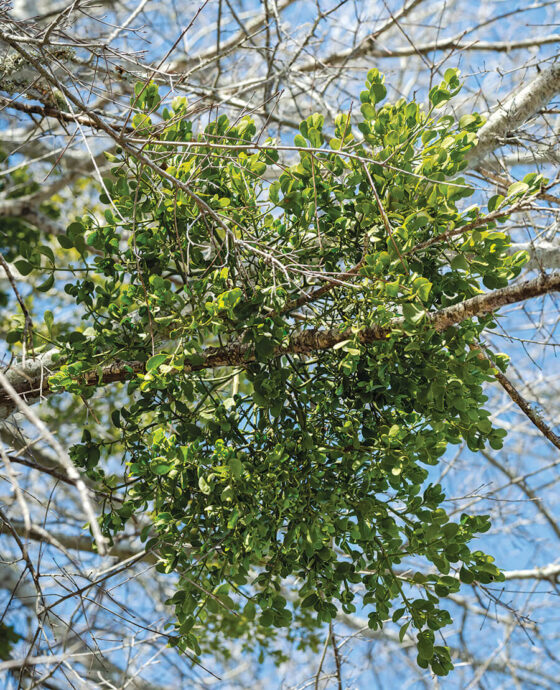
American mistletoe grows on more than 100 tree species. In winter, its sticky, white fruit serves as important meals for hungry birds like cedar waxwings and mockingbirds. Birds pluck the fruits, wiping their seed-covered beaks on branches as they eat, and their seed-filled droppings land on trees. Mistletoe’s sticky seeds become glued to the branches, then snake root-like filaments into the tree’s tissue and begin to grow.
“North Carolina’s mistletoe species has the scientific name Phoradendron leucarpum,” says entomologist and botanist Bill Reynolds. “Phoradendron is derived from Greek and means ‘thief of the tree.’ ”
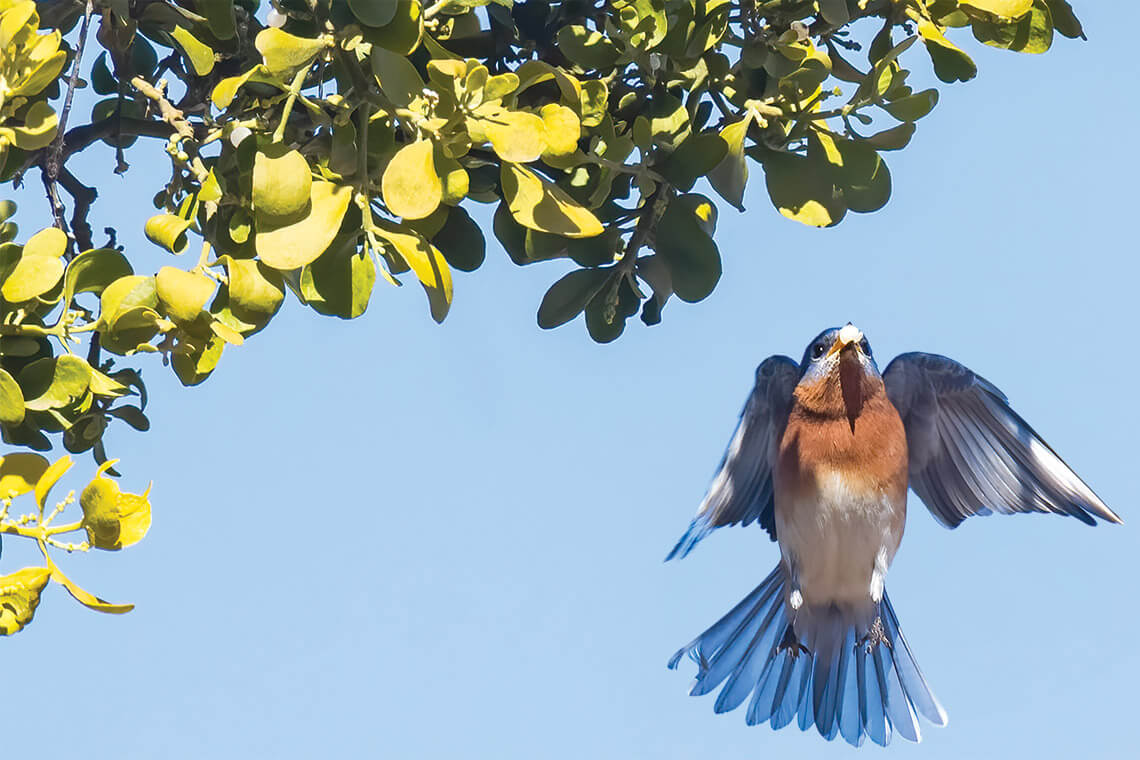
Eastern bluebirds are one of many avian species that feast on sticky, white mistletoe berries growing high in tree canopies. photograph by Samantha Starr Nature Photography
Mistletoe uses trees for nutrients and water, which it slurps from tree branches as it grows into a leafy tangle of plant. Sure, it thieves, but it rarely kills healthy trees. Instead, it adds another layer of life to the outdoors. The animals take notice.
“If you look at all of that green, it kind of looks like a dense, bushy cloud in the tree,” Reynolds says. “Have you ever seen an airplane vanish for a second in a cloud? Well, birds use mistletoe like that to vanish from predators. It’s often cover for many bird species.”
Birds like robins, bluebirds, chickadees, nuthatches, pine siskins, pigeons, and mourning doves all nest in the tree thief, and they hide there when danger rears its head. Then, they eat — and spread its seeds from tree to tree.
“If you see a lot of mistletoe in a forest, you can guess correctly that there’s a healthy bird population,” Reynolds says.
Owls and other raptors claim the larger plants for soft breeding sites.
Furred animals like chipmunks, squirrels, and deer all eat it, and some of the smaller ones nest in its tender, evergreen leaves, too.
“Some of our ancestors are from Europe, which has a highly toxic mistletoe species,” Reynolds says. “That’s where we get the impression that mistletoe can kill you. Here, it can make you or your pets sick, but it’s not likely to do you in.”
Other winged animals need mistletoe, too. Hairstreak butterflies — some of the most beautiful in the United States — feed on its leaves as caterpillars and sip nectar from its flowers as adults.
“The great purple hairstreak depends on mistletoe for survival,” Reynolds says. “It’s the single host plant for its larvae.”
Shimmering blue-brown, with flashes of orange, great purple hairstreaks flit and wiggle high in the treetops with mistletoe. “Many of us don’t realize when we’re outside, we’re walking under the wings of these amazing butterflies,” Reynolds says. If you can’t see that high, look to goldenrod and native asters. “They spend a lot of time in the canopy but will come down to meadows,” he says.
• • •
This is the hour for gifts, for love and unexpected joy found in unexpected places. In a baby, a star, in candles burning out the darkness of long winter nights. In the sticky, milk-colored berries that feed the voices singing on cold winter days, the green leaves of shelter, the rainbow of wings wrapped up tight like a present, reminding us all, each of us, that spring will come.
At both the turn of the century and today, Beaufort’s waterfront has attracted a hum of commerce and community. At its heart, a historic avenue tells that history, from the stately double-porched homes to the sound of ships announcing their arrival at port.



 Listen as the pages of the magazine come to life in the