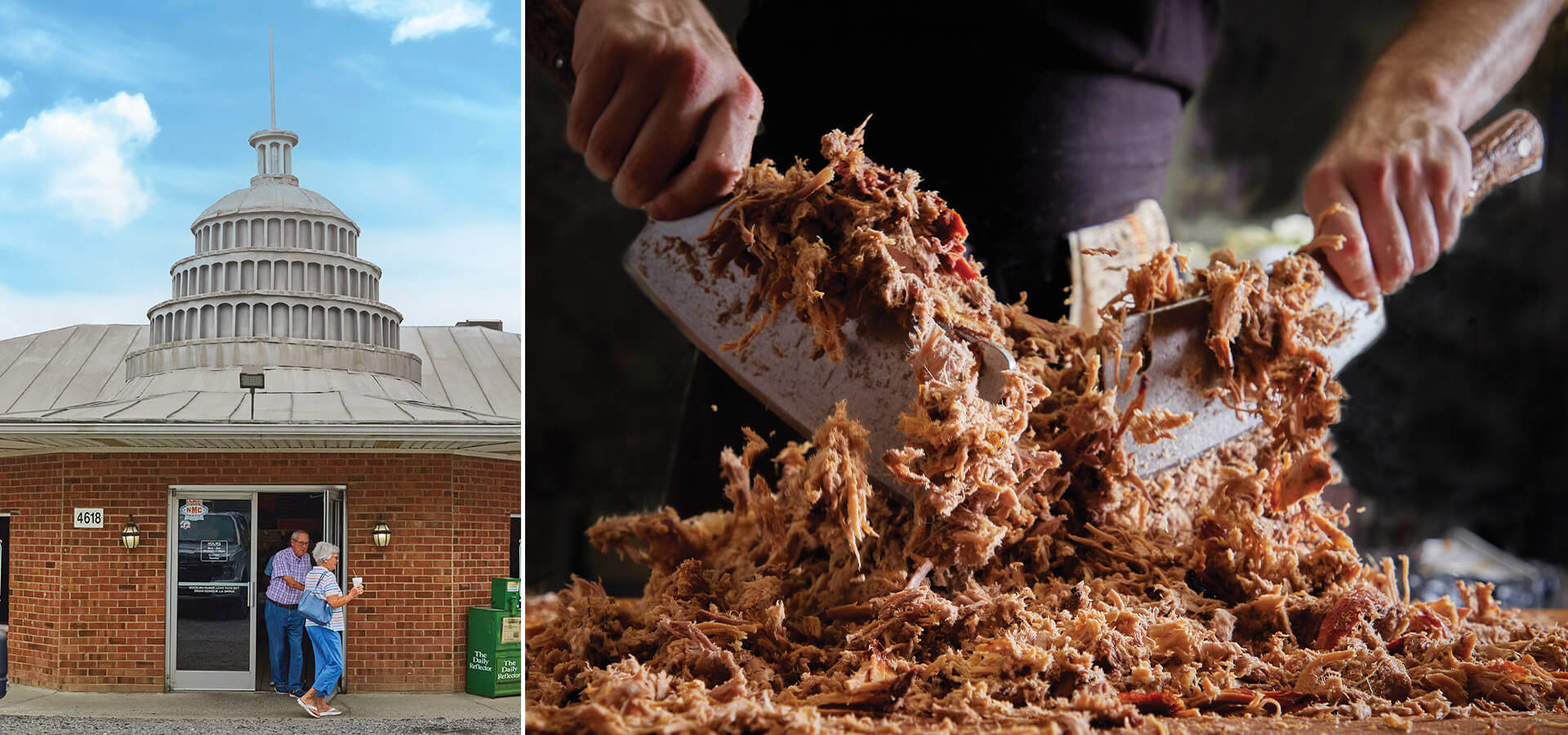
Cover my eyes with a blindfold, drive me to an unknown location, and I’d know immediately that I was in North Carolina — if I heard just one sound: the steady whack-whack-whack of a cleaver on a wooden cutting board as properly cooked pork is turned into a pile of barbecue.
Nothing else sounds exactly like it, and no other place — not Georgia, not Texas, not Kansas City — prepares its barbecue exactly this way. You can slice brisket and whack pork slabs into ribs. You can hack smoked chicken into the usual drums, wings, and thighs. But for pork barbecue — real pork, our pork — you have to chop.
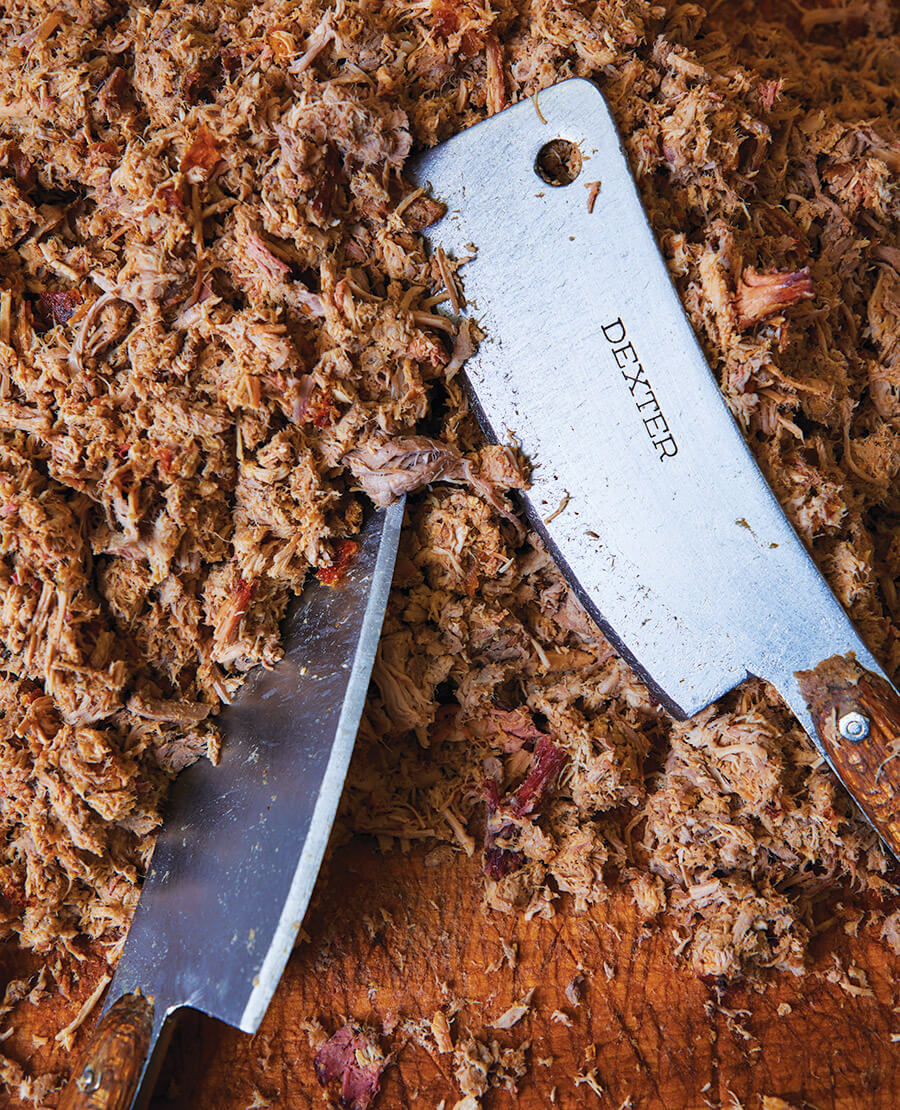
Metal meets wood — the sound of breaking down barbecue is woven into the fabric of North Carolina smokehouses. photograph by Chris Rogers
You have to chop so much, and so vigorously, that you can gauge the authenticity of a barbecue joint by looking at its cutting board. A good restaurant will have a trough carved right into the wood. The first time I went to Canterbury Cathedral in England, I was struck by the troughs worn into the stone steps by nearly 900 years of pilgrims climbing to the shrine to Thomas Becket, many on their knees.
At a North Carolina barbecue joint, it doesn’t take that long to wear out a board. From Red Bridges Barbecue Lodge in Shelby to Skylight Inn BBQ in Ayden, they chop so hard and so much that they wear through a board every six months.
• • •
In my job as the food editor at The Charlotte Observer, I once spent 24 glorious hours hanging around the Skylight. I listened to the murmur of people standing in line, waiting to pick up barbecue to take home. I heard the squeak of the foam-plastic containers as Bruce Jones, the son of the late founder, Pete Jones, filled them with pork from the pile atop a massive wooden slab that was almost worn right through, topping each one with a shingle of cornbread.
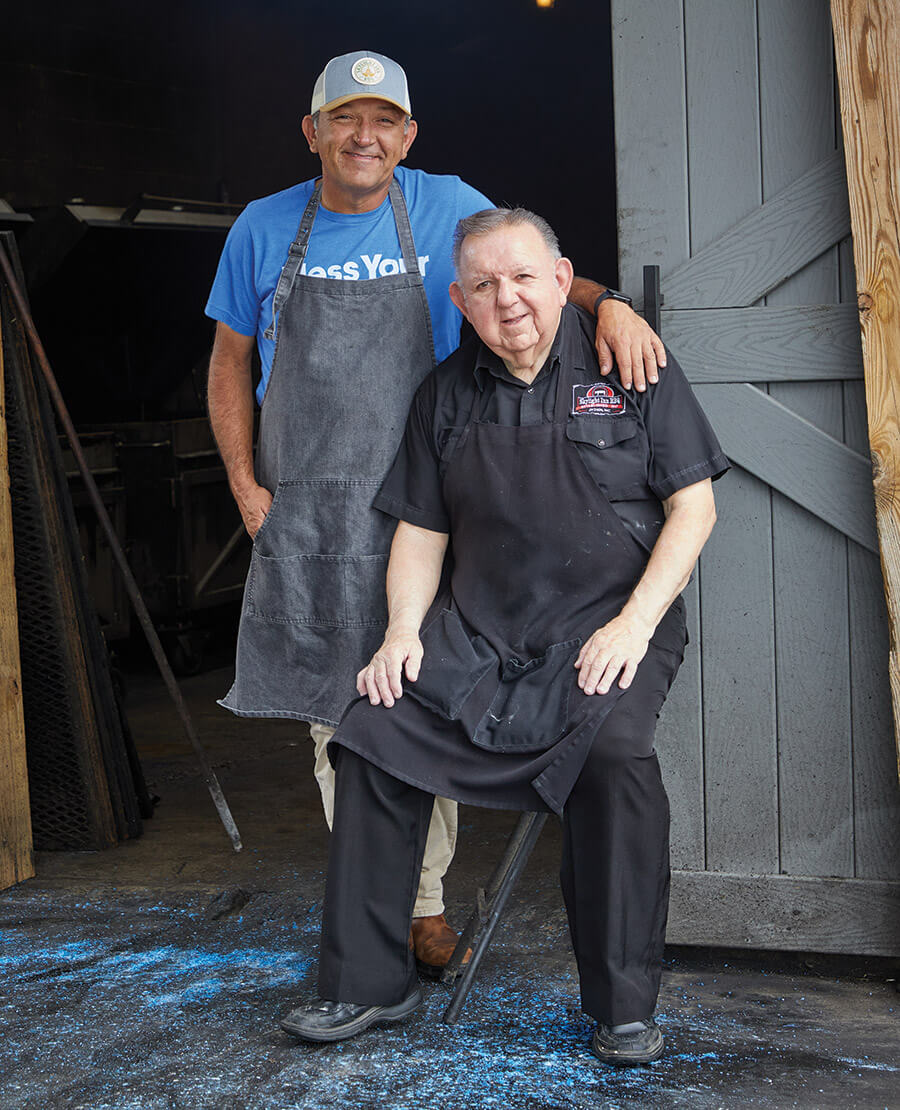
Sam Jones (left) and his father, Bruce — two of the owners of Skylight Inn BBQ — are meat maestros who create beautiful music and delicious barbecue with their cleavers and chopping boards. photograph by Chris Rogers
For me, the best part started behind the restaurant in the late afternoon, as Bruce’s brother Jeff shoveled glowing wood coals under whole hogs in the pits to start the next day’s batch. I was still there at 10 at night, while Jeff banked the fires, rattling down sheet-metal covers on cables to cover the pigs. And I was back again at 5 in the morning, when Jones walked over from his house across the highway. In a clattering wheelbarrow, he hauled loads of wood to tall brick fireplaces to stoke crackling fires. He shoveled more coals into the pits, the metal of the shovel blade raking across the concrete blocks with a twang. When the taut brown pig skins sounded like a drumhead when he tapped them with a knife, they were done.
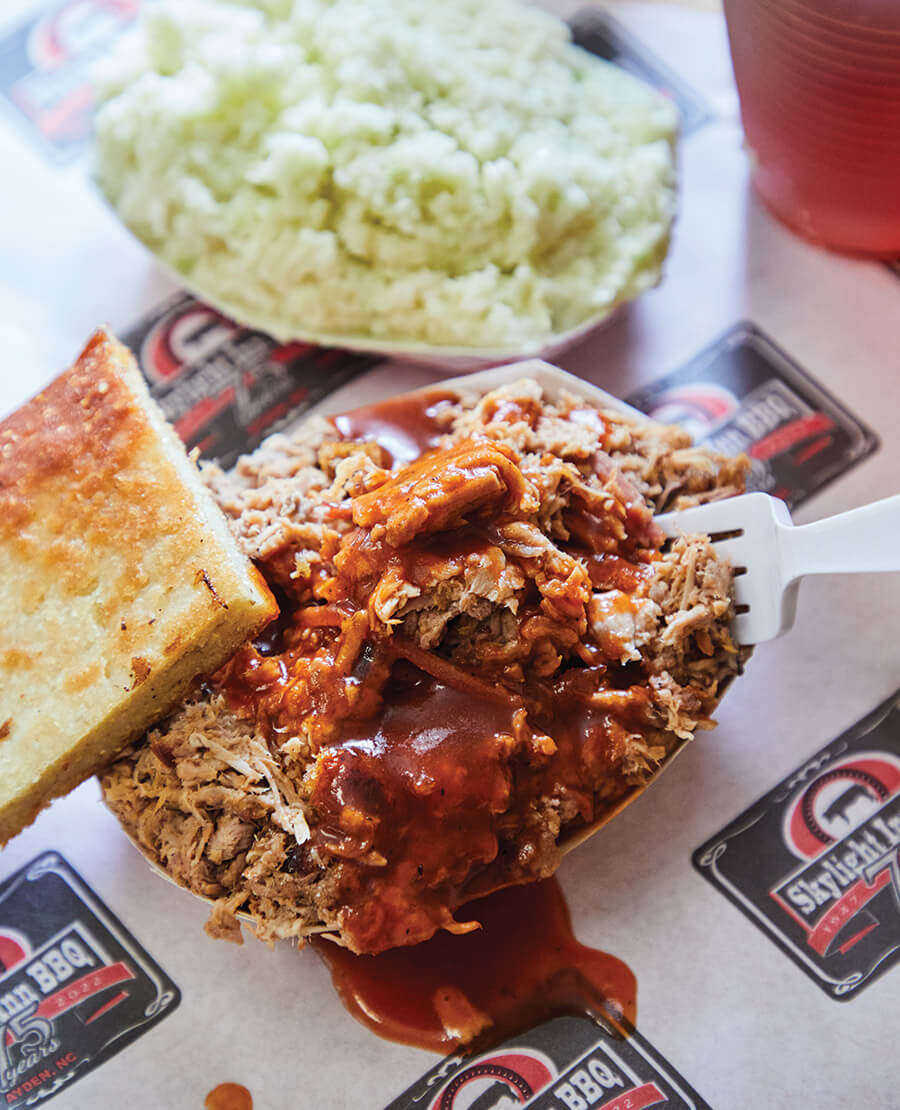
Eastern-style barbecue from Skylight Inn BBQ is served with its signature shingle of cornbread. photograph by Chris Rogers
For a joyous hour, I watched Jones and his helper, James Howell, work together to chop the meat from those pigs, each man using two cleavers at a time: Howell like a jazz drummer, with a steady riff, Jones with his tongue between his teeth, furious and fast.
That’s the thing about that chopping: Everywhere that barbecue is still done the right way — cooked low and slow over wood burned down to coals — it’s always the same. But it’s always different: from rat-a-tats as fast as machine gun blasts, to slower, lighter taps that sound like a cobbler at a bench, putting a sole on a shoe.
• • •
In 40 years of writing about food in North Carolina, I’ve watched the same scene and heard that same sound in dozens of places. I’ve made the sound myself, in my own kitchen, reducing hours of labor and hot coals to a mound of chopped pork. I’ve never quite mastered the double-cleaver action, although I have done it with a cleaver in one hand and a butcher knife in the other, secretly proud of my ability to make my own staccato drumming without losing the tip of a finger.
I called Red Bridges Barbecue Lodge one morning to ask if they still hand-chop their barbecue. I had my answer when the woman on the other end put the phone down while she fetched co-owner Natalie Ramsey, granddaughter of the founders, Red and Lyttle Bridges.
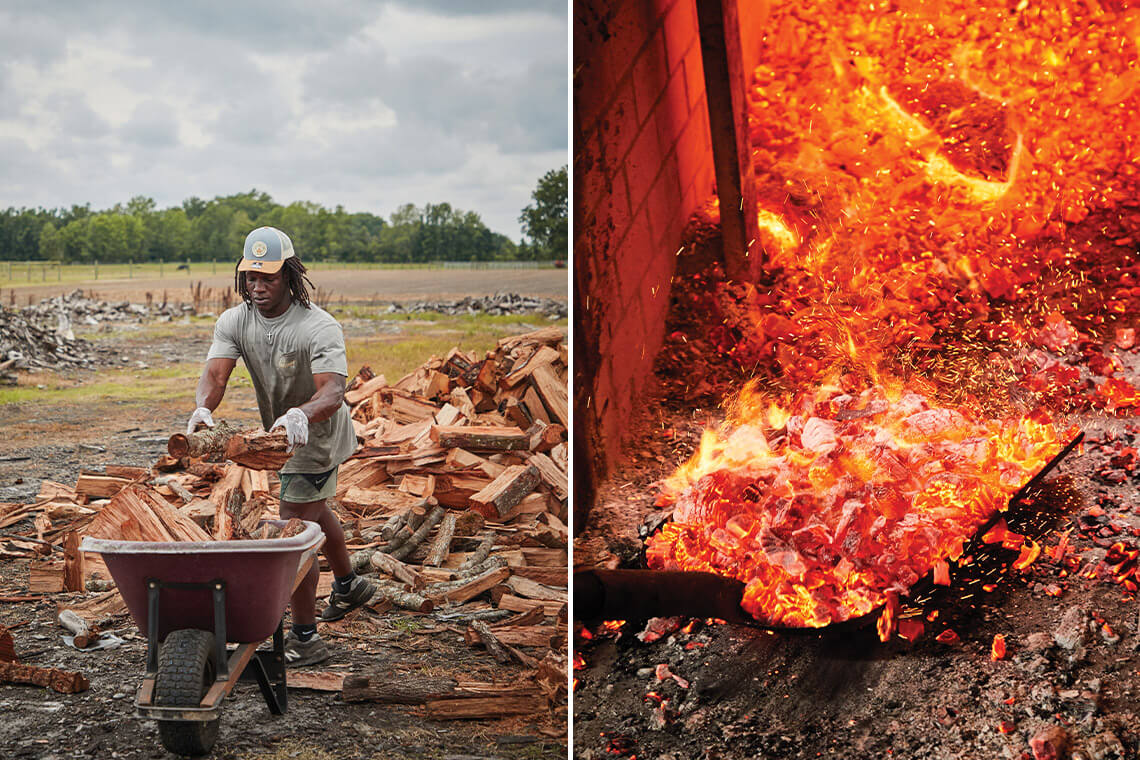
At Skylight Inn BBQ, the sounds behind the meal — the crackle of coals and the thud of hardwood as Brandon Lancaster loads a wheelbarrow — all echo the reward of eastern-style barbecue. photograph by Chris Rogers
Over the din of the morning rush, I could hear it: the distinctive sound of chopping, a background drumming.
Ramsey laughs when I stop by at lunchtime a few days later, eager to talk about chopping. Of course they still do it by hand, she says. “My mamaw’s motto was, ‘If it ain’t broke, don’t fix it.’ ”
Ramsey can’t imagine not hand-chopping because she’s sure they get more meat off the pork shoulders doing it the old way — the right way.
Sitting at Red Bridges, tucking into my plate of coarse-chopped with outside brown, I can hear the tap-tap-tap floating from the kitchen. And I know I’m exactly where I’m supposed to be.