 In the wake of Hurricane Helene, people across the mountains did what they could: planting, building, repairing, creating. These are stories not of grand gestures but of small acts that became the scaffolding of recovery. Read about those who came together to support each other.
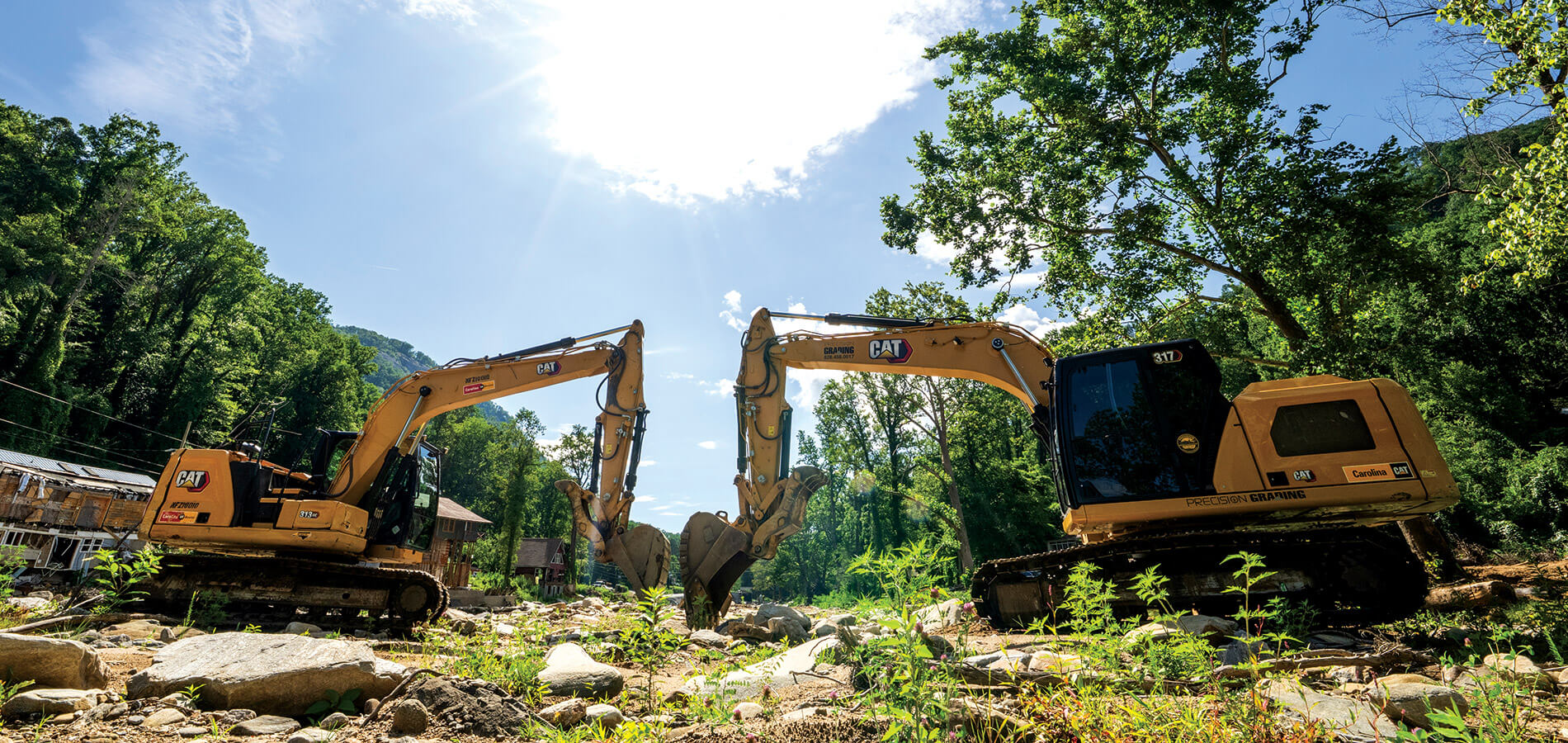
I meet Jake Jarvis of Precision Grading on Day 265: Jarvis numbers the days in his Facebook posts, which he uses to chronicle the all-volunteer work he and his crew have been doing since Helene struck last September. For the most part, he’s worked seven days a week, sunup to sundown.
He tried to call a friend out on NC Highway 9, he tells me, in the days right after the storm. The friend didn’t answer, so Jarvis crewed up one of his trucks and started down toward Bat Cave on U.S. Highway 64. The enormity of the destruction revealed itself slowly: “I remember tearing up and telling my guys to get out and get to work,” Jarvis says. It took hours just to cut the trees and utility poles away from the road. (His friend was OK, but it would take another two weeks to reach him.)
“At the bottom,” Jarvis tells me, “Bat Cave was an island. The bridges were washed out. The fire chief said the roads were gone; people were in trouble. I told him I’d build him a road, get him side-by-side access by the end of the day.”
A side-by-side, I clarify, is a four-wheeler, a UTV. They needed a way for emergency vehicles to reach people trapped and injured by flooding, by mudslides. Jarvis and his crew built the road, built so many roads in the coming days — often, in part, using the foundations of buildings that were gone. Precision Grading has been there, give or take, ever since.
• • •
I came to know of Precision Grading in the weeks after Helene, when we’d gone to Asheville to evacuate my mother-in-law back to Greensboro. News was spotty; I’d crowdsourced a safe route in and out of Asheville and was now deep-diving social media for reliable, local information about when and how the area might get power and water back.
I don’t know if Jarvis’s October 15th post was the first I saw, but it is the one where he says, for the first time, that he would be willing to accept donations. He’d been going house to house, helping people one project at a time, free of charge.
It was costing $3,500 a day (now $4,500 per day) just to run and repair the equipment (excavators, bulldozers, dump trucks) and to pay the crew. At first, Jarvis was running about half on private donations and half on his own funds. He took a private job six weeks in just to make ends meet, but he knew he’d come back into his community.
“But I knew I couldn’t leave the people sitting like they were — and I couldn’t charge them.”
“I’m not really worried about me,” he says when asked whether he was able to pay himself a salary. “But I knew I couldn’t leave the people sitting like they were — and I couldn’t charge them.”
It was the volunteer aspect that kept me coming back to the Precision Grading posts day after day — that, and the photographs. So many bridges, so many driveways, so many homes.
In Green River Cove alone, some 30 homes were washed away or destroyed. Jarvis worked with the riverkeeper there to remove vehicles and septic tanks from the water and put the river back where it was supposed to be. It’s a sentence that doesn’t make sense. Neither does stopping your life to rebuild communities one boulder at a time — unless you can, unless you’re able, and so that’s what Jarvis has been doing.
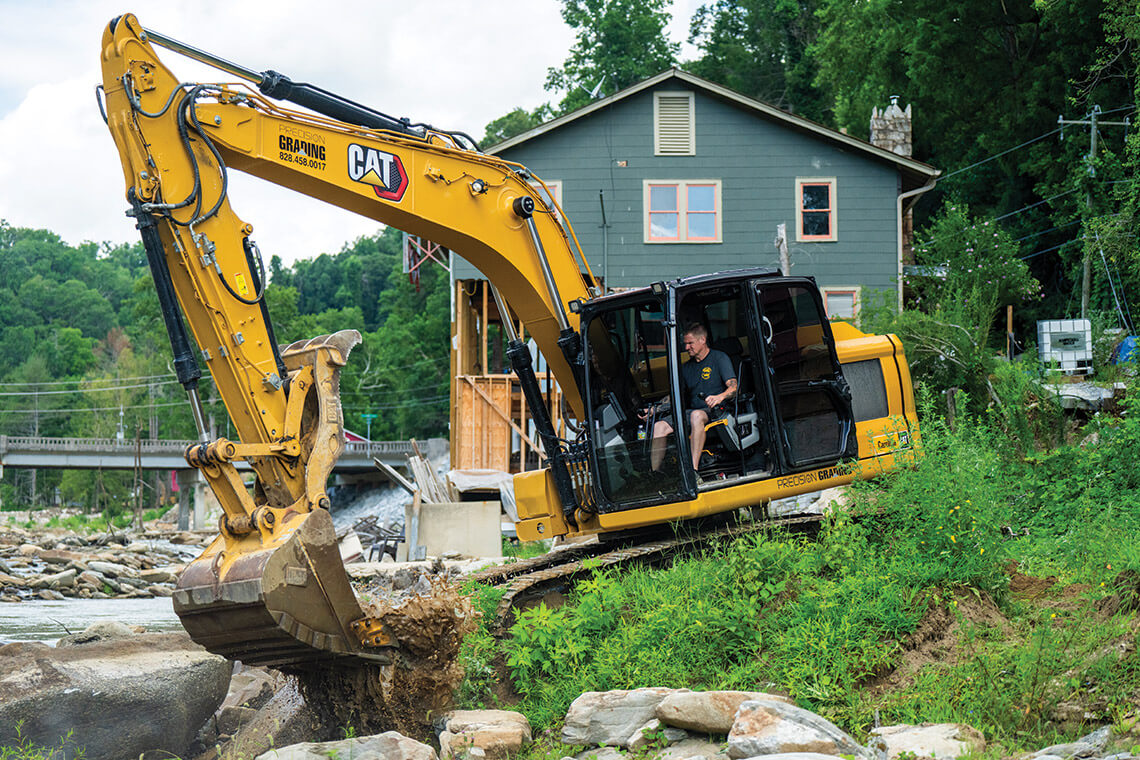
Saluda native Jake Jarvis couldn’t bear to see his neighbors in need — so he fired up his excavators and got to work. photograph by Derek Diluzio
There are donation options in a post pinned to the top of the Precision Grading Facebook page; there is a help list that remains more than 100 people long. People keep coming back onto the list, too, because it keeps raining, hillsides washing away again because so little is stable yet.
Jarvis has a servant’s heart. He stands with me on the side of the road in Bat Cave, activity buzzing around us. There’s so much to do. He’ll be working in the driveway at one job, and a neighbor will walk up, find a way to ask if maybe Jarvis could help them, too. There are signs reading “THANK YOU PRECISION GRADING” hanging off riverside homes he’s saved by rebuilding the riverbank and the bridge across, shoring up foundations.
“How long do you think you’ll have to go?” I ask him.
He sighs, and I can see the stress in his shoulders. “I don’t know if we’re halfway yet.”
• • •
The job Precision Grading is working on today, Day 265, is demolishing a medical center and grading smooth the lot it once stood on. Sixty loads of dirt from this parcel got trucked down the road to fill in land lost at a rebuilt home. Jarvis and his crew are also finishing a camp for a group of traveling Amish and helping Spokes of Hope, a disaster response and relief agency, coordinate volunteers.
Shannon Brookshire, who volunteers at Precision Grading, is also the treasurer for the Saluda Pantry. It’s so much about logistics, she tells me, before apologizing and taking a call: Someone’s donating lubricant for the heavy equipment. A donor in Virginia sent 100 bridge beams. Brookshire’s accent suggests that unlike Jarvis, who’s lived in Saluda all his life (save for a stint in the Air Force; he enlisted after 9/11), she’s not originally from here. “Michigan,” she says. “But after this, I’ll never leave.”
We’re down on a temporary gravel road, in a scoured riverbed that now feels more like a canyon. “I’ve learned how important it is to be around people you can rely on. I’ve never been around such amazing people,” she says. I ask how she met Jarvis, how she came to work for him. “Oh,” she says, and makes a gesture at, well, everything. “This,” she says.
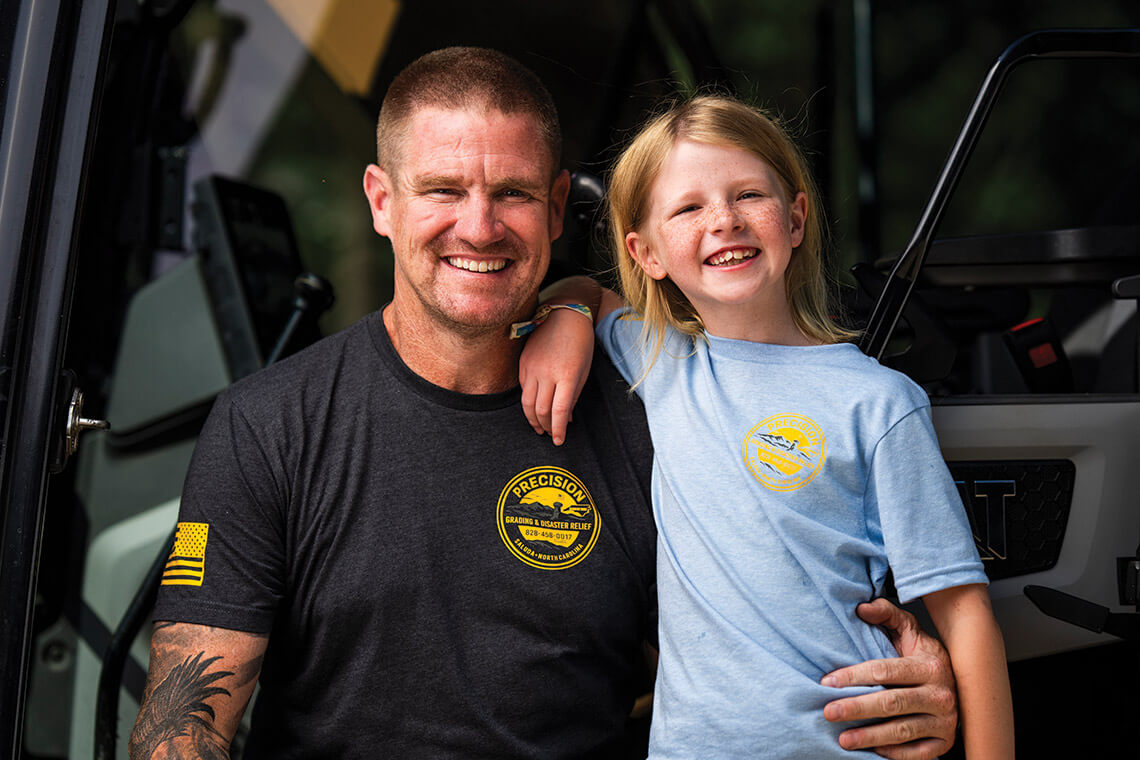
In July, Jarvis was named “America’s Hardest Worker” — a national award in the construction industry. His daughter, Mya, has been with him every step of the way. photograph by Derek Diluzio
Mya, Jarvis’s 9-year-old daughter, had been asleep in the cab of the dump truck. She now walks over, yawning. Jarvis is a single father. Mya’s on emotional support duty, he told me earlier. People find it helps having her around. She came to the worksites with him after school during the year, and they brought a camper to Bat Cave for the summer and weekends: The drive back to Saluda each day had taken a toll.
“It’s so hard,” he says of people watching their homes get taken down. “Took their whole lives to build this — takes us 10 minutes, and their house is in a pile.” Almost nobody had flood insurance. Having Mya there, Jarvis says, seems to ease the burden.
I get down on one knee. Mya’s got a seriousness about her, but also an openness, and maybe something like hope. She’s a kid. Maybe she sees these coves and hollers the way her dad does, as places that are hurting and could use her help.
“What’s the best part?” I start to ask her, but the question’s wrong. She knows what I mean, though, somehow. “Hanging out with him,” she says, meaning her dad. “What do you tell people?” I ask her. “That they’ll get another house, maybe a better one,” she says. She gives a small smile. “You know, positive stuff.”
• • •
Precision Grading’s post for Days 265 and 266 describes the work at the medical center, then notes: “In Chimney Rock we focused on saving the foundation of the Burnt Shirt building on Main Street. It was looking more and more vulnerable every day, and I just decided I couldn’t watch and not act on that property any longer. I took my entire team down there …”
I think that’s my fascination with these posts, and with Precision’s work: Jarvis and his crew cannot watch and not act. Early in the storm recovery, one of the posts noted that Precision Grading was “the only crew down here.” They’re very much not now — Bat Cave and Chimney Rock were crawling with contractors and volunteers the day I visited — but Jarvis has been there from the beginning. One friend didn’t pick up the phone, but entire communities were crying out. Jake Jarvis and his crew had the skills, the equipment, and the heart to help.