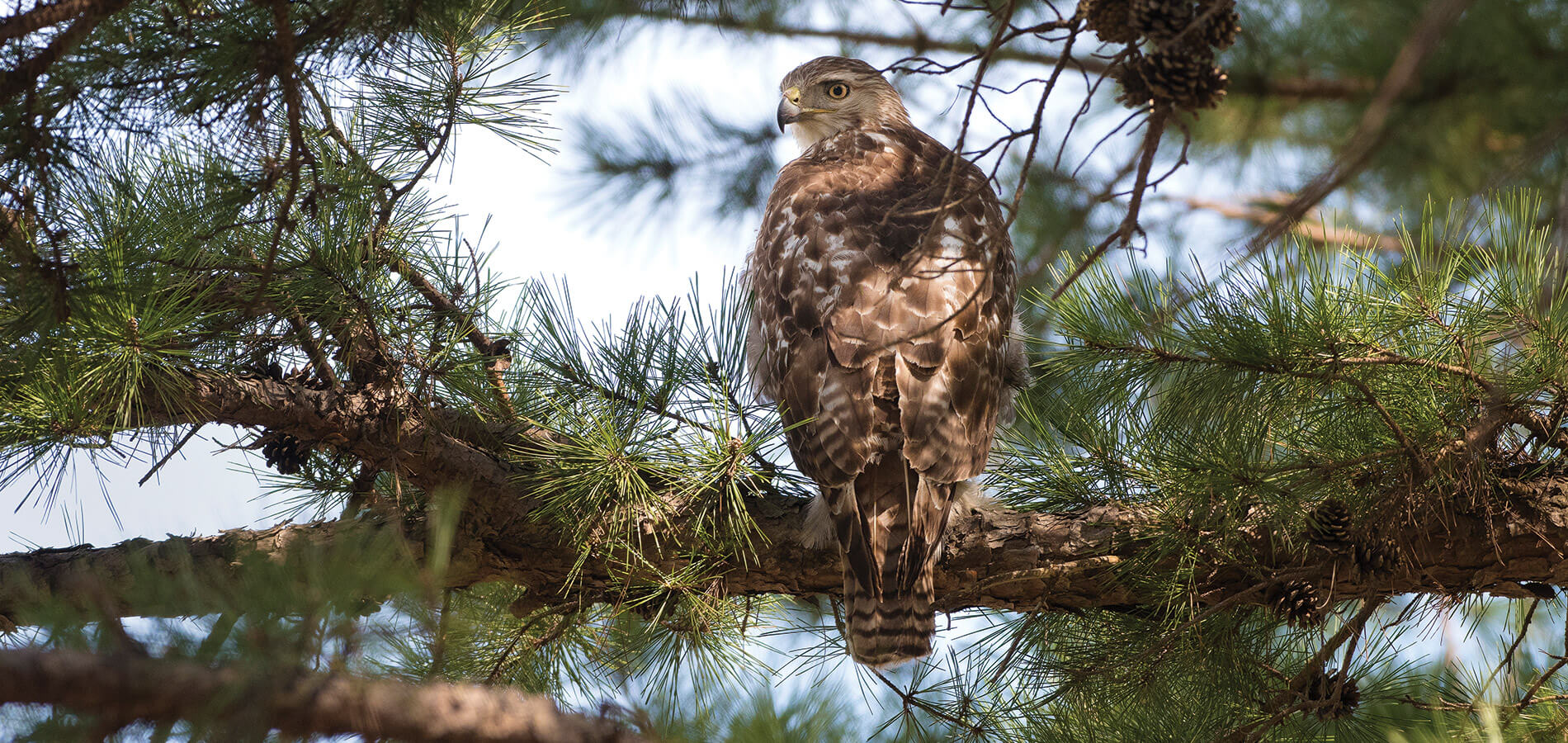
Longleaf pines wake me most mornings in this little corner of the Piedmont. Up in one of those trees lives a red-tailed hawk who has been with me for three years, and if the hiss and creak of the trees in the morning breeze don’t wake me, she will. She screes from her perch, and she screes when she wings it past my window. I never fail to get out of bed when I hear her, perhaps because I am superstitious, or maybe a romantic, or maybe it’s just the early-morning knowledge that the world is thrumming outside, and I’ll miss it if I don’t get going. “Why so loud, girl?”
Time is passing, I imagine her saying. And she’s right; it’s time. I’ve missed a lot; I don’t want to miss any more. I sit down at my worktable. I hear her return to her nest, and together — at least I think of it as together — we get to our work.
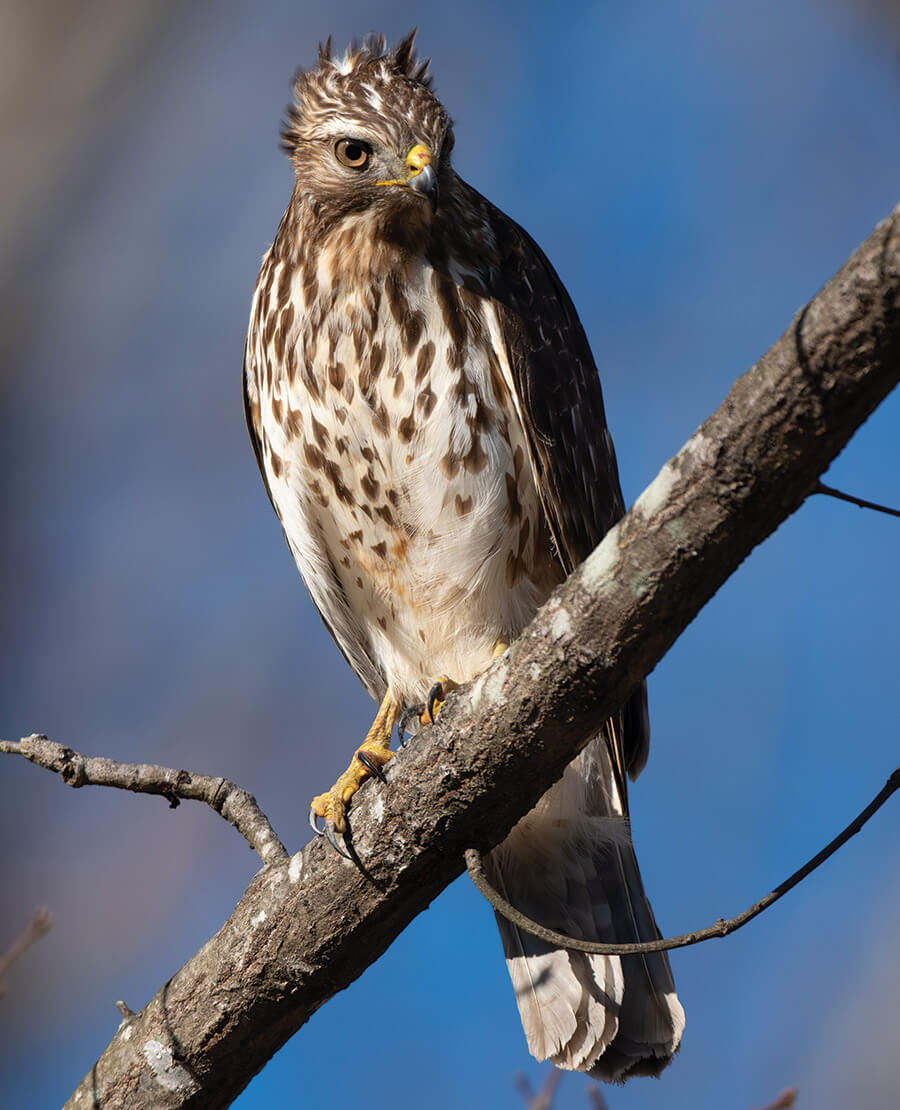
Red-shouldered hawk photograph by Eric Abernethy
I first encountered a red-tailed hawk as a silhouette in a beat-up copy of Peterson’s A Field Guide to the Birds, 1947 edition, which my parents kept close to settle their disputes. They had met at a field biological station, and throughout their marriage, they argued sharply over the identification and Latin names of birds, wildflowers, insects, and mushrooms in a way that was both combative and fond. I think it was the way they talked to each other that first summer, when they fell in love.
My sister and I, neither of us ever to become a scientist, were generally able to grasp what they were arguing over: pattern and shape recognition, color awareness, behavior, environment, the way the world felt when you reached out and touched it. But with birds, they added sound and language, which made my parents seem magical.
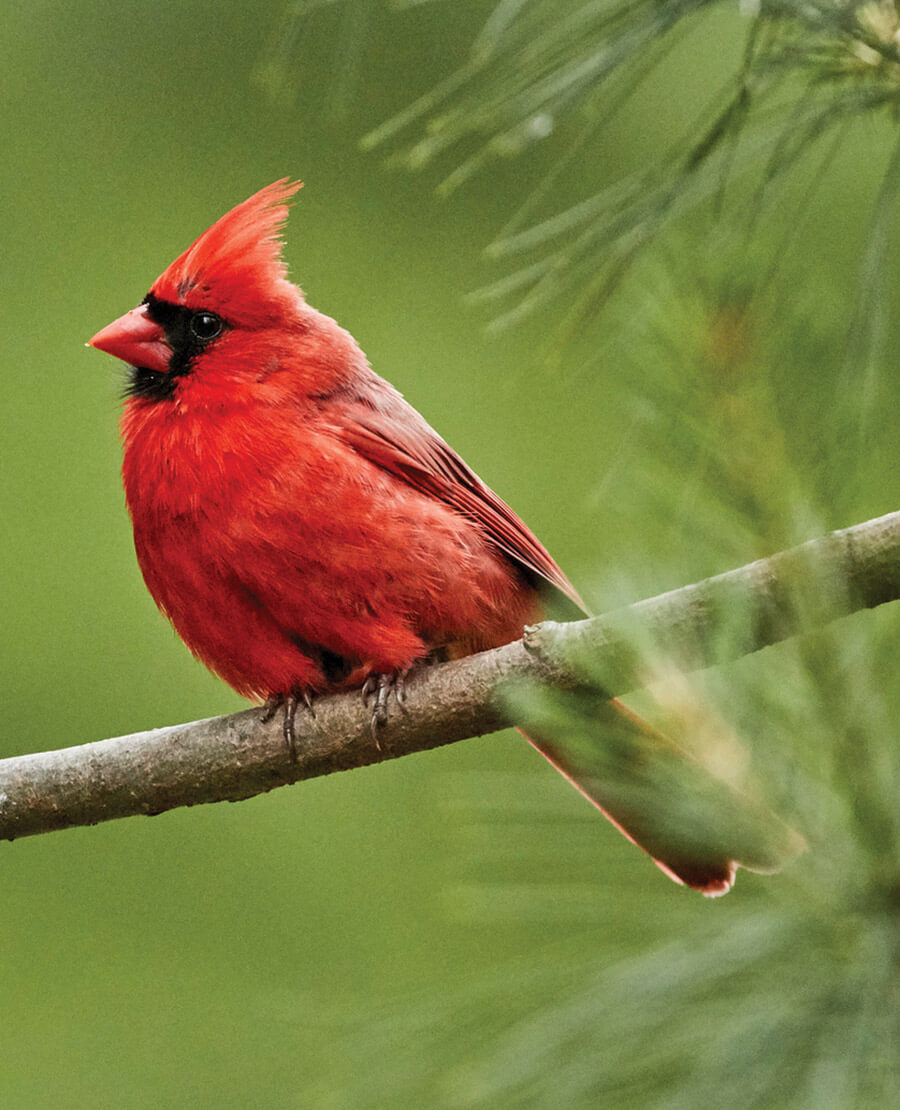
Northern cardinal photograph by Gary W. Carter/Corbis Documentary/Getty Images
The crowd of birds that surrounded us in our cabin in the woods sounded like just that to me: a crowd, undifferentiated and impossible to distinguish one from the other. Just a lot of hubbub. And this — together with the sounds of insects and frogs, and the scuffle of critters in the underbrush, and even the rattlesnake that seemed to hiss rather than rattle — was the sound of the woods.
On our hikes up the little mountain, my father would say, There’s a Carolina wren. You know that one. But I didn’t, and I’d say. Where?, and he’d say he didn’t know but it’s out there. Do you hear it?
The birds my parents knew were everywhere. There’s a cardinal, Dad would say. They’re easy to hear. And Shhh, stop: There’s a pine warbler. But all I heard was the cacophony, the insistent sound of the unknown, secretive, omnipresent, and unfathomably fecund woods. Sometimes I turned back to the cabin to get some quiet.
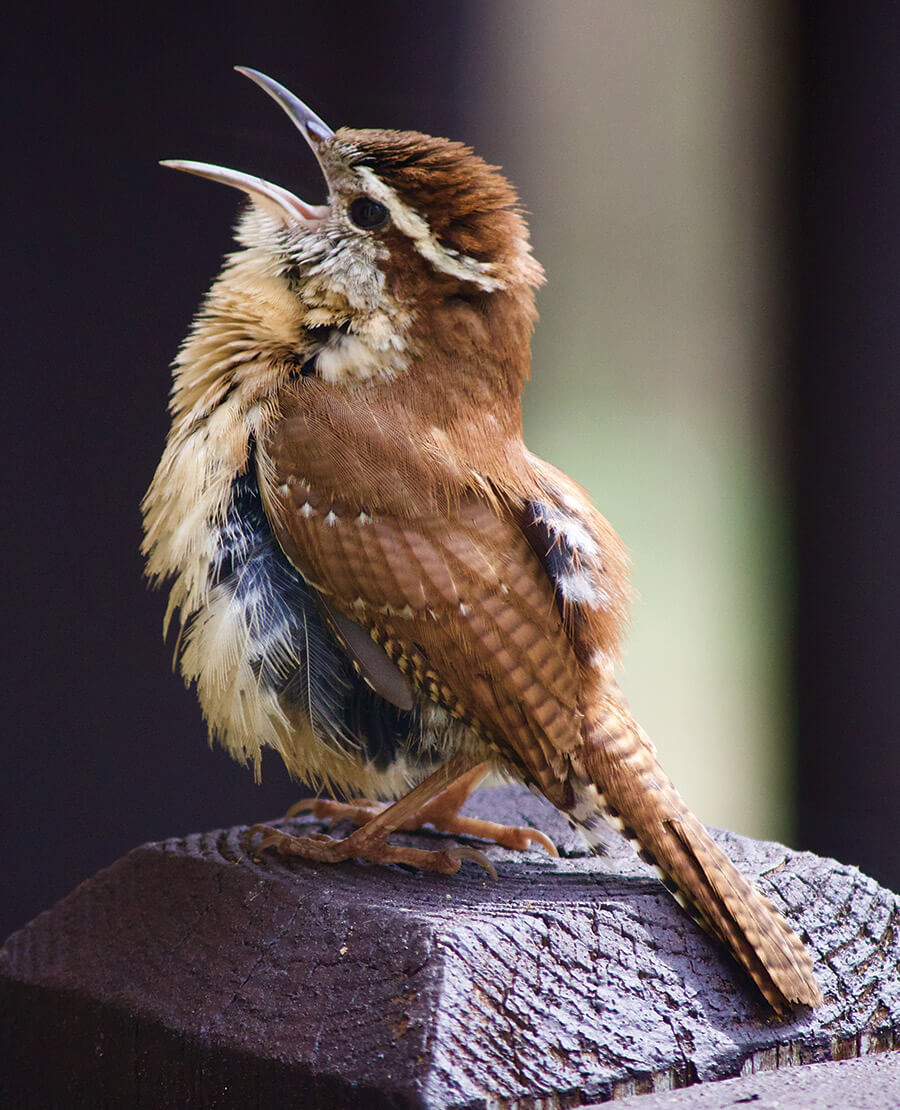
Carolina wren photograph by Sarah Heinitz/iStock/Getty Images
I know now that there is no quiet place, and if there were such a place, I wouldn’t want to live there. And, even more, learning the sounds of what’s out there in the piney woods was worth the effort. There is comfort in knowing each of the voices in the choir.
Crowd noise, undifferentiated, becomes white noise, a desert containing nothing, a barrier to memory. But one blue jay scrabbling under the blackberries and calling out its warnings is a connection, and then a memory. There was my father at Merritt’s store when he was at UNC, the bell of the gas station dinging, asking if he could trap varmints on Mr. Merritt’s land for a population study. And even before that, there was the sound of waves in the bay where Dad fell in love with biology. One leads to the next. Even the sound of my parents debating the sound of the birds is itself a memory, or really a thousand of them.
• • •
It’s quieter now, but not quiet. My mother is no longer here to argue with my father, so on the bird-watching trip my sister, father, and I took to the coast, it was my sister and I who argued with him. We’re pretty good birders, my sister and I, but we also use our phones to help us. Dad has his books.
“Dad, I think that’s an anhinga,” I say, pointing at the strange, big, dark waterbird with the improbable neck, sunning its wings.
“Yeah, I don’t know about that.”
“Dad, here’s a picture. No, wait, here’s a video,” I say, holding the screen up to him. He squints at it. “Could be, but I’ll need my books.” I look at my sister, and she shakes her head. There was only one person whose opinion he might have accepted on the spot, and only after a colorful argument. But she wasn’t with us, and it’s no fun to argue with a phone. I understood. When we got back and he confirmed the identification in one of his many bird books, it didn’t feel like much of a victory to me. It felt like cheating.
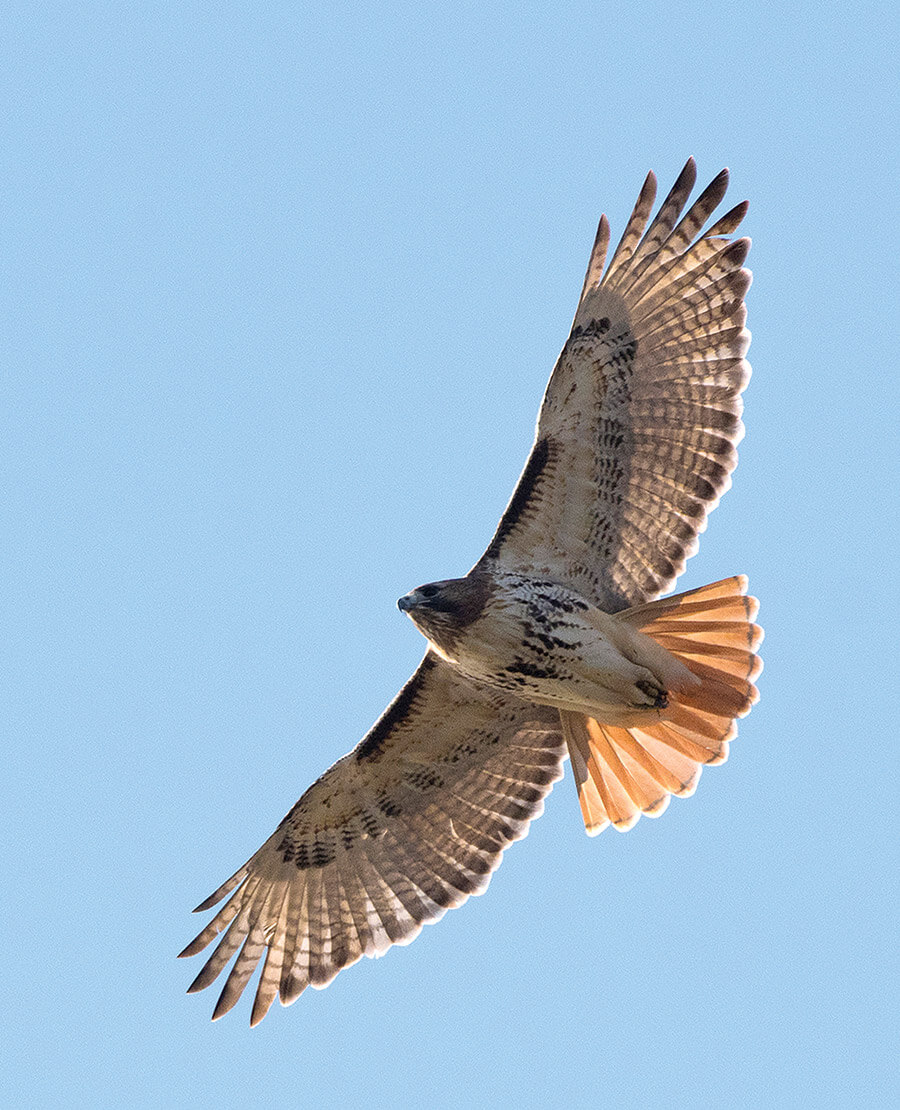
With a wingspan of about four feet, red-tailed hawks soar along the edges of woods, looking for food. Dark markings on the undersides of their wings, from their shoulders to about halfway down, differentiate them from red-shouldered hawks. photograph by Eric Abernethy
But there is a kind of cheating Dad has embraced, and that’s the app on his phone that identifies bird calls. Sometimes on a bird walk, he’ll fall behind, and on backtracking, we’ll find this man in his 80s, more bent and craggy than he used to be, standing perfectly still and holding his phone high above his head like a torch. He looks up at the tree canopy expectantly, as if this device could draw all the birdsong in the world to him, where he could keep it forever.
He can still identify dozens and dozens of birds. He’s still got the knack, and those calls also cross over the decades to find him. I stand quietly next to him with my own phone raised in the air.
He and I look down at the list on our phones. Dozens of bird species surround us, close enough to be heard by our little microphones. And in the trees, only an occasional shadow zips through our peripheral vision, a flash of color so fast you wonder if you actually saw it. In our lists is evidence that we are surrounded, not just by the sounds we know but also by the unseen Carolina chickadees, the yellow-rumped warblers, the gnatcatchers and the flycatchers, the vireos, the phoebes. A secret world of things still to be seen, and sounds to be remembered. These days, I want to remember the sound of everything.
“We’re never alone, I guess,” I say to my dad. “You have no idea,” he tells me.
• • •
I live by myself now. At the moment, there’s a chipping sparrow outside my window. I see nothing, but I hear it. I’ve been learning. There’s a Carolina wren out there, too, and there’s always a cardinal. Can’t see those either. Then they all go quiet. My hawk has returned, and she’s got a lot on her mind. Her call echoes.
I work on learning my bird calls, and I have great friends who walk the Haw River and listen with me. Slowly, the woods have become knowable and the critters known — not exactly companions, but not strangers either. My little corner of the Piedmont expands and contracts simultaneously. My daughters are adults now, and their little bare feet no longer thump down the hallway of our old house. I hear the sound of air in the feathers of the eagle that nests across the river. My father lives in Kentucky near my sister, and we had to skip the birding trip this year because Dad wasn’t up to it. Every so often I hear a new bird, and the world becomes bigger. I am becoming balder. Things change.
And then there is a twittering from the table.
“Hi Dad,” I hear my daughter say on the speaker, and it all connects in that instant. The sound of everything I ever cared about comes back to me.