 Listen as the pages of the magazine come to life in the Storytellers podcast featuring the voices of Our State writers. Each podcast episode features a writer reading their column aloud, allowing each distinct voice to shine. Click below to listen to Eddie read his column aloud.
It starts with a bump and a solid thump, like popping the clutch on a straight-drive. If you don’t know what that feels like, then you surely don’t know what it’s like to plow behind a pair of mules. In a fallow field outside Benson, I gently smack the reins against the flanks of Samson the mule (the bump), and he and his plow-mate, Millie, lurch forward (the thump). When the going is good, I use a lever to drop the blade of a plow into the dirt. Instantly, I feel the strain of leather and steel as the plow blade bites.
I’m riding on a rusty metal seat and can feel every shake, rattle, and roll. I pull the reins to keep the mules on track, but they know what they’re doing. That’s the thing about plowing a field with mules: Everybody thinks they’re the one in charge.
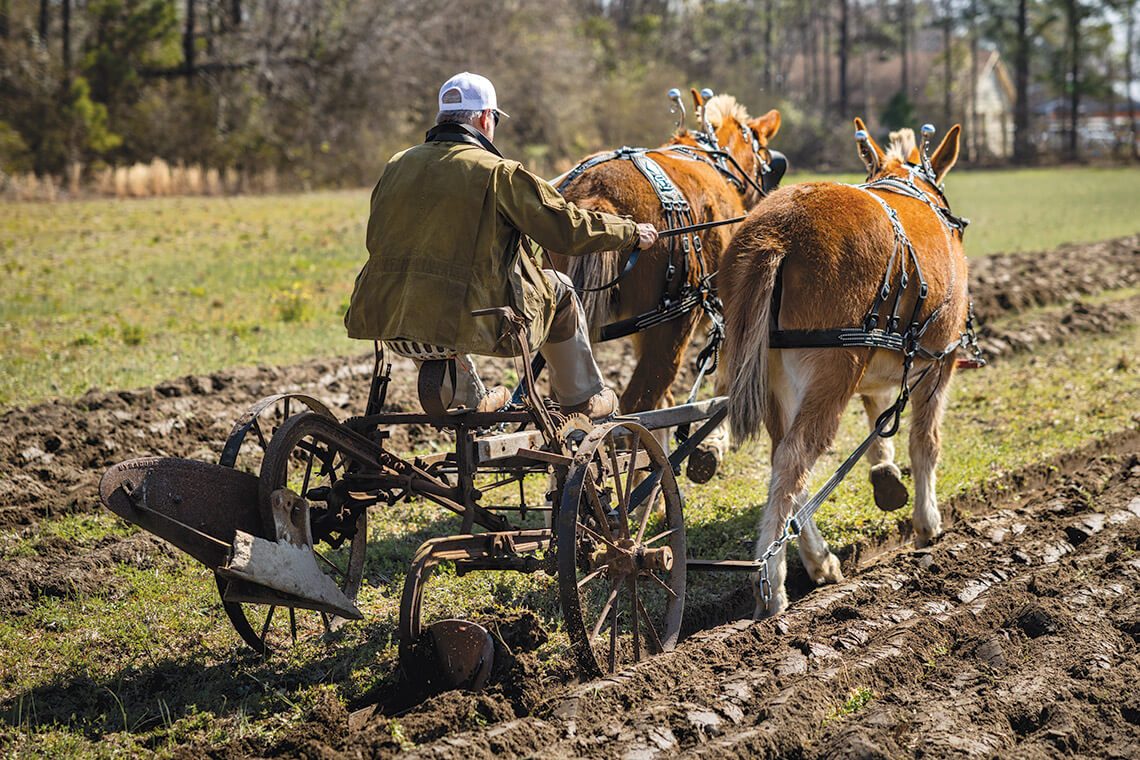
Plowing with Samson and Millie, the author got a glimpse of what life was like for the farmers — and mules — who helped build our state. photograph by Charles Harris
I’ve long wanted to try this. A few steps behind a mule, it seemed to me, I might connect to a time in rural history that passed me by. I’ve heard it all my life: North Carolina was built on a foundation of one- or two-mule farms. I suspect there was little romance in such a hardscrabble life, but I want to know what it’s like.
My mule-plowing mentor is Billy Brown, president of the Mule City Mule Club, which is anchored in Benson. A farrier by trade, he grew up on a Sampson County farm and knows what it’s like to pull life and a living out of the ground. He doesn’t turn down many opportunities to demonstrate the old ways. He seems touched that I’m genuinely interested in this ancient art and his role in keeping it alive.
• • •
We meet smack in the middle of town, at McLamb Mule Stables. Back in the day, Benson was a famed mule-trading town. Hundreds of the animals would arrive by rail and stock the offerings at the dozen or so stables clustered near the depot. “They were like car dealerships,” explains Gordon McLamb, who has preserved his family’s 1920s mule barn, the last one standing in town. He’s a cornerstone of the annual Benson Mule Days festival in September and of Benson mule history in general.
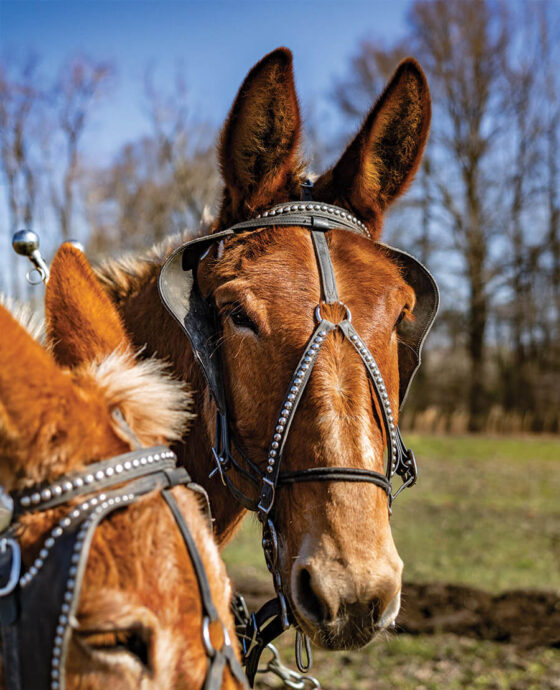
From the old barn, Brown and I caravan to a field where Samson and Millie are tied to a horse trailer. My first thought is: Dadgum. Those things are big. In my ignorance, I had imagined mules to be more donkey-like — as in, smallish. These creatures are 16 hands high and solid as rhinoceroses. They eye me with a disaffected, mulish gaze that I interpret thusly: This guy? You’ve got to be kidding me.
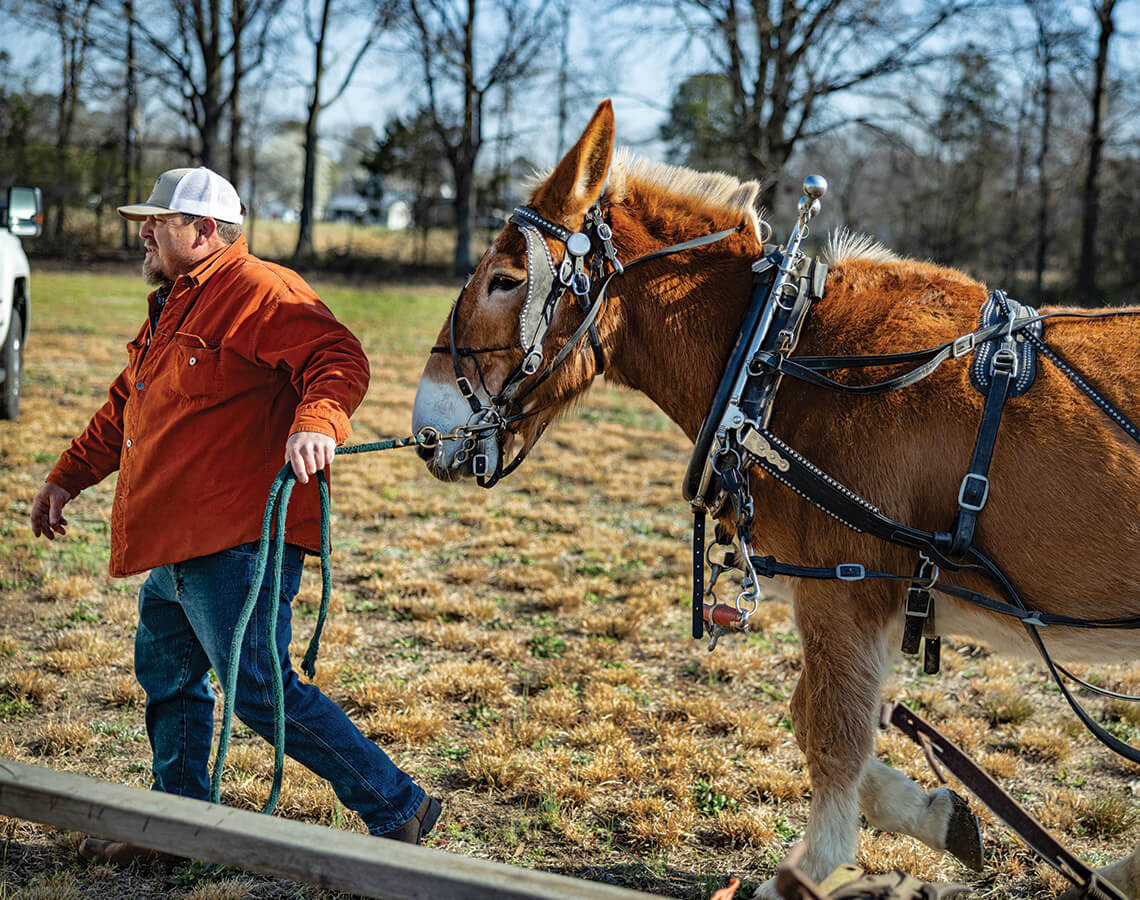
As president of the local Mule City Mule Club, Billy Brown makes sure the draft animals get their due. photograph by Charles Harris
Brown hooks up the mules, snapping the trace chains to a yoke-like thing called a doubletree, which performs a peculiar kind of physics. The whole apparatus is designed for efficiency: The mules don’t pull the plow. Through the mechanics of the traces, doubletree, and other elements of a plow’s design, they push, which is easier.
Brown plows a few furrows with Samson and Millie as I fast-walk beside them. He wants to show me how to use the plow’s controls, but he also wants to work the wiggles out of the animals before I step into the driver’s seat. After a few passes over the field, he dismounts and hands me the reins. Time to punch the clock.
• • •
Here’s something I didn’t understand: The first pass with a plow isn’t to score the earth with a deep groove into which seeds are planted. It’s to turn the topsoil over and bury the grass and weeds under a layer of newly exposed soil. That turns winter’s vegetation into compost and exposes fresh soil to the rejuvenating inputs of sunlight and fresh air. Breaking and planting a field requires multiple passes with a beast of burden, be it a mule or a diesel tractor. Despite lifelong experience with the agricultural landscape of eastern North Carolina — do you know how many times I’ve driven past a farm field on my way to the beach? — this is a minor revelation.
And a meaningful one. Sitting atop a 100-year-old plow, I feel the pitch and roll of the ground in every joint in my body. Small clouds of mud dust puff up when I slap the reins against the mules’ flanks. I smell the new soil, opening like a breaking wave beneath my feet. But what’s most surprising is the chorus emanating from the mules, the plow, the earth itself. The trace chains clink; the doubletree groans under the shifting pressures of dragging the plow. Squeak of old axle, moan of old leather. The chuffle of the mules and the glop-plop-glop of their hooves.
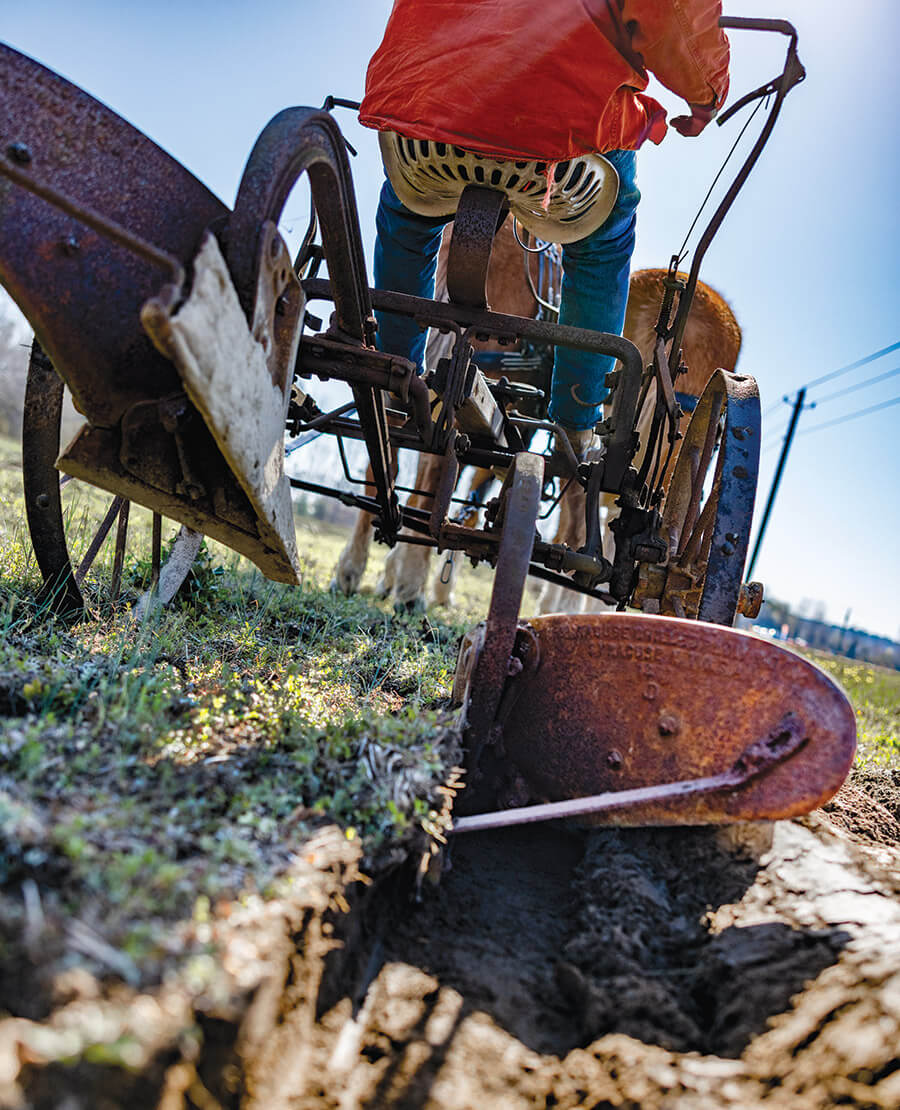
Although tractors have mostly supplanted them in the fields, mules have endured as an icon of Benson. photograph by Charles Harris
Samson and Millie don’t need much direction. I’m not saying there’s nothing to it: I have some work to do. I rein Millie back into the furrow when she steps out. I check the depth of the furrow to make any adjustments with a large, ratcheting hand crank. And I keep one eye on a white-barked tree at the end of the field, my guiding light, a beacon that keeps me plowing in a straight line. In a perfect world, Brown tells me, I would keep the left edge of Millie’s left hoof up tight against the left side of the furrow. That’s the goal.
So I do what he says. I watch the tree and plow a single furrow through the field, listening to a musical score nearly lost to history. Jingle and jangle, huff and puff. Behind the plow, the earth turns over. It sounds like a long exhalation, like the planet is taking a deep breath as it opens to the sky.
This year’s Benson Mule Days will be held September 25-28. For more information, call (919) 894-3825 or visit bensonmuledays.com.
print it