 Listen as the pages of the magazine come to life in the Storytellers podcast featuring the voices of Our State writers. Each podcast episode features a writer reading their column aloud, allowing each distinct voice to shine. Click below to listen to Eddie read his column aloud.
For centuries, this is how they came. Up the broad Neuse River, fringed with salt marsh and then tall pines, the south and north shores closing in as they moved ever inland. Up the river, past what we know today as Adams Creek and Clubfoot Creek, around the sweeping turn at Cherry Point, the waterway growing narrower and narrower. And as it did, the possibilities grew wider and wider as they headed toward the unknown.
I peer into the distance and ease the throttle back a bit, so the boat takes the swells at a gentler pitch. Ahead, the shores of the Neuse appear like an unbroken curtain across the horizon. For a moment, I have an inkling of how the early explorers might have felt, their eyes searching the shore for clues to what might lie ahead.
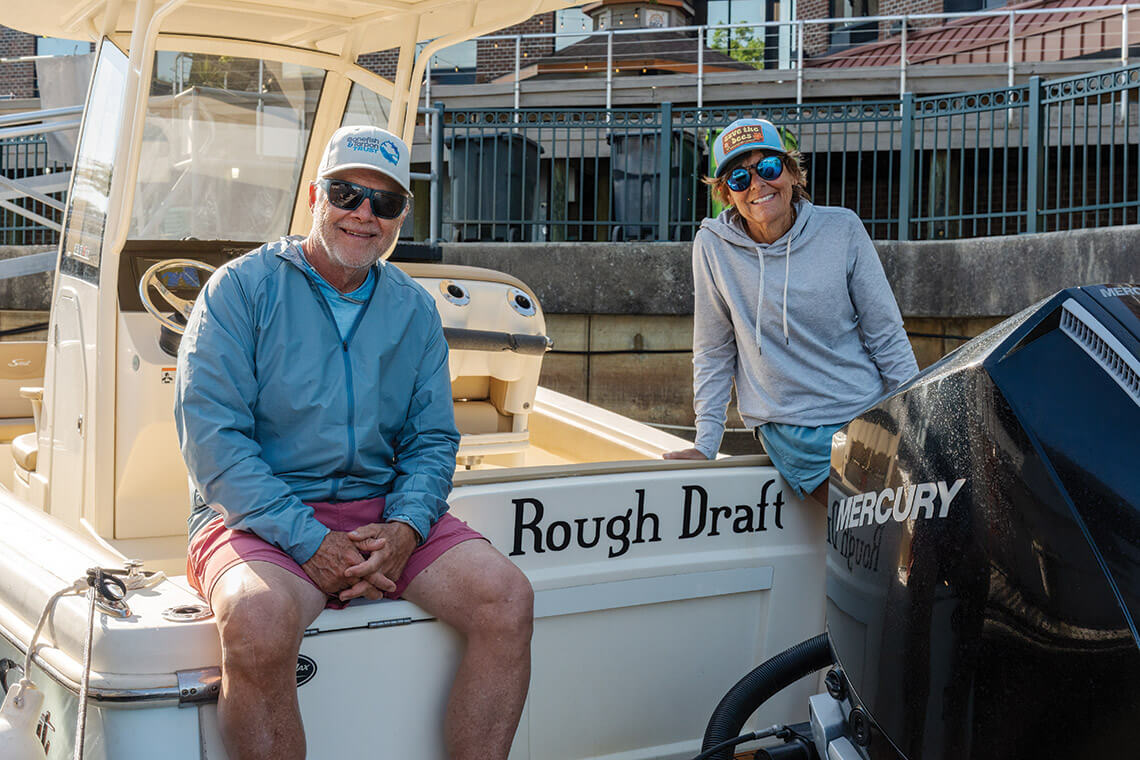
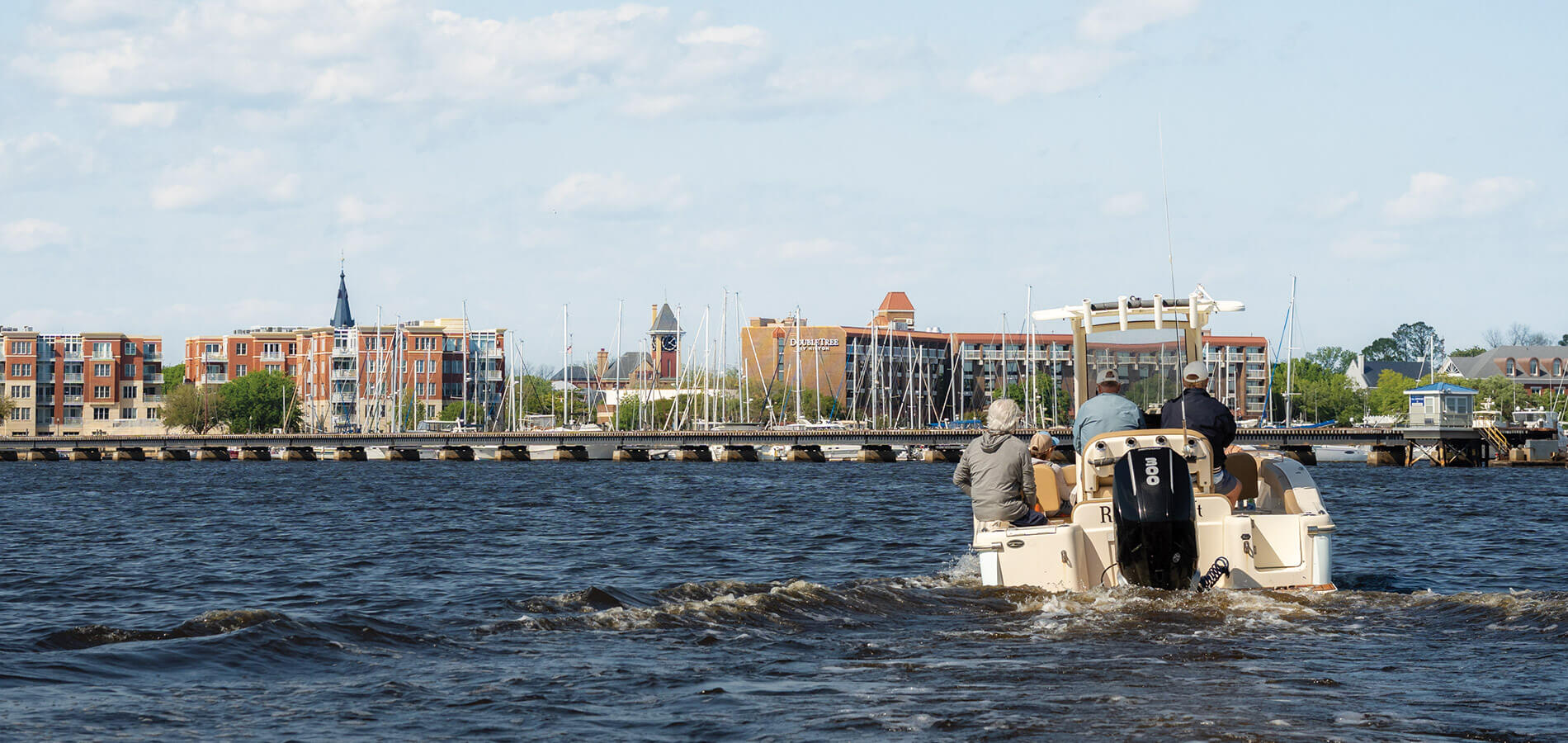
When the Nickenses travel aboard Rough Draft, they take part in a long tradition of exploring North Carolina by water. photograph by John Mauser
Suddenly, something catches my eye: the horizon’s first vertical line. It’s a mast, or a tower. Something out of place and man-made. It breaks my reverie. Time to make landfall.
“Dead ahead,” I tell my crew. Our pals Michael and Jill Highsmith and Mike and Meredith Palmer are on the boat with Julie, most of them lolling about on the bow deck while I handle the difficult chore of holding on to the boat’s steering wheel. “New Bern at 12 o’clock.”
• • •
New Bern, Bath, Washington. Edenton, Columbia, Wilmington. Waterlily and Bayboro. There was a time when rivers and sounds were major highways to towns and villages like these, and arriving by water was more run-of-the-mill than exotic. Julie and I have discovered there’s still something alluring about cruising into a picturesque harbor town with little but a change of clothes, even in these modern times. We’ve boat-tripped to waterfront towns from Virginia to Georgia, trundling up creaky docks and cobbled streets for overnights in boutique hotels and inns.
Arriving by water sets a different tone for travel. You have to pack light. Without a car, you’re on your feet, poking through shops and cafés. Every little lane and alley leads to new discovery.
We’re in good company: The first known written report of the North Carolina coast was made by such a traveler. In 1524, the explorer Giovanni da Verrazzano wrote a description of sailing near the mouth of the Cape Fear River and then Bogue Banks. He mentioned Native Americans clothed in skirts of animal skins and “garlands of birds feathers.”
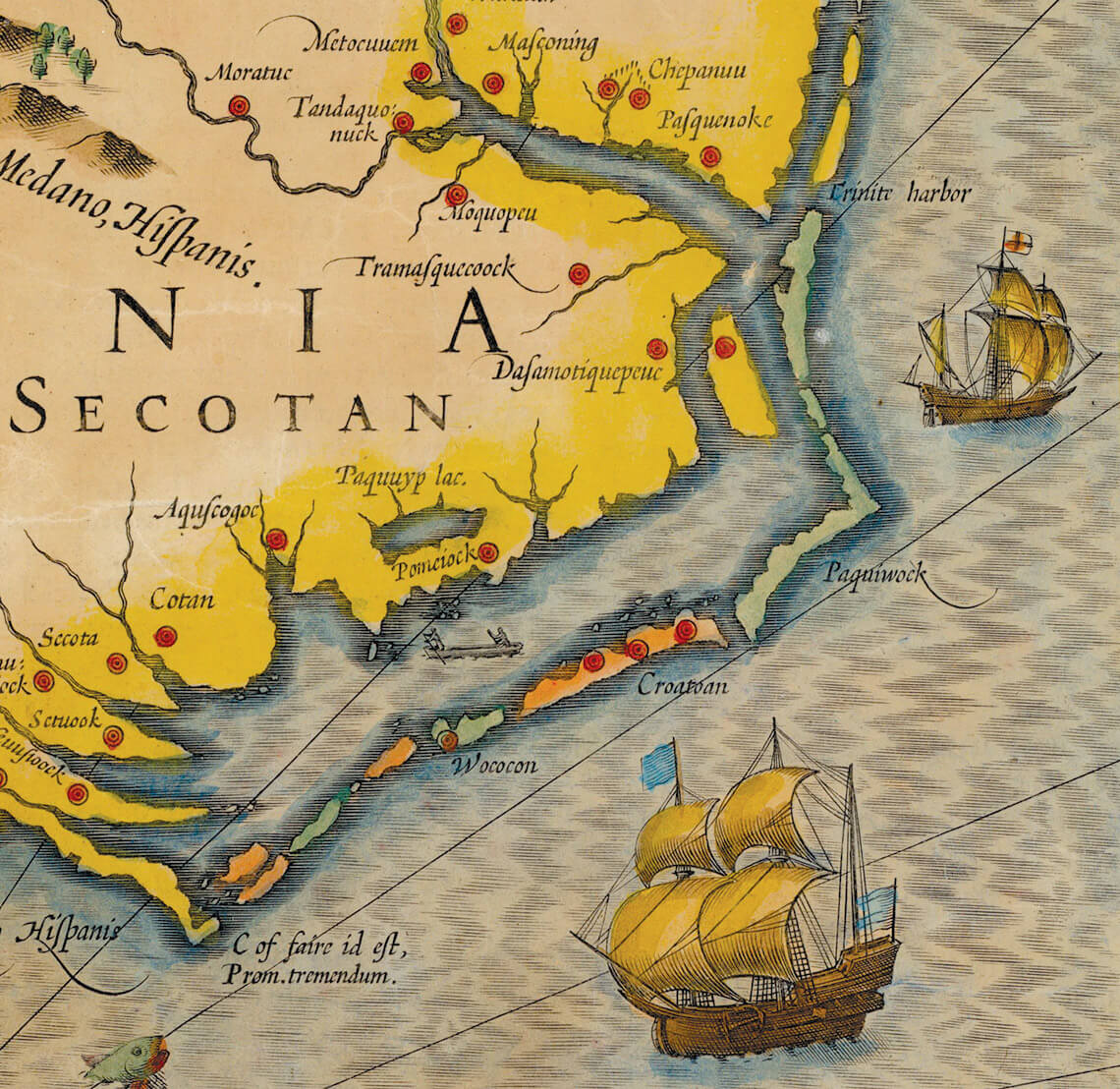
An early 17th-century map of the Southeast. Photography courtesy of State Archives of North Carolina
Sixty years later, the English sea captain Arthur Barlowe reported climbing a small hill near what is now Oregon Inlet and letting loose with an arquebus, a massive matchlock gun. At the gun’s report, a flock of white “cranes” arose from the trees with a cry “as if an army of men had shouted all together.” Barlowe wrote that the island’s “goodly woods” were full of animals, “even in the midst of summer, in incredible abundance.”
After these initial accounts, the decades of the early and mid-17th century were marked by a bit of a drought for New World exploration, what with Europe embroiled in the Thirty Years’ War. By the 1660s, however, the white sails of wooden ships could again be seen from North Carolina beaches. In 1663, William Hilton sailed from Barbados on the ship Adventure. That October, he threaded the Cape Fear shoals, passed Bald Head Island, and continued upriver past the present-day Wilmington waterfront. It was “a very pleasant and delightful place,” he wrote. “We travelled in it several miles, but saw no end thereof.”
Cruising up the Neuse River, or the New or the Pasquotank or even Hilton’s Cape Fear, I try to imagine how those early explorers felt. Every bend in the river was a portal to a new world. And I also imagine what North Carolina’s original inhabitants thought of sails over the water. The so-called New World was no unpeopled barren. The feelings of possibility that filled the sails of those first mariners brought concern and consternation to those looking downriver.
• • •
Threading through the docks of the New Bern waterfront, my 24-foot boat seems lilliputian compared to the yachts with acres of gleaming fiberglass. We swing into a slip beside a boat so large we can see a television playing beyond the cabin windows. Liveaboards have their appeal, for sure. But so does shouldering a small bag and striking out into a new town, open to whatever treasures reveal themselves.
Julie ties off the boat fenders as I bring Rough Draft to a halt, and she steps onto the dock to cinch down a cleat hitch. I watch out of the corner of my eye, not wanting her to see that I’m checking her work like a middle-school math teacher, but she knows how obsessed I am with knots. She passes the line once around the base, figure-eights the cleat horns, and finishes up with a locking hitch. Nice.
She immediately looks my way. “I see you watching,” she says. “I know you can’t stand it.”
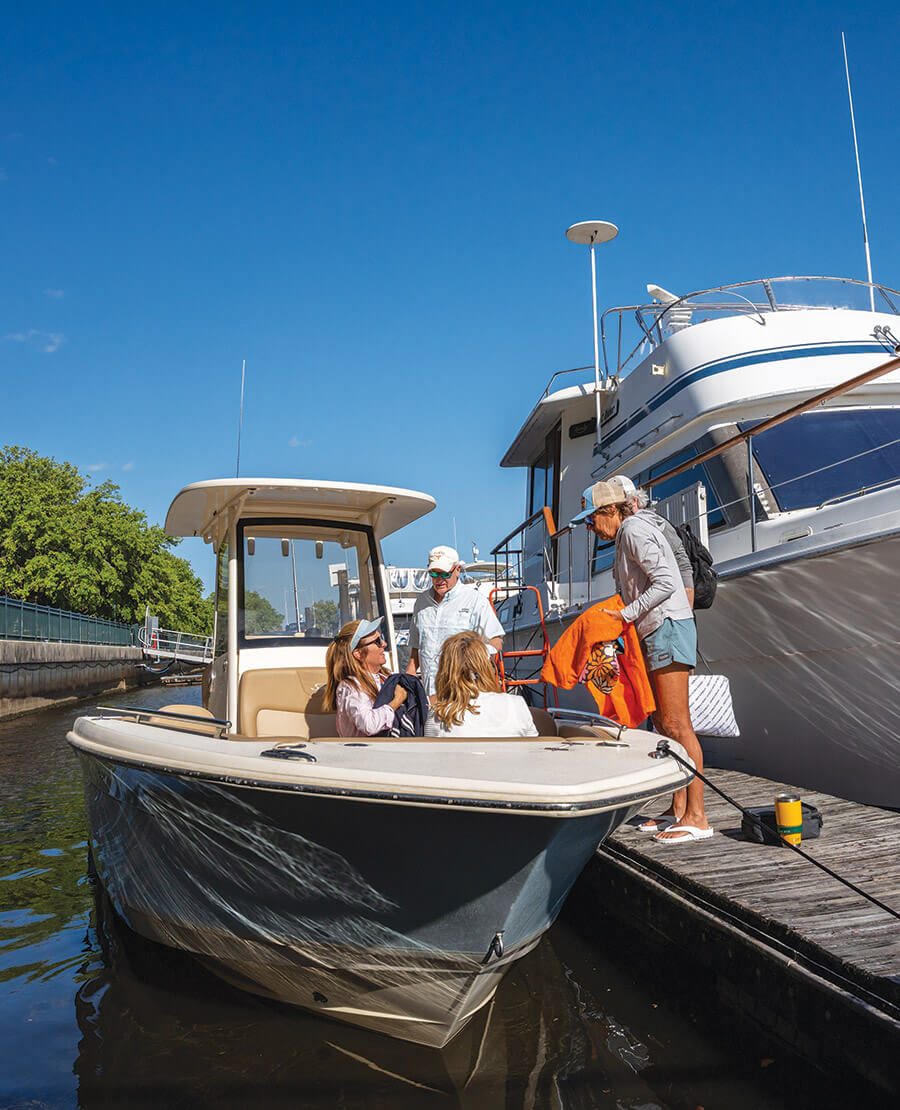
With the company of friends and Julie, the Ramblin’ Man completes his coastal explorations. photograph by John Mauser
I laugh. She’s come a long way but is solidly salty. She’s cracked ribs against dock railings and crouched on top of foam boat cushions as we’ve fled lightning overhead. A couple of years ago, beating through a violent, wind-whipped Beaufort Inlet in our old 20-foot boat, she held on to a railing so tightly for so long that she lost feeling in her palm and forearm for days. “If we’re going to keep doing this,” she said, “we have to get a bigger boat.”
I do what Julie tells me to do.
Tied up snugly, the six of us head up the floating docks, the squeak and groan of mooring lines a welcome, familiar greeting. Those first few steps on solid ground, after hours on a boat, have a rocking, rollicking feel that lets you know you’ve moved from one reality to another. The dock hinges clang, water laps along the bulkhead behind, and the cityscape rises ahead.
As we make our way to the hotel, I stop for a last look at the boat. Check to see if the lines seem tight, the fenders placed properly. Then, like so many times before, I turn my back to the water. Bon voyage, I think with a grin. A new escapade awaits on shore.