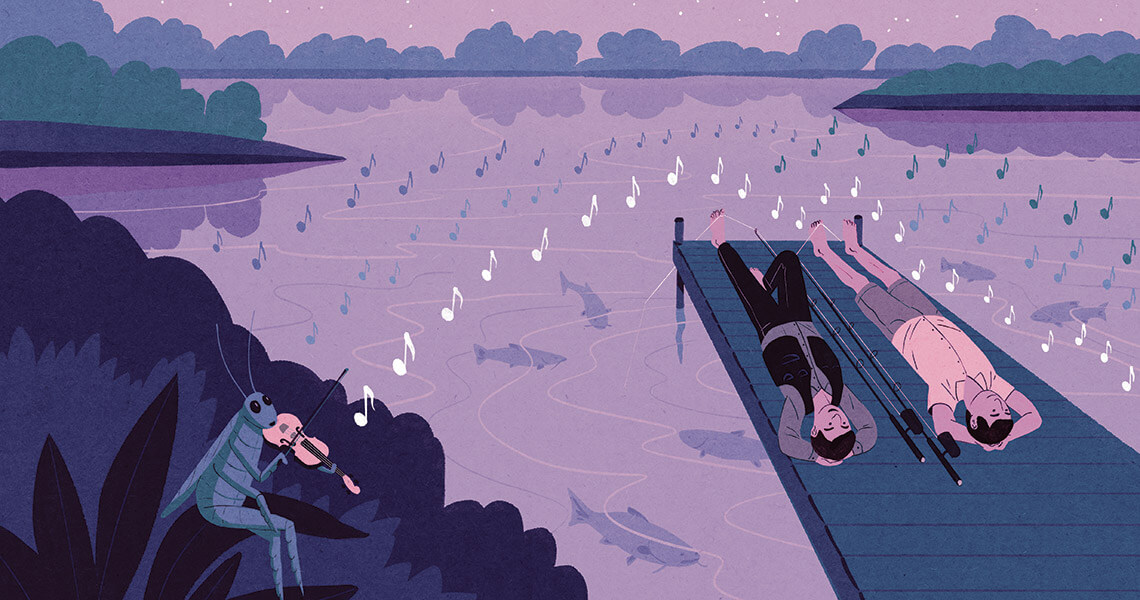
We carried two fishing rods apiece and had a pocket full of hooks, lead split shot we mashed with our teeth, and a tube of 100 percent DEET bug dope so strong that the smell burned the inside of our nostrils. We traveled light because we weren’t supposed to be there in the first place.
Stretched out on the far end of the docks at Oak Hollow Lake in High Point, beyond the illumination of the security lights, we looped the fishing lines around our big toes and laid the rods beside us. That way, when we nodded off, any catfish that took a liking to our globs of worms would tug on the line, which would tug on our toes and wake us up for the fish fight. We thought that was pretty smart. Since we knew it was against the rules to be on the docks after dark, smart wasn’t exactly what we were shooting for. But the loop around the toe? That was brilliant.
A night fishing trip is a front-row seat to planet Earth’s finest symphony.
Except I never nodded off. Not once. Lying there in the cooling evening, with the warmth from the sun seeping into my back from the dock’s wooden boards, you would think I would zonk out in an instant. Instead, I lay there, wide awake, mesmerized by the vespertine chorus.
Night sounds flooded in from every direction — the jug-a-rum groan of a bullfrog. Cricket frogs like glass marbles clicking against each other — there had to be a million of them. The incessant song of a whippoorwill played from the grassy lawn on the far side of the dark parking lot. A curious splash against the shore — hard to say if it was a feeding bass or a night heron on the hunt.
The longer I lay there, the more I heard. I’ve been an aficionado of night sounds ever since — especially those accompanying a night fishing trip, which is a front-row seat to planet Earth’s finest symphony.

The truth is, we humans are interlopers in the night. We require a solid dose of light for vision, while many animals, if not most, do not. As the earth spins, darkness creeps across the land like a dark fog. A page is turning, and many creatures stir. They have adapted and evolved to gather, hoard, and utilize the merest fragments of light — the moon’s glow and the stars’ dim sparkle.
The eyes of some bees may even contain photoreceptors that gather light for more extended periods of time than a mere glance, like a camera whose shutter stays open for nighttime exposures. Other creatures sport a separate reflective layer behind the retina, called the tapetum lucidum, that intercepts any light that escapes the retina and sends it back to the front of the eye for another pass. It’s this so-called “eyeshine” that glows in your headlights when you see a deer or a cat at night. All those adaptations make nighttime the right time for many creatures to roam. And since we light-adapted humans are, literally, in the dark, we turn to our ears to help fill in the story of the nighttime wilds.
I try to listen past the easy sounds — the shriek of a Fowler’s toad, the banjo-string ploink of a green frog.
Lying on the fishing dock, I would hold perfectly still and purposefully minimize any sound — my breathing, the rasp of my shirt sleeve when I scratched my nose, the rustle of fishing weights and Now and Later candies in my pocket. Hearing is what happens when your eardrums vibrate. Listening is an active state, no less than knocking out a push-up. Just as you can boost your night vision by avoiding light, which temporarily destroys the “visual purple” proteins in your eye that convert light to electric pulses, I think you can boost hearing by going stone-cold quiet.
I try to listen past the easy sounds — the shriek of a Fowler’s toad, the banjo-string ploink of a green frog. I pick up the clicky chorus of a field cricket. It must be hunkered down in a hideout somewhere between the dock boards. It’s a pleasing sound when you’re sprawled out under the stars. Not so much when you’re trying to find the raucous rascal that’s keeping you awake.
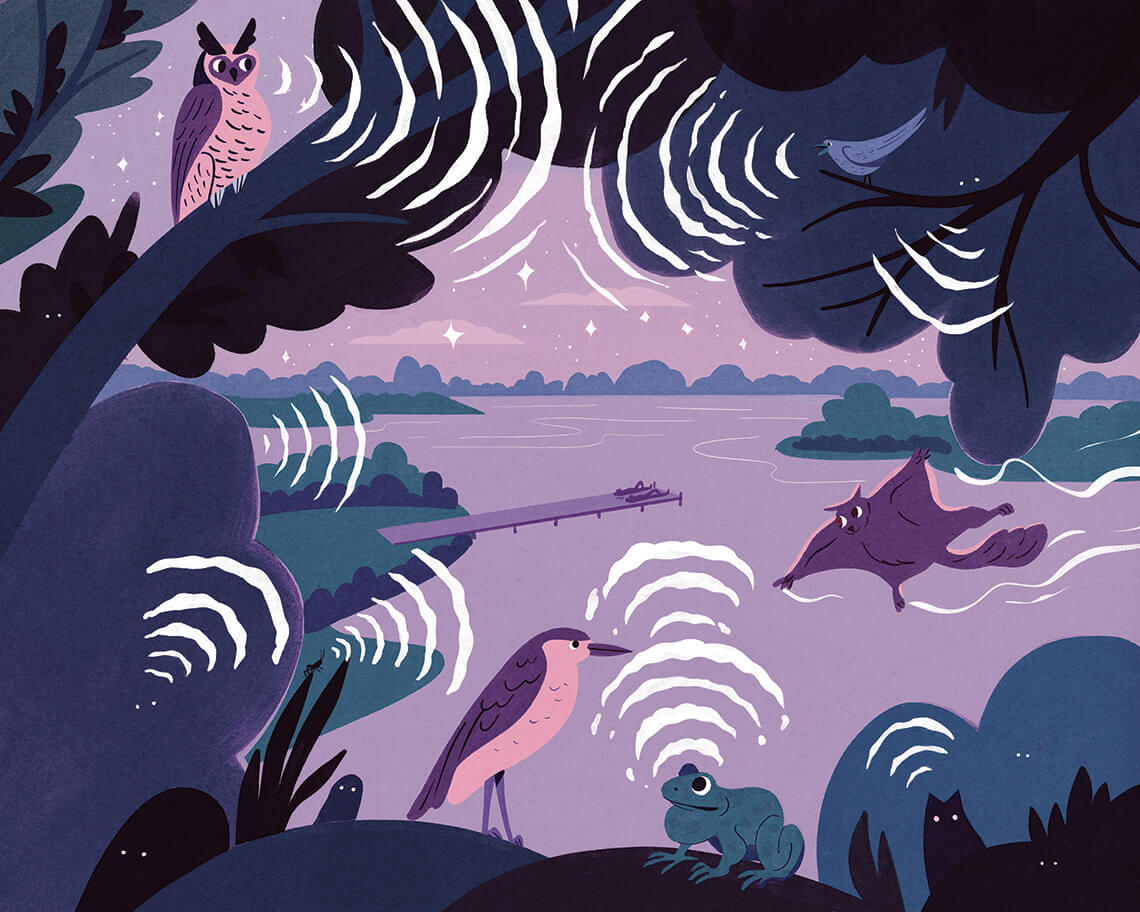
illustration by Ryan Johnson
Listen. Harder. There’s the low, baritone hoo-hoo hoo of a great horned owl, a mournful call that seems a bit out of character for such a creature. If I were a great horned owl, I’d be rocking a 1980s hair-metal band song more in keeping with my predatory instincts. I pick up the buzzy, nearly nonstop trill of a Carolina ground cricket. And the nagging whine of mosquitoes zeroing in on my ear lobes. I didn’t say every sound was pleasant. And there’s that whippoorwill again. What a chatterbox.
A deep breath, and let it out. Listen.
And that’s when I hear the most marvelous sound of the nighttime chorus. It’s like a tiny ripple in the night, a quirky, chirpy, chippy call. A Southern flying squirrel has come out to play. Most folks wouldn’t believe how many of these little critters live around us, for they rarely come out in the daytime. But there it is, when you listen intently, a sound like a dog working over a squeaky toy, just on the edge of hearing.
I cock my head to glean each detail and decipher each call. Sound is a river, and all those trills, chirps, grunts, and ga-ruumphs blend together in a braided aural stream, flowing out of the humid Southern night, ferrying me into a world I cannot see.