Put ramekins on a baking sheet. Bake for 25-35 minutes, until puffed and golden. Remove from oven, and let stand for 5 minutes. With a flexible spatula, remove strata to
Listen as the pages of the magazine come to life in the Storytellers podcast showcasing the voices of Our State writers. Each podcast episode features a writer reading their column
Listen as the pages of the magazine come to life in the Storytellers podcast showcasing the voices of Our State writers. Each podcast episode features a writer reading their column
Listen as the pages of the magazine come to life in the Storytellers podcast showcasing the voices of Our State writers. Each podcast episode features a writer reading their column aloud, allowing each distinct voice to shine. Click below to listen to Brad read his column aloud.
Although the memory is more than 60 years old, it’s vivid in Marty Webb’s mind. His eighth-grade class was being taken to Hoke County High School for orientation. As the buses lined up outside their school, Webb’s friend nudged him: “We want to get on Brown’s bus.”
Brown Hendrix was a senior at Hoke County High School and a popular student bus driver. “Everybody wanted to get on Brown’s bus,” Webb recalls. “He was so jovial and friendly, and when I saw him driving that bus, I said, ‘That’s exactly what I want to do.’”
Two years later, Webb got his chance. When an announcement was made that a county official was coming to school to sign up prospective drivers, “I flew to the office as fast as I could to get my name at the top of that list.”
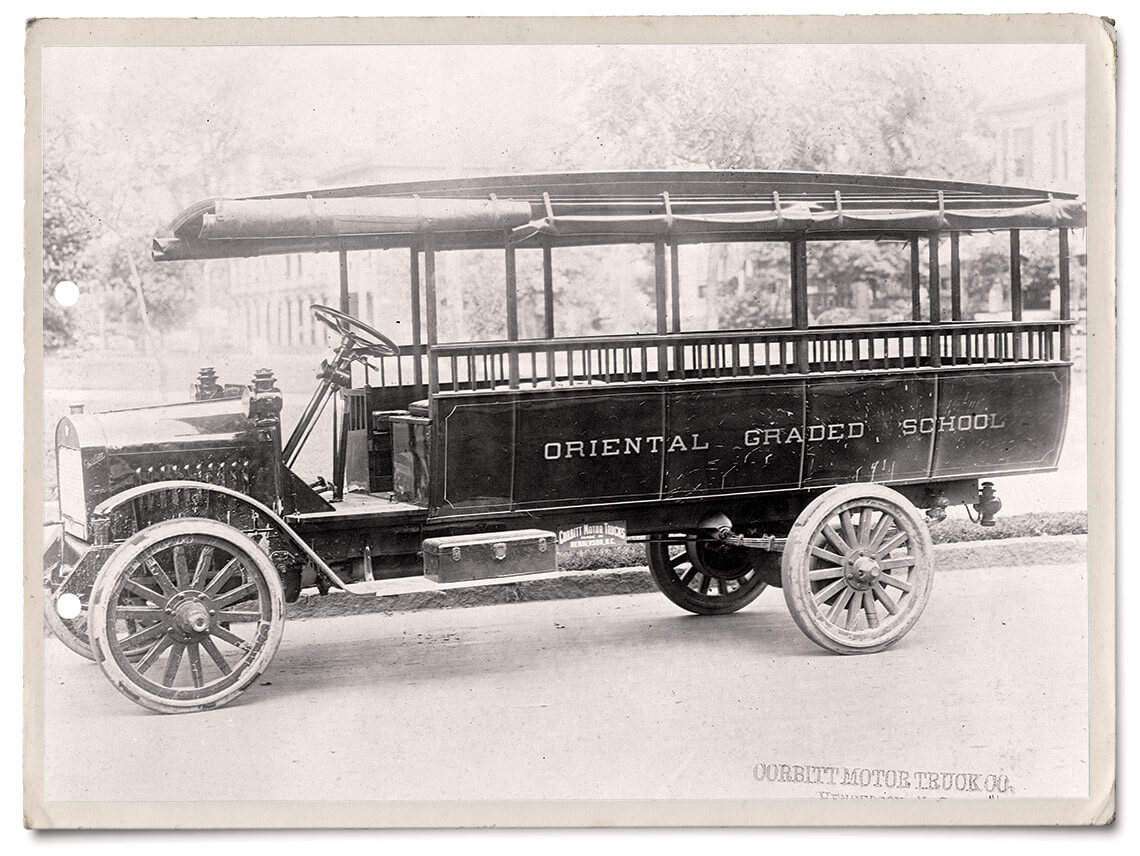
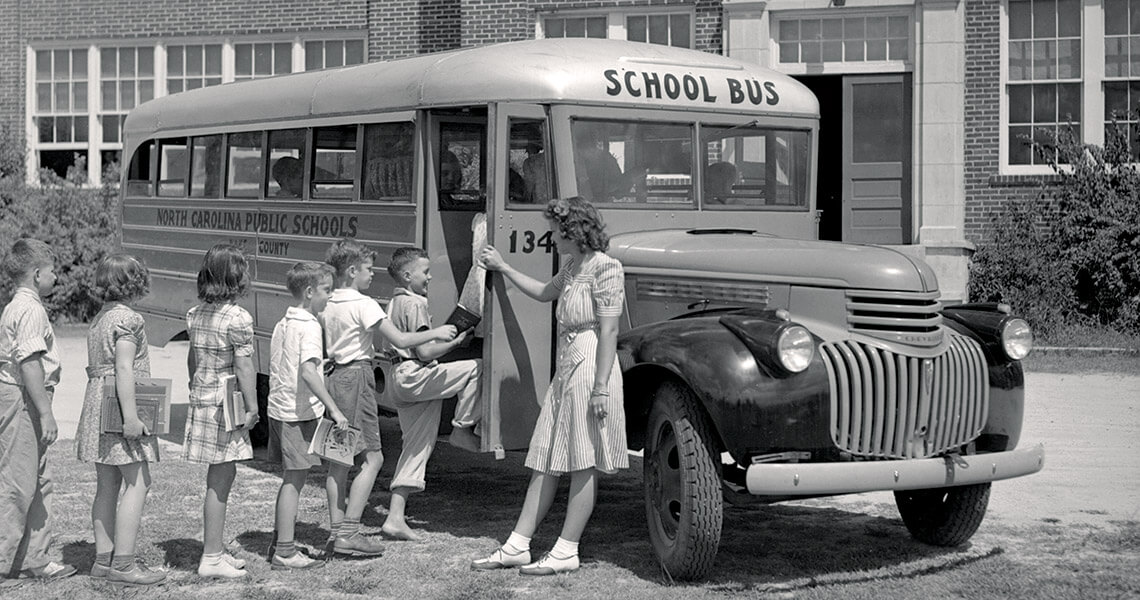
North Carolina officially committed to transportation for its students in 1911. Six years later, Pamlico County purchased a 30-passenger bus from the Corbitt Company of Henderson to transport students to school. It was North Carolina’s first motorized vehicle used for pupil transportation.
The first motorized school bus began service in Pamlico County in 1917. Photography courtesy of State Archives of North Carolina
By 1928, every North Carolina county boasted transportation for its public-school students. Even then, student bus drivers were not uncommon. Joe Darden, a student bus driver who attended Cumberland County’s Pine Forest High in the early ’60s, recalls that his father, Ernest, drove parts of the same route as a teen back in the ’20s.
For the past few years, Darden — whose late wife, Jackie, was also a student bus driver — has been collecting stories from his peers, working to ensure their history doesn’t disappear in the rearview mirror. “For today’s young and even middle-aged adults, the idea of a 16-year-old driving a school bus with 65 to 70 children as passengers is hard for them to believe,” he says. “But we did it.”
For kids like Joe and Jackie Darden and Marty Webb, being a student bus driver was like hitting the teenage trifecta: You had your own vehicle to drive to school (yes, student drivers parked their buses at home). You got paid well (by teen standards). And you were considered cool (by many).
“The bus drivers were looked up to,” Webb says. “You weren’t at the level with the jocks who played football, but you were definitely on a pedestal. People knew you were a bus driver. It made you feel good.”
• • •
Rebecca Copeland attended Jesse O. Sanderson High School in Raleigh and drove a bus in 1973 and 1974, ferrying kids to Ligon Junior High and York Elementary. “I was awed by the cool factor. And I liked the idea of earning money,” she says.
Copeland was inspired to become a bus driver by a fellow student who had taken over her brother’s route. “She wore hip-huggers and high-heel boots and had this really cool rock ’n’ roll vibe,” Copeland remembers. “She was very beautiful and petite, but she was driving this enormous bus and managing to keep everyone in line.”
Lisle Glover rode Copeland’s bus as an eighth grader and remembers the barely controlled mayhem that sometimes played out behind the driver’s seat: “But she was my favorite bus driver. Just very laid-back and cool and easygoing.”
Copeland’s “What happens on the bus, stays on the bus” approach endeared her to her passengers. “They were just junior high school kids with a lot of energy,” she says. “As long as they weren’t hurting each other, I didn’t mind if they got a little rowdy.”
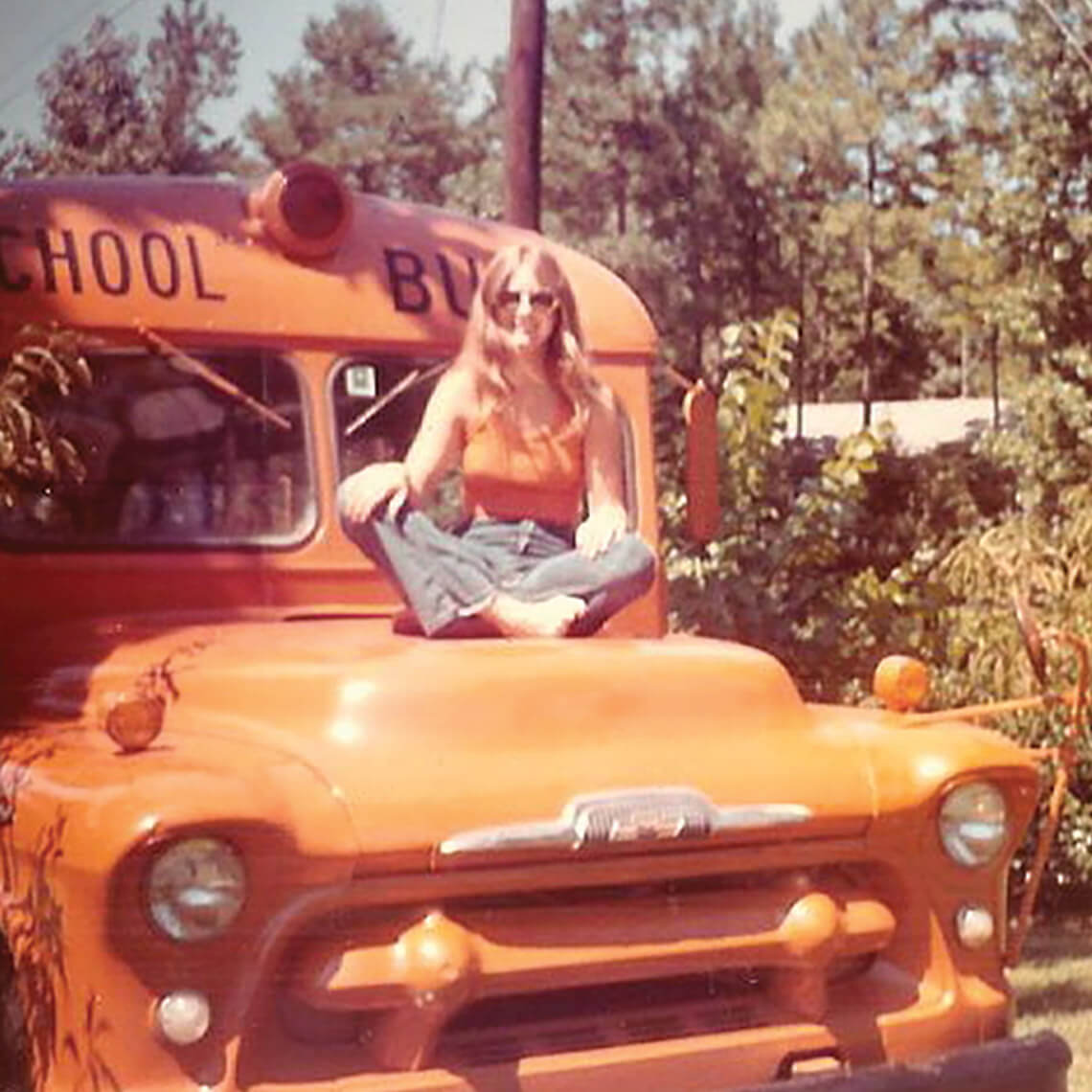
As a student bus driver in Raleigh in the 1970s, Rebecca Copeland drove a 1955 and then a 1957 Chevy before getting a major upgrade her senior year: a 1974 Ford with automatic transmission. Photography courtesy of Rebecca Copeland
Glover and his busmates’ worst impulses were held in check by an age-old concern: “When you’re that age, because she was an older woman, you wanted her to think you were cool.”
Debbie Tuttle Dusch attended Leroy Martin Junior High School in Raleigh in the late ’60s and remembers how she and her classmates gave their student bus drivers a hard time, too. “There was a country road, and we’d go around a curve and down a hill, and it always seemed like we were flying,” she says. “We’re screaming and tormenting her like we’re on a ride at a fair. But she never lost it. She just kind of tuned us out.”
The buses could be more challenging to wrangle than the students who rode them. Untested hands juggled an oversize steering wheel, stick shift, door handle, and manual stop sign. Generations of teens who grew up doing the Jitterbug or the Hustle had to learn a new dance that included clutch, brake, and gas pedals. And the power steering? “The power was provided by your biceps and triceps,” Darden says with a laugh.
• • •
It would be comforting to think that safety was the No. 1 priority when it came to student transportation. But the widespread hiring of student drivers in North Carolina primarily came down to cost. In short, students were a much cheaper option than adults. When the Great Depression hit, schools were under even greater financial pressure, leading to the state’s full embrace of student bus drivers by 1933.
Despite this calculated reality, safety didn’t necessarily take a backseat to the bottom line. While economics might have driven the demand for the low-cost workforce, it was the students’ safety record that kept them in the driver’s seat.
Because local school districts hired their drivers, principals were able to identify and select students that had the requisite reflexes, temperament, and judgment. Many teens in rural communities also had experience driving complex farm equipment, and the training was thorough.
Darden remembers several days of classroom work, followed by an exam. “Then you moved on to the road test,” he says. “It took a full day, and if you passed that, you got a bus driver’s license. It didn’t mean you got a bus, but it meant you could drive as a substitute.”
Darden gained experience as a substitute before getting his own bus. He transported mostly elementary school students his senior year. “I was apprehensive at first,” he says. “I think it taught me responsibility and some measure of leadership.”
Over time, he figured out how to maintain order on the bus by having a couple of high schoolers help keep things calm. And he learned to make sure there was always someone with a towel handy to keep the windshield clear — the buses were notorious for their weak defoggers.
For both Darden and Webb, one of the biggest challenges of the job was getting out of bed at the early hour that bus driving required. Webb solved the problem by having his younger brother crank the bus, warm it up, and drive it up to the house, “so all I had to do was jump in and go.”
• • •
At least 20 states made use of student bus drivers over the years. But North Carolina’s program was the envy of the nation for its safety and efficiency. In the 1958-’59 school year, the national average for transporting students was $37 per pupil. North Carolina’s cost was $15 per pupil.
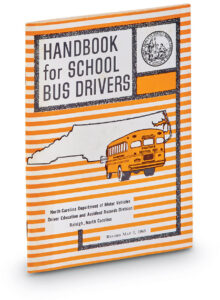
The scale of the operation is hard to fathom today: According to North Carolina’s 1965 Handbook for School Bus Drivers, half a million students were transported to and from school daily by bus drivers, 90 percent of whom were students themselves.
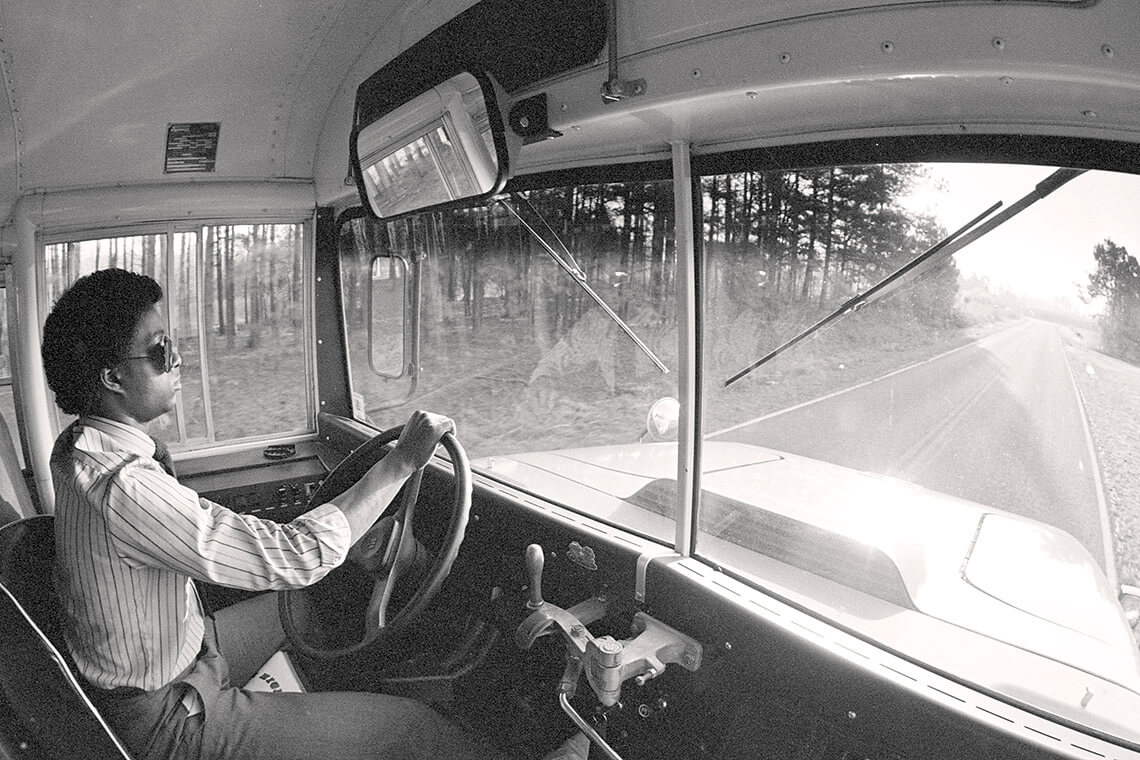
The system would continue into the ’80s, as a 1983 photo in The News & Observer showed. photograph by The News & Observer, from the N&O Negative Collection, State Archives of North Carolina
The 1965 Handbook for School Bus Drivers applauded the safety record of student drivers. photograph by Matt Hulsman
On the safety side of the equation, both opponents and proponents of student bus drivers cited various accident statistics to make their respective cases. But a 1964 study conducted by Cornell University on school bus accidents in North Carolina concluded “the accident rate for student drivers was not different from the adult drivers to a statistically significant degree.”
That’s not to say that safety rules weren’t bent from time to time. Webb remembers how he and several other students traveled to High Point with a county supervisor to pick up new buses. Their governors — devices that regulated the speed of the buses — were set at 37 miles per hour. After taking delivery, the supervisor told them he was going to put the speed up to 55 because, “Boys, I don’t want to be two days getting back to Raeford.”
The governors were reset to 37 miles per hour after the trip home, but Webb enjoyed every moment driving his temporarily hot-rodded bus: “To be able to drive 55 in a school bus, I felt like I was Richard Petty.”
• • •
Young women served as student bus drivers going back to the earliest days of the program, and their numbers skyrocketed during World War II due to the scarcity of available men. For the 1942-’43 school year, North Carolina trained just 82 female student bus drivers. For the 1944-’45 school year, that figure rose to almost 1,000.
In the 1980s, Webb’s daughter Wendy Webb Johnson made her father proud when she became a student bus driver, ferrying middle schoolers during her junior and senior years at Seventy-First High School in Fayetteville. Her motivation was simple: “I wanted to be like my dad.” She still owns her red letter jacket with a “School Bus Driver” badge on the front and her bus number, 9, on the sleeve. “The saddest day of each year was taking the bus and turning it back in,” she says, recalling driving in a caravan back to the garage. “It was both fun and sad.”
As it turned out, hers was the last generation of student bus drivers. In 1966, Congress had amended the Fair Labor Standards Act, which prohibited employment of those under 18 in hazardous occupations — including driving a bus. North Carolina and several other states received exemptions for 20 years, but in 1988, no exemptions were granted, and the student bus drivers finally reached the end of the line.
These days, as North Carolina struggles to find qualified bus drivers, it’s amazing to think there was once a steady supply of teenagers who could navigate a 35-foot-long bus with the skill of a sea captain, handle a stick shift like Junior Johnson, ride herd on a bunch of rambunctious kids better than a trail boss — and look cool doing it.
Get our most popular weekly newsletter: This is NC
At both the turn of the century and today, Beaufort’s waterfront has attracted a hum of commerce and community. At its heart, a historic avenue tells that history, from the stately double-porched homes to the sound of ships announcing their arrival at port.




 Listen as the pages of the magazine come to life in the