Craig Hamilton’s journey back to his roots started in 2018 with a hurricane, a disfigured pecan tree, and a passel of fish.
“Mother Nature always wins all arguments with me,” Hamilton says. “And when she supplied the pecan tree, it was a sign, and there was never any more discussion after that.”
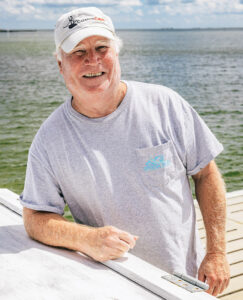
Hamilton left the Triangle area to return to Atlantic. “My little ulterior motive: I’d get to hang out with people I’ve known since kindergarten,” he says. photograph by Baxter Miller
At one point a Category 4 hurricane, Florence walloped eastern North Carolina from New Bern to Wilmington, leaving people Down East without electricity for a couple of weeks. Hamilton rode it out in Beaufort with his mother. Once the roads were cleared, he went out to the small community of Atlantic to check on things. The two pecan trees across from his grandfather’s homeplace had survived the storm, but one stood ragged and broken, its thick limbs torn and twisted by the wind.
“The beauty of the tree was gone,” he says.
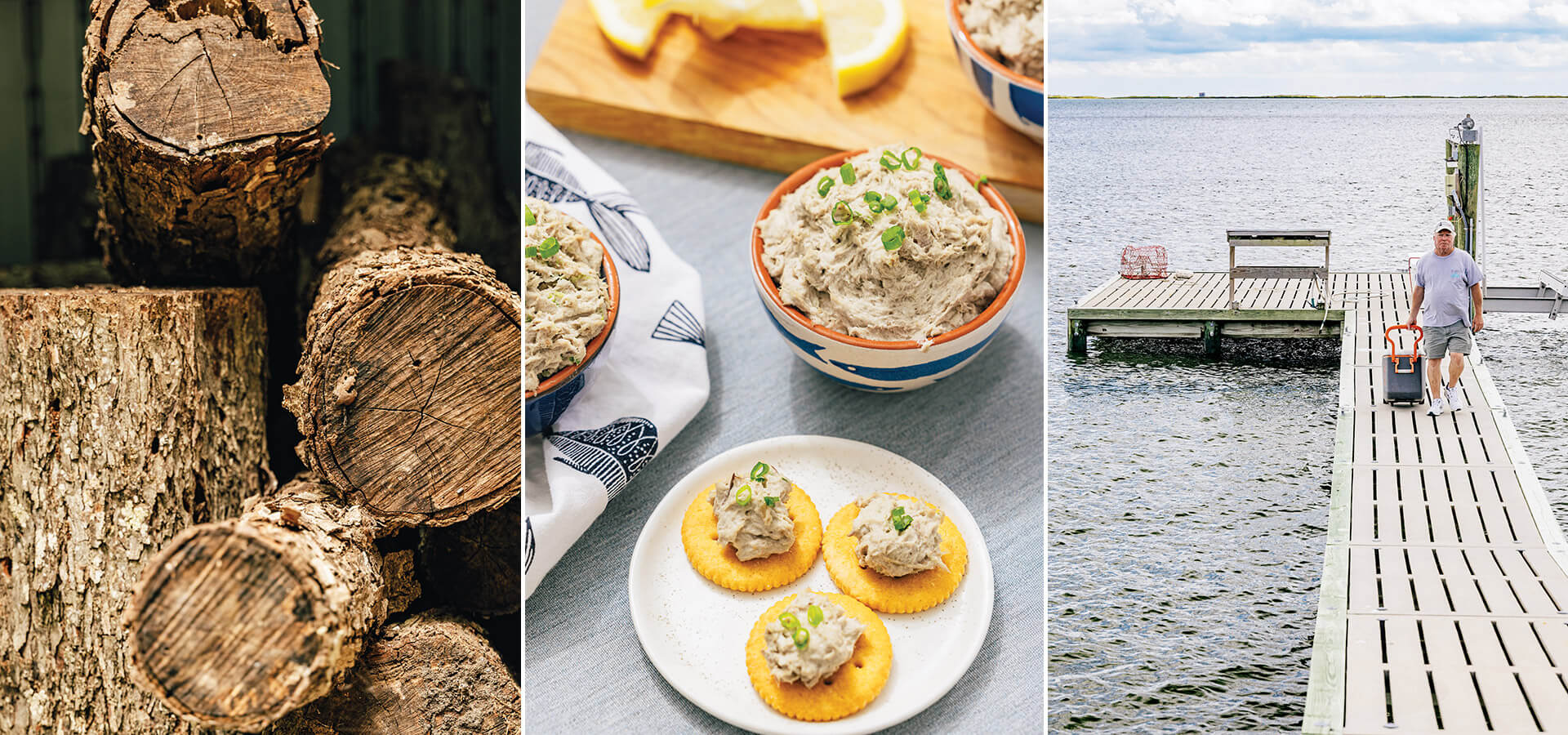
He took it down, cut the wood into logs, and stacked them in a little shed beside the house.
• • •
A proud Down Easter, Hamilton grew up in Beaufort, spending a weekend a month in Atlantic, one in a string of coastal fishing communities. He left at 17 with big ambitions — and spent decades traveling the globe in a career that mixed science, software, and pharmaceuticals before finding his way back.
Around 2014, nearing 60, he started spending more time in the Down East area. His mother was still living then, so he bought a small house in Beaufort. He purchased a boat and entertained the idea of leading fishing charters. He began spending weekends in Atlantic, where his grandfather’s childhood home had stood across from Core Sound. The original house had burned down, but it had been rebuilt, and behind it stretched 13 wooded acres. Across the road those two once-graceful pecan trees remained.
• • •
With plenty of wood on hand, hamilton decided to try his hand at smoking. He experimented with whatever was running — red or black drum, sheepshead, pompano, Spanish mackerel — adjusted brines, and shared the results with family and friends. It was a hit.
“Once I did pecan,” he says, “everybody said, ‘Oh, this is a significant improvement over every other wood.’ ”
Hamilton had planned to just smoke fish for fun. But after sharing samples at the North Carolina Seafood Festival in Morehead City for Carteret Catch, people begged him to sell it.
His fish, like his path home, is seasoned with salt air, pecan smoke, and a love for the place that raised him.
That’s when the idea came to him: He had the wood, the know-how, and a steady source of fish. Maybe he could create a small “value-added” business — one that supported local fishermen and provided a few jobs in his hometown of Atlantic.
“It’s all about the jobs,” he says. “If you don’t have jobs, you’re going to leave.”
The pandemic stalled his plans for building a smokehouse in Atlantic, but Hamilton pressed on, converting a used food truck into his smoking HQ. He also learned a lot about the wood he was using: Pecan, it turns out, dries hard. It regularly bends the blades on his saw. Now, he cuts it up with a circular saw, a band saw, and a hatchet or an axe.
• • •
On most weekends these days, Hamilton — ball cap low over his wispy white hair — can be found with his associate, Charity Flowers, peddling smoked fish fillets and spreads under the name Ophelia Inlet Products at the Olde Beaufort Farmers’ Market. The winding path that brought him home was long — but it’s seasoned with salt air, sweet pecan smoke, and a deep love for the place that raised him.
Every week, Hamilton visits a couple of fish houses in the community of Cedar Island to buy fresh catch. He never haggles.
“That was the point of all this,” he says. “To help fishermen.”
He scales and fillets the fish; Flowers debones them. Then they brine the fish in brown sugar, salt, molasses, and water trucked in from Beaufort, and smoke it low and slow at about 175 degrees. Fat drips into a pan as the wood gently perfumes the fillets. Refrigerated, the vacuum-sealed fish stays moist for about 12 days.
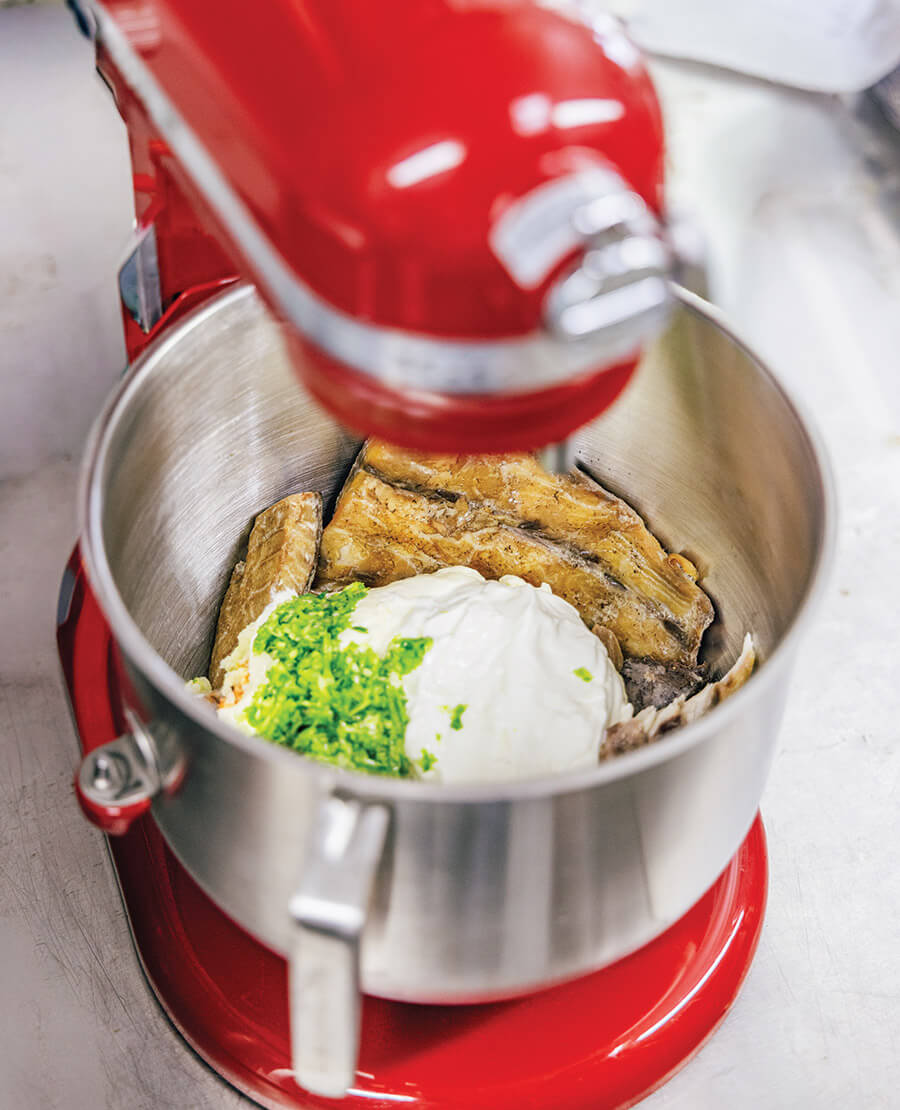
Hamilton mixes the brined and smoked fish with sour cream, green onions, and more for his signature dip. photograph by Baxter Miller
“I’m smoking for taste,” he says. “A hundred years ago, you had to smoke it dry enough to keep it on the Oregon Trail.”
The hardest part? The paperwork. Hamilton tracks everything — time, temperature, brine ratios — in meticulously labeled notebooks because, quoting a phrase he learned while working in the pharmaceutical industry: “If you didn’t record it, you didn’t do it.”
“I know paperwork,” he says. “It doesn’t scare me. The chemistry degree comes in handy.”
• • •
Ophelia Inlet Products Smoked Fish was never meant to be big enough to save Atlantic — but it has earned a loyal following in the Beaufort area. Hamilton sells about $500 worth on Saturdays, and new customers find him every week.
At 70, he doesn’t know how long he’ll keep going. But he’s got the wood to do it.
“I’ve got enough pecan to last me past the time I’m dead,” he says, laughing. And if he runs out? “Well, there’s still that second tree.”
For more information or to order, visit opheliainletproducts.com.